
Alipay
Can Foreign Tourists Use Alipay or WeChat Pay Without a Chinese Phone Number, Bank Account, or Address?
Foreign tourists can usually prepare Alipay or WeChat Pay without Chinese residency details. Learn what overseas information is needed and what payment setup really proves.

Quick Answer
Yes. For ordinary tourist merchant payments, foreign visitors generally do not need a Chinese phone number, a mainland Chinese bank account, or a Chinese residential address before they can prepare Alipay or WeChat Pay.
You can normally start with:
- an overseas mobile number that remains accessible;
- your own passport;
- an eligible international credit or debit card;
- access to your bank’s SMS, app, email, or other security checks;
- truthful home-country or card-billing details if requested;
- working internet access;
- another payment method for backup.
The boundary matters: registering an account is not the same as completing a real merchant payment. A card appearing in the app also does not guarantee that the issuing bank will approve every transaction.
Even after both apps are ready, keep cash and a physical card. This guide explains the broader payment methods tourists can use in China.
Do You Need a Chinese Phone Number, Bank Account, or Address?
| Chinese detail | Normally required for basic tourist merchant payments? | What still matters |
|---|---|---|
| Chinese phone number | Normally no | Your overseas number must remain accessible for login and security checks |
| Mainland Chinese bank account | Normally no | You need an eligible international card and bank approval |
| Chinese residential address | Normally no | The app or bank may request your real home-country or billing address |
“Normally no” is not a universal guarantee.
The current in-app prompt takes priority because account status, issuing bank, card product, app version, and verification requirements can differ.
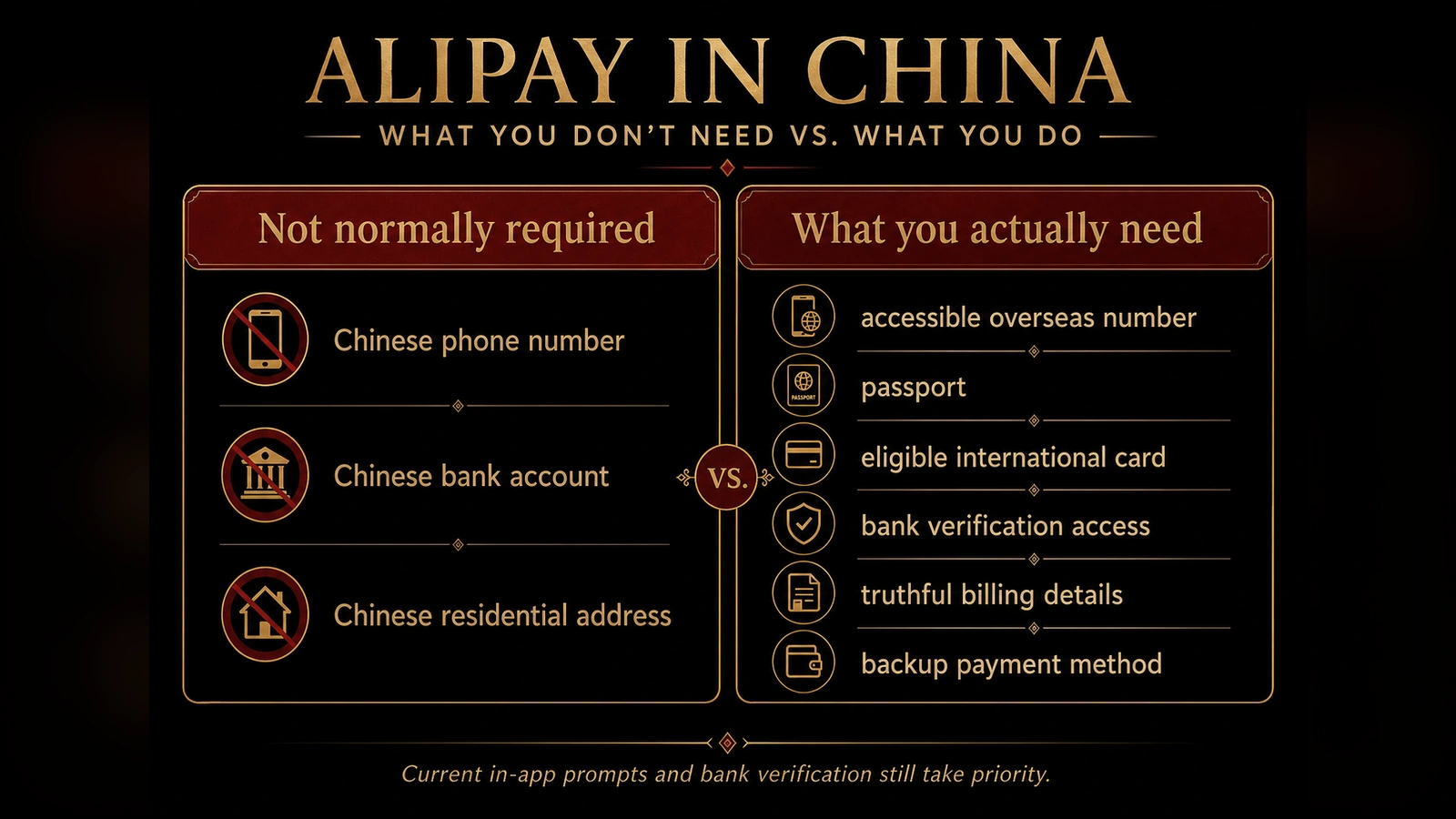
You usually do not need Chinese residency details, but you still need real identity, card, verification, and backup information.
“Installed” Is Not the Same as “Ready to Pay”
The original question asks whether a foreign visitor can “successfully install” Alipay or WeChat Pay.
Installation is only the beginning.
There are several separate checkpoints:
1. Downloaded
The official app is installed on your phone.
This proves only that the app is present.
2. Registered
You have created an account with basic information and can log in.
This does not prove that payment features are available.
3. Payment Activated
You can access the relevant payment area, such as Pay, Scan, Wallet, Services, or Weixin Pay, depending on the app version and account.
4. Identity and Card Verified
You have completed the identity steps requested by the app and added an eligible international card.
A card being visible inside the app proves that the setup stage was accepted. It does not prove that your bank has approved a real purchase.
5. Merchant Payment Completed
A normal merchant receives the money and the app shows that the transaction completed.
Only then do you know that the current account, card, merchant, amount, and payment path worked for that transaction.
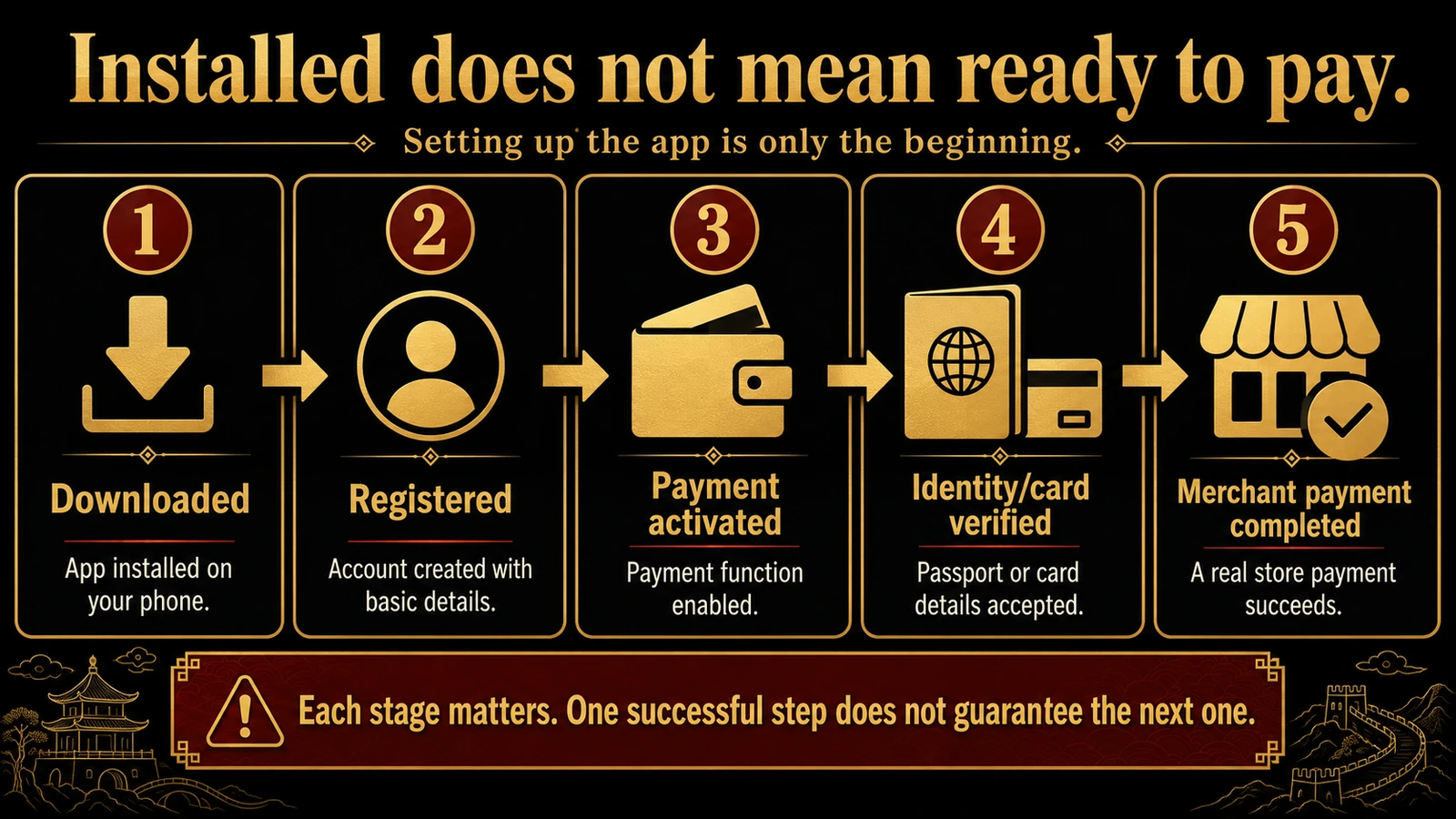
One successful stage does not guarantee the next one.
This is why “I installed the app” and “I linked my card” are incomplete answers.
Readers who are preparing Alipay can separately test their Alipay setup before traveling to China. One test is useful information, but it cannot guarantee every future payment.
What You Actually Need From Home
An Overseas Number You Can Keep Using
Current visitor guidance allows foreigners to register payment apps with a foreign or Chinese mobile number.
The important question is not whether the number starts with a Chinese country code. It is whether you still control it during the trip.
Your number may be needed for:
- account login;
- security checks;
- password recovery;
- SMS verification;
- bank confirmation;
- account alerts.
A data-only travel eSIM gives your phone internet access, but it may not receive messages sent to your normal number.
Before departure, check whether:
- your original SIM remains active;
- roaming SMS is available;
- bank codes still go to that number;
- an app notification or email can replace SMS;
- you know how to recover the account abroad.
Do not build the account around a temporary number that you will lose shortly after registration.
Your Own Passport
Alipay or WeChat Pay may request passport information and, depending on the account, a face or identity check.
Use your own information.
Do not borrow another person’s:
- Chinese ID;
- phone number;
- bank card;
- payment account;
- verified identity.
Mismatched names and borrowed identities create more problems later, especially when the account asks for another security check.
An Eligible International Card
Foreign tourists can use eligible international credit or debit cards as the funding source for supported merchant payments.
The card should generally support:
- overseas transactions;
- online or card-not-present purchases;
- third-party wallet payments;
- security verification;
- sufficient balance or credit;
- the amount you expect to spend.
The card network is only the first check. The issuing bank can still approve or decline the real payment.
This article does not rank individual banks. Use the separate guide on which debit cards work with Alipay and WeChat Pay to check the network, issuer settings, verification access, fees, limits, and backup value.
Bank Verification You Can Complete in China
Your card may be linked successfully and still require another approval at checkout.
The bank may send:
- an SMS code;
- an app notification;
- an email;
- a one-time password;
- a fraud alert;
- a request to confirm the transaction.
Imagine that you reach a convenience-store counter and the payment app sends the purchase to your foreign card. Your bank asks for confirmation, but the registered phone number is no longer active.
The weak point is no longer Alipay or WeChat Pay registration. It is your access to the issuing bank.
Truthful Address Information
A Chinese residential address is not normally presented as a standard prerequisite for ordinary tourist merchant payments.
But “no Chinese address required” does not mean that no address will ever appear in the setup process.
You may be asked for:
- your country;
- your real home address;
- your card-billing address;
- a postal code;
- other information that matches the bank’s records.
Keep these three concepts separate:
Chinese residential address: a place where you live in China.
Home-country residential address: the real address where you normally live.
Card-billing address: the address held by the issuing bank for that card.
Do not invent a Chinese address. Do not use a hotel address as your card-billing address unless it is genuinely the address held by the bank.
Use truthful information that matches your identity and financial records.
Can You Register Alipay With a Foreign Phone Number?
Generally, yes.
A foreign visitor can normally use an eligible overseas number to register Alipay and prepare basic payment functions.
You still need to make sure that:
- the number belongs to you;
- the country code is correct;
- you can receive the registration code;
- you will retain access during the trip;
- the number is not temporary or about to expire.
A Chinese number may help with some local services, deliveries, phone calls, or separate Chinese accounts.
That is a different issue.
A local service asking for a Chinese number does not mean that basic Alipay merchant payments universally require a Chinese SIM card.
Can You Use WeChat Pay Without a Chinese SIM Card?
Generally, yes.
Tencent’s current international traveler guidance says users can download WeChat with an international phone number and link an eligible international credit or debit card to Weixin Pay.
However, WeChat Pay depends on the WeChat account itself.
That can add another layer involving:
- account registration;
- login security;
- a new device;
- account region;
- payment-feature visibility;
- identity checks;
- international-card linking.
One foreign traveler may see the payment entry immediately. Another account may need additional setup or verification.
A Chinese phone number is not automatically the missing piece.
What If WeChat Does Not Show Wallet or Weixin Pay?
Do not immediately assume that a WeChat account created outside China can never make payments.
First check:
- whether the app is current;
- whether account registration and login security are complete;
- whether
Meshows an entry such asServices; - whether the payment area appears as
Wallet,Weixin Pay, or another current label; - whether a payment tool may appear under a location such as
Settings → General → Tools; - whether the account asks you to complete identity information first;
- whether you have attempted to add an eligible international card.
Menu names and locations can vary by version, language, region, and account status.
There is no responsible way to promise that one fixed menu sequence will activate payment for every account.
If the app clearly says the current account cannot add the card or use the payment feature:
- save the exact message;
- check the identity and account details;
- use official in-app support;
- avoid creating multiple accounts in quick succession;
- never borrow another person’s identity.
Can You Use the Apps Without a Chinese Bank Account?
For ordinary tourist merchant payments, a mainland Chinese bank account is normally not required.
The usual funding path is:
Chinese merchant → Alipay or WeChat Pay checkout → linked international card → issuing-bank approval → completed merchant payment
The international card supplies the money behind the purchase.
This is not the same as loading funds into a full mainland Chinese wallet.
A linked foreign card does not automatically unlock:
- person-to-person transfers;
- red packets;
- every personal collection QR code;
- wallet-balance top-ups;
- withdrawals;
- every local financial function;
- every Mini Program.
The reasonable expectation is supported merchant spending, not a complete local-wallet experience.
Alipay and WeChat Pay Are Not Identical
Both apps can help foreign tourists pay Chinese merchants, but they do not have exactly the same setup experience.
Alipay
For many first-time visitors, Alipay feels more like a dedicated payment and travel tool.
The preparation usually centers on:
- overseas-number registration;
- passport or identity verification;
- international-card linking;
- finding Pay and Scan;
- merchant payments;
- supported transport or travel services.
WeChat Pay
WeChat Pay sits inside the broader WeChat account.
That means the result may also depend on:
- the WeChat account being in good standing;
- login and device security;
- whether the payment entry is visible;
- whether Weixin Pay needs to be enabled;
- identity and card verification.
Some travelers complete Alipay first. Others find WeChat Pay easier.
Do not treat either result as a universal rule. Prepare both when possible, use one as the main option, and keep the other as a second mobile-payment path.
Why One Foreign Traveler Succeeds and Another Does Not
Two travelers can both have an overseas number, a passport, and a foreign card but still receive different results.
Possible differences include:
- phone-number verification;
- WeChat account registration or security review;
- passport verification;
- legal-name mismatch;
- card network;
- issuing-bank approval;
- international or online-payment settings;
- OTP access;
- the specific debit or credit card product;
- merchant-payment route;
- personal code versus merchant code;
- app version;
- account region;
- current platform security checks;
- repeated attempts.
These are possible layers, not diagnoses.
If a card appears in Alipay but the payment fails, that does not automatically prove that Alipay rejects all foreign cards.
The decline may have happened at the bank, account, merchant, or QR-code level. Use the focused guide on why a linked foreign card can still fail at checkout instead of guessing from one error message.
What Your Foreign-Card Setup Is Mainly For
Set realistic expectations.
A foreign-card-funded Alipay or WeChat Pay account is mainly useful for supported merchant purchases such as:
- restaurants;
- convenience stores;
- supermarkets;
- cafés;
- shopping centers;
- ordinary retail shops;
- supported transport services;
- established merchant QR codes;
- merchant-presented payment codes;
- supported travel-app orders.
Do not depend on it for:
- personal transfers;
- red packets;
- loading a full local-wallet balance;
- withdrawals;
- every Mini Program;
- every private individual;
- every merchant;
- every amount;
- every hotel deposit;
- every Didi or transport path.
One successful merchant payment proves that transaction worked. It does not guarantee every future transaction.
Pre-Trip Readiness Checklist
Before departure:
- Download Alipay and WeChat from official app stores.
- Keep your overseas number active.
- Confirm that the number can receive security checks during the trip.
- Keep your passport available.
- Match your legal name across the passport, payment account, and bank card where possible.
- Add at least one eligible international card.
- Preferably add a backup card from another bank.
- Confirm access to bank SMS, email, app approval, or OTP.
- Check that Alipay Pay and Scan open normally.
- Check whether Services, Wallet, Weixin Pay, or the relevant current entry is visible in WeChat.
- Understand that merchant payment is not personal transfer.
- Do not use a borrowed identity, account, or card.
- Carry physical bank cards.
- Keep some RMB cash.
- Do not make the whole trip depend on one app or one card.
After completing the free checks above, an optional pre-trip payment readiness test can test one specific Alipay or WeChat Pay payment path. It is voluntary, and one result cannot guarantee every merchant, amount, QR code, or future transaction.
Bottom Line
Foreign tourists do not normally need to become Chinese residents before preparing Alipay or WeChat Pay for ordinary merchant spending.
For a short trip, you generally do not need:
- a Chinese phone number;
- a mainland Chinese bank account;
- a Chinese residential address.
What you actually need is:
- an overseas number you can still access;
- your own passport;
- an eligible international card;
- access to bank and app verification;
- truthful home-country or billing details if requested;
- a clear understanding of merchant payments versus full local-wallet functions;
- at least one backup payment method.
The most important lesson is not to confuse installation with payment readiness.
Downloaded → Registered → Payment activated → Identity and card verified → Merchant payment completed
If WeChat does not initially show Wallet or Weixin Pay, that does not prove the account can never pay.
If a card appears successfully, that does not prove every merchant transaction will be approved.
If one merchant payment succeeds, that does not unlock personal transfers, red packets, every Mini Program, or every future transaction.
You do not need a complete set of Chinese residency details for an ordinary tourist payment setup. You do need to prepare your overseas phone number, passport, card, verification access, and payment backups properly.
Last updated: July 21, 2026. Travel platforms, entry rules, app behavior, prices, and service availability can change. Re-check official sources before departure.
Discussion
Ask a question, share recent experience, or flag information that may be outdated.
0 visible comments
No discussions yet.