
Alipay
Which Debit Cards Work With Alipay and WeChat Pay in China?
Learn how to choose a foreign debit card for Alipay and WeChat Pay by checking the card network, bank settings, verification access, fees, limits and backup card.
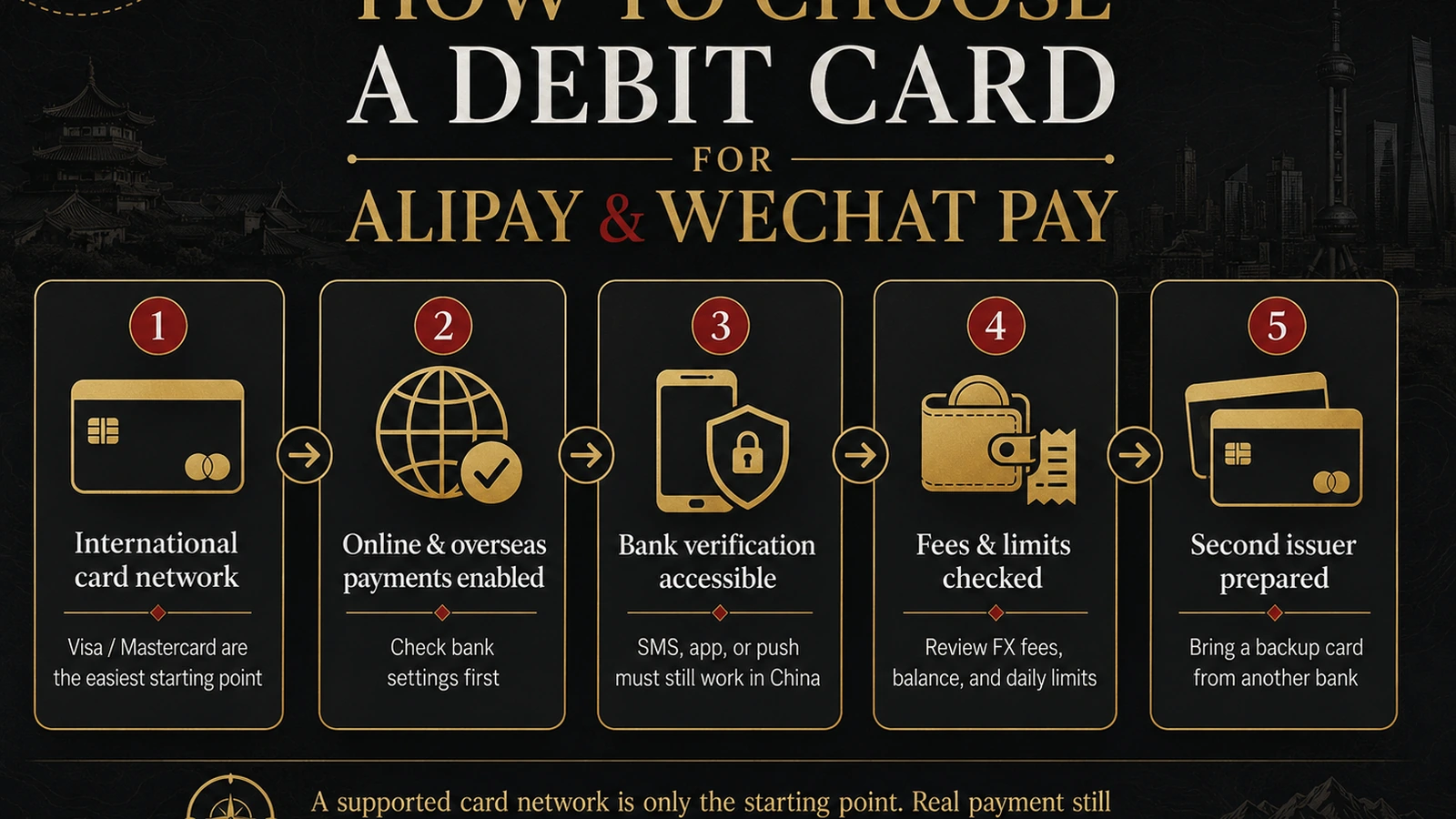
Quick Answer
Foreign debit cards can work with Alipay and WeChat Pay.
For most travelers who want one card to try with both apps, an internationally enabled Visa Debit or Mastercard Debit is the simplest starting point. The card should support online and overseas purchases, allow you to complete bank security checks while you are in China, and have fees and limits you understand.
But the logo on the card is only the first check.
A card can belong to an eligible network, appear successfully inside Alipay or WeChat Pay, and still have a real payment declined by the issuing bank.
Prepare a second card from a different bank instead of relying on one debit card for the whole trip.
What Does “Works With Alipay and WeChat Pay” Actually Mean?
Travelers often see a card appear inside the app and assume the payment setup is finished.
It is not.
There are four separate stages.
1. The Card Network Is Eligible
The card first needs to belong to a network the payment app currently accepts.
This only means the card type may be considered by the app. It does not mean every bank that issues cards on that network will approve China-related transactions.
2. The Card Can Be Added
You enter the card number, expiry date, and security information, and the card appears in Alipay or WeChat Pay.
That is useful progress.
It proves that the app accepted the card details at the setup stage. It does not prove that the issuing bank has approved a real merchant purchase.
3. The Issuing Bank Approves a Real Payment
When you pay at a convenience store, restaurant, taxi, or another merchant, the transaction still has to pass through the card network and your issuing bank.
The bank may check:
- overseas-payment settings;
- online-payment settings;
- available balance;
- daily or per-transaction limits;
- merchant category;
- account status;
- security authentication;
- fraud controls.
The bank can approve or decline the transaction even though the card was added successfully.
4. The Merchant Payment Completes
Only when the merchant receives the payment and the app shows a completed transaction do you know that this payment worked.
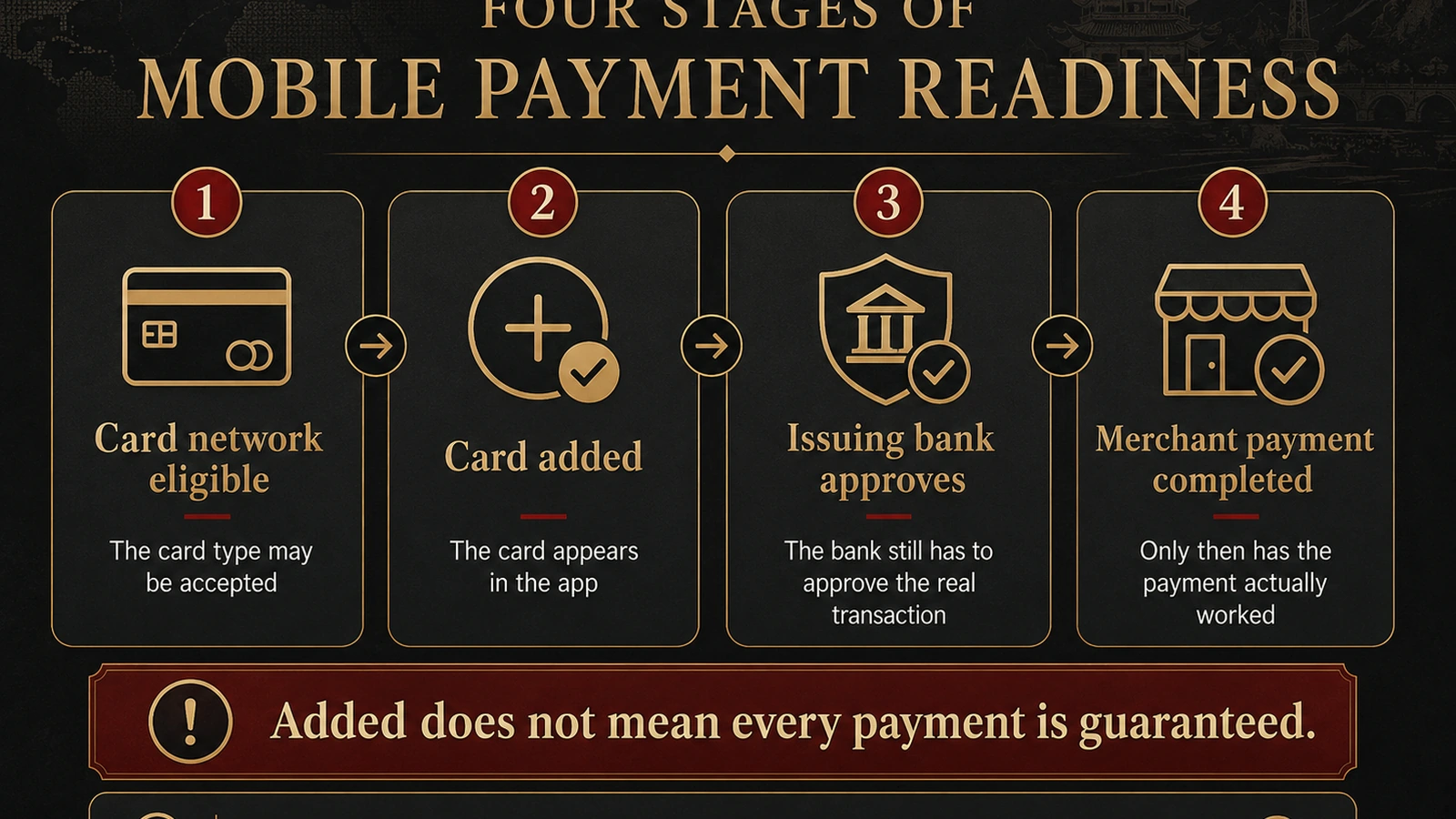
“Card added” is not the same as “every payment is guaranteed.”
The important sequence is:
Card network eligible → Card added → Issuing bank approves → Merchant payment completed
Each stage matters. None of the earlier stages guarantees the next one.
Start With the Card Network
Visa Debit and Mastercard Debit
If you want one debit card to try in both Alipay and WeChat Pay, Visa Debit and Mastercard Debit are usually the easiest common starting point.
They are widely issued internationally, both apps support major international cards, and banks often provide clear controls for overseas and online transactions.
That does not mean:
- Visa Debit is always better than Mastercard Debit;
- every Visa Debit card will work;
- every Mastercard Debit card will work;
- the card network can override the issuing bank.
Two cards can display the same Visa Debit logo and behave very differently.
One bank may allow overseas e-commerce and third-party wallets. Another may issue a card that is mainly intended for domestic use or ATM withdrawals.
The logo tells you which network the card uses. The bank’s settings determine what the specific card can actually do.
Other Eligible Card Networks
WeChat Pay also lists international credit and debit cards on networks including Visa, Mastercard, JCB, American Express, Discover Global Network—including Diners Club—and UnionPay.
Alipay supports eligible major international credit and debit cards issued outside mainland China for everyday merchant spending in mainland China.
Do not assume the two apps have identical card-network rules or that every bank on a listed network is accepted in the same way.
A card on another eligible network may work well for you. But for a traveler who wants a simple card to try across both apps, Visa Debit or Mastercard Debit is usually the most straightforward place to begin.
Five Things That Matter More Than the Bank Name
There is no reliable global ranking of banks whose debit cards are guaranteed to work with both apps.
A useful card-selection process focuses on five checks.
1. International and Online Transactions Must Be Enabled
Open your bank app or online banking and look for controls such as:
- international payments;
- overseas transactions;
- online purchases;
- e-commerce payments;
- card-not-present payments;
- third-party wallet payments.
Different banks use different labels.
A card may work at an overseas ATM but still block online merchant transactions. Another card may work in a physical card terminal but reject a third-party mobile wallet.
Do not only ask your bank:
Can I use this card abroad?
Ask a more specific question:
Does this debit card support overseas online purchases and third-party mobile-wallet payments?
That is much closer to how Alipay and WeChat Pay use the card.
2. You Must Be Able to Complete Bank Security Checks in China
Your bank may approve a payment only after you confirm it through:
- an SMS code;
- a push notification;
- the banking app;
- email;
- a one-time password;
- a phone call.
This can become the weak point even when the card itself is eligible.
Imagine that your Visa Debit card appears correctly in Alipay before departure. You assume everything is ready.
At a Chinese convenience store, the bank requests an app confirmation or sends a code to your home number. If you cannot log in to the bank app and your original SIM cannot receive the message, the payment may stop there.
Before leaving, confirm:
- whether your original SIM will remain active;
- whether SMS roaming is available;
- which phone number receives bank codes;
- whether the banking app works abroad;
- whether app approval can replace SMS;
- how account recovery works outside your home country.
Mobile data in China does not automatically give you access to the number used by your bank.
3. Check Foreign-Transaction and Currency-Conversion Costs
A debit-card payment usually takes money from your bank-account balance.
When the merchant charges in RMB, your final cost can depend on:
- the card network’s exchange rate;
- the issuing bank’s conversion method;
- a foreign-transaction fee;
- a currency-conversion fee;
- account-specific charges.
Alipay and WeChat Pay are the payment entry points. They do not make every linked bank card use the same rate or fee structure.
Check your bank’s current fee information before departure.
Look for:
- foreign-transaction fees;
- currency-conversion fees;
- minimum charges;
- weekend or special-rate adjustments;
- account-tier differences.
A card with higher fees may still work perfectly well. The point is to know the cost before using it for dozens of small purchases.
This article does not rank live exchange rates because those terms can vary by country, account, date, and issuer.
4. Check Your Balance and Spending Limits
A debit card spends money from the available bank balance.
A linked card cannot complete a payment if the balance is too low.
Also check:
- daily spending limits;
- online-purchase limits;
- international-transaction limits;
- single-transaction limits;
- temporary security limits.
Some travelers keep online limits low for security. That is sensible until a normal hotel, transport, or shopping transaction exceeds the limit.
A limit-related decline does not mean Alipay or WeChat Pay rejects the card network.
It may simply mean the bank did not allow that amount.
Make sure normal daily spending fits within your settings, and know how to adjust a limit in the bank app when necessary.
5. Prepare a Second Card From a Different Issuer
A second card is most useful when it comes from a different bank.
Two cards issued by the same bank may share:
- the same overseas restrictions;
- the same fraud controls;
- the same verification number;
- the same account freeze;
- the same technical outage.
A stronger backup looks like this:
- main card from Bank A;
- second card from Bank B;
- both enabled for online and overseas payments;
- both bank apps accessible;
- both verification methods available.
At a convenience-store counter, if the first debit card does not work, do not submit the same payment repeatedly.
Switch to the second bank’s card, the other mobile-payment app, cash, or a physical card. Finish the purchase first and inspect the first card later.
Do Wise and Revolut Debit Cards Work?
Wise
Wise is one of the better-documented examples because Wise provides instructions for adding its cards to Alipay and WeChat Pay.
That makes it a reasonable option to consider.
But availability can vary by:
- the country where the Wise card was issued;
- the card network used for that product;
- account eligibility;
- verification status;
- individual transaction approval.
A Wise card is not a universal guarantee.
It still needs the same checks as any other debit card:
- international transactions;
- online payments;
- available balance;
- bank-app access;
- verification;
- transaction limits;
- a backup card.
Revolut
Public traveler reports show that Revolut cards can work, but experiences differ by user and payment path.
Some travelers report normal use in Alipay and WeChat Pay. Others report repeated authentication, a merchant-payment decline, or a failure in an app-based service such as Didi.
These reports show that Revolut may work. They do not support a universal recommendation or a universal rejection.
A Revolut user should still check:
- the current card network;
- the account’s issuing country;
- online and overseas settings;
- app authentication;
- real merchant-payment results;
- a second card from another issuer.
Your Existing Bank Debit Card
You may not need to apply for Wise, Revolut, or another travel product.
A Visa Debit or Mastercard Debit from your normal bank may be enough when it:
- supports international purchases;
- supports online payments;
- allows third-party mobile-wallet transactions;
- permits China-related transactions;
- provides accessible security verification;
- has acceptable fees and limits.
Your existing bank card may also be easier to manage because:
- you already understand the banking app;
- your phone number is already registered;
- you know how to move money into the account;
- customer support is familiar;
- you do not need to complete a new financial-account application before the trip.
Choose based on the specific card’s functions, not the marketing label attached to the product.
What About Virtual and Prepaid Cards?
There is not enough consistent information to treat every virtual or prepaid card the same way.
Some issuers allow their virtual cards to be added to Alipay or WeChat Pay. Other products may block third-party wallets, overseas use, or certain merchant categories.
Prepaid cards, gift cards, and one-time virtual cards may have additional restrictions.
The safe conclusion is:
- some virtual cards may work;
- some may not;
- some prepaid cards may work;
- some may not.
Do not make an unconfirmed virtual or prepaid card your only China payment plan.
A physical debit card also has extra value because it may be useful at a hotel, a compatible ATM, or a merchant that accepts international cards directly.
Which Debit Cards Are Weak Choices?
These cards are not necessarily impossible to use, but they are weak choices as your only option.
Domestic-Only or ATM-Only Cards
A card designed mainly for domestic transactions or cash withdrawals may not support the payment path used by Alipay and WeChat Pay.
Cards Without a Supported International Network
A local-only card network may not be accepted unless the payment platform and issuer have a specific arrangement.
Cards With Overseas or Online Payments Disabled
An eligible card network cannot help when the bank has switched off the required transaction type.
Cards You Cannot Verify in China
A card becomes difficult to rely on when the bank sends every security code to an inaccessible number or the banking app cannot be opened abroad.
Cards With Unknown or Unacceptable Fees
The payment may work while still costing more than you expected.
Unconfirmed Virtual, Gift, or Prepaid Cards
Treat them as optional experiments, not your only payment route.
One Debit Card as the Entire Plan
No single debit card should carry your whole trip.
China now uses mobile payment heavily, but mobile payment still depends on the card, bank, account, phone, and current transaction.
For the broader setup, see the payment methods tourists can use in China.
Why an Eligible Debit Card Can Still Fail
Even after a card is added successfully, a payment may fail at another level.
Possible layers include:
- issuing-bank decline;
- international or online settings;
- low balance;
- transaction limits;
- incomplete identity verification;
- inaccessible SMS or banking-app authentication;
- Alipay or WeChat Pay account status;
- merchant configuration;
- an in-app payment route;
- merchant QR code versus personal collection code;
- a security check;
- repeated attempts.
One error message usually does not identify the exact layer by itself.
A single decline also does not prove that the debit card can never work.
For a focused troubleshooting process, check whether the payment failed at the bank, account or QR-code level.
Merchant Payment Is Not the Same as Personal Transfer
A foreign debit card working for a shop payment does not turn an international visitor’s account into a full local Chinese wallet.
Merchant purchases are different from:
- sending money to a friend;
- scanning a personal collection code;
- red packets;
- balance top-ups;
- local financial services.
A card suitable for ordinary merchant spending may still be unavailable for those person-to-person functions.
This article is about choosing a card for normal travel purchases.
Pre-Trip Debit-Card Checklist
Before relying on a debit card in China, check each item:
- [ ] Check the card network.
- [ ] Confirm that it is an international payment-enabled debit card, not only an ATM card.
- [ ] Enable online purchases.
- [ ] Enable overseas transactions.
- [ ] Check whether the bank allows third-party wallet or card-not-present payments.
- [ ] Confirm that the banking app works abroad.
- [ ] Confirm access to SMS, email, app, or push authentication.
- [ ] Review foreign-transaction and currency-conversion costs.
- [ ] Check the available balance.
- [ ] Check daily and per-transaction limits.
- [ ] Add the card to Alipay before departure.
- [ ] Add the card to WeChat Pay before departure.
- [ ] Learn where Pay and Scan are in both apps.
- [ ] Prepare a second card from another issuer.
- [ ] Carry the physical cards.
- [ ] Keep some RMB cash.
- [ ] Consider a small optional merchant-payment test if you want one more data point.
Do not stop at “Card added.”
Check that both apps open, the card appears correctly, and the bank’s authentication route is still available.
You can also test Alipay before traveling to China, but one test can only tell you about the account, card, merchant, amount, and payment route used in that transaction.
After arriving, use a normal convenience store or established merchant for a small first payment instead of making a hotel deposit or urgent transport booking your first test.
Should You Use a Pre-Trip Payment Test?
An optional pre-trip payment readiness test can show whether one merchant payment works with your current setup.
It cannot guarantee:
- every merchant;
- every amount;
- every app-based service;
- hotel deposits;
- personal transfers;
- every payment after arrival.
The test is voluntary.
It gives you one real transaction result. It does not replace a second card, WeChat Pay, physical cards, or RMB cash.
Bottom Line
Foreign debit cards can work with Alipay and WeChat Pay for normal merchant spending in China.
For a traveler who wants one card to try in both apps, an internationally enabled Visa Debit or Mastercard Debit is usually the simplest starting point.
But the card network is only the first filter.
A good China-travel debit card should:
- belong to an eligible international network;
- support overseas and online purchases;
- allow third-party wallet payments;
- let you complete bank verification in China;
- have understandable fees;
- have enough balance and suitable limits;
- be backed by a second card from another issuer.
Wise is a well-documented option, but availability and approval vary by country and account.
Revolut can work for some travelers, but public experiences differ by user and payment path.
A normal bank-issued international debit card may already be enough.
Do not waste time looking for one globally guaranteed “best debit card.” That card does not exist.
An eligible network does not guarantee that the card can be added. A card that is added does not guarantee bank approval. Bank approval only confirms the transaction that actually completes.
Prepare two cards from different banks, add them before departure, keep access to bank authentication, and carry physical cards plus some RMB cash.
Last updated: July 26, 2026. Travel platforms, entry rules, app behavior, prices, and service availability can change. Re-check official sources before departure.
Discussion
Ask a question, share recent experience, or flag information that may be outdated.
0 visible comments
No discussions yet.