
Alipay
What Payment Methods Can Tourists Use in China?
What payment methods can tourists use in China? Learn how Alipay, WeChat Pay, RMB cash, foreign bank cards and other options work during everyday travel.
Quick Answer
Tourists in China can pay with Alipay, WeChat Pay, RMB cash, and foreign-issued bank cards.
In real life, these methods do not work equally well everywhere.
At a convenience store or restaurant, mobile payment is usually the easiest. At a hotel front desk, a physical card may be useful for the room charge or deposit. If your phone dies, your network drops, or the app suddenly refuses a payment, a few RMB notes can get you out of the queue.
For most short trips, the practical setup is simple:
Use Alipay or WeChat Pay for everyday spending, carry some RMB cash, and bring a physical bank card as a second backup.
You do not need one perfect payment method. You need one everyday method and two ways to switch when the first one does not work.
What Are the Main Payment Methods in China?
China’s official payment guide for overseas visitors lists mobile payment, bank cards, and cash as normal payment options.
For a first-time tourist, that official list becomes much easier to use when you turn it into three levels.
Everyday payment
- Alipay
- WeChat Pay
Reliable backups
- RMB cash
- A physical foreign-issued bank card
Other options
There are other payment products in China, but most short-term tourists do not need to set up everything. Start with the four methods above. They cover the situations that matter most: shops, restaurants, hotels, taxis, ride-hailing, public transport, and attraction tickets.
The important point is that none of these methods replaces all the others.
Cash can pay a cashier, but it cannot create a Didi order. A physical Visa or Mastercard may work at a hotel, but the small noodle shop next door may not accept it directly. Alipay may pay a merchant, but that does not mean your foreign-card setup can transfer money to a private person.
Alipay: Usually the Easiest Everyday Starting Point
For many foreign visitors, Alipay is the easiest mobile-payment tool to prepare before coming to China.
At a convenience store, the cashier may scan your payment code. At a café or restaurant, you may scan the merchant’s QR code. Alipay can also appear inside transport, ticketing, hotel, and ride-hailing services.
Eligible international bank cards can be added to Alipay for everyday purchases in the Chinese mainland. The official Alipay guidance for international visitors explains the basic setup and the limits of using an international card.
But four small details matter.
Downloading the app is not the same as being ready
You still need to register, add a card, complete any requested identity checks, and make sure you can log in without help.
Do this before your flight. The airport arrival hall is a bad place to discover that your bank wants an SMS code sent to a number you cannot access.
A linked card is not a guaranteed payment
Seeing the card inside Alipay only means the card was added. It does not promise that every merchant, QR code, amount, or online service will approve every transaction.
Your card issuer can still block a payment. Alipay may ask for verification. A particular transaction path may not support the card. Another linked card may work even when the first one does not.
Paying a merchant is not the same as transferring money
This is one of the biggest misunderstandings.
An international card linked to Alipay is mainly useful for merchant purchases. The official Alipay guidance says international cards do not support person-to-person transfers, red packets, or several other local wallet functions.
So you may be able to pay for lunch but fail when trying to send money to a friend, private driver, or landlord.
Alipay is useful, but it should not be your only plan
Your phone can lose power. Your network can disappear. Your bank can decline a transaction. Carry cash and a physical card even when Alipay looks fully prepared.
For the detailed setup work, see how to check Alipay before traveling to China.
WeChat Pay: Another Strong Everyday Option
WeChat Pay—called Weixin Pay in some official English material—is the other major mobile-payment option used across China.
It is connected to WeChat, so payment may appear at a shop counter, inside a Mini Program, during a taxi or transport service, or as part of an online order.
Tencent’s official visitor payment page says overseas users can link eligible international cards and pay merchants across the Chinese mainland. Tencent also describes use in dining, transport, shopping, and hotel accommodation.
For travelers, the practical point is straightforward:
- WeChat Pay can handle many everyday merchant payments.
- It can also be useful when a service runs inside WeChat.
- It gives you another payment path when Alipay is not cooperating.
But do not mix merchant payment with every other function inside WeChat.
Official guidance from Beijing for overseas-card users states that international cards can be used for everyday purchases but do not support functions such as money transfers and red packets. The exact account experience can also vary with verification, card issuer, phone number, and transaction type.
You do not need both Alipay and WeChat Pay working perfectly before you travel. One prepared app can be enough for daily spending. Having the second one ready gives you a useful switch when the first app or card fails.
RMB Cash: Still Useful, Especially When Your Phone Is the Problem
RMB cash is still a valid way to pay in China.
It is useful when:
- your phone battery is low;
- your mobile data stops working;
- your payment app will not open;
- your bank blocks the transaction;
- the cashier can take cash more quickly than you can troubleshoot the app;
- a taxi driver accepts cash and you want to finish the ride.
Cash is a good backup because it does not need a login, signal, verification code, or bank approval.
But cash is not a complete replacement for mobile payment.
Imagine you are sitting in a restaurant where the menu opens from a table QR code. Cash may pay the final bill, but it cannot open the Mini Program, choose the dishes, submit the order, and confirm the table number.
The same problem appears with:
- Didi ride creation;
- online attraction tickets;
- Mini Program orders;
- app-based hotel or transport bookings;
- services that need an online reservation before payment.
Cash solves the money handover part. It does not always solve the steps that come before it.
Carry a sensible amount of RMB in smaller notes. Do not rely only on large notes, because a small shop or taxi driver may not have much change ready.
For a deeper explanation, see whether China is mobile-payment-only.
Foreign-Issued Bank Cards: Useful, but Not the Best Only Method
A physical Visa, Mastercard, or another eligible international card can still be useful in China.
You are more likely to use it at:
- hotels;
- airports;
- large shopping centres;
- international chain stores;
- some tourist attractions;
- merchants showing the relevant card-network logo;
- ATMs that support your card network.
The same physical card may also be the funding card behind Alipay or WeChat Pay.
These are two different payment paths:
- You tap, insert, or swipe the physical card at a POS terminal.
- Alipay or WeChat Pay charges the linked card after a QR payment.
One path may work when the other does not.
Do not assume every shop with a card terminal accepts every international card. Small restaurants, local shops, market stalls, and family-run businesses may be set up mainly for mobile payment and cash.
Before traveling:
- make sure overseas transactions are enabled;
- keep access to your bank app;
- make sure you can receive security codes;
- save the bank’s contact details;
- bring more than one card if possible;
- keep the cards in separate places.
At a hotel, also remember that paying the room charge and providing a deposit may be treated as separate transactions. A card that paid for the booking online does not automatically guarantee that every front-desk charge will use the same route.
Which Payment Method Usually Works Best in Different Situations?
The table below is a practical starting point, not a nationwide promise. The actual answer can change by city, merchant, transport system, hotel, account, and card.
| Situation | Usually easiest | Useful backup |
|---|---|---|
| Convenience store or supermarket | Alipay or WeChat Pay | RMB cash |
| Restaurant or café | Alipay or WeChat Pay | Cash, or card where accepted |
| Small local shop | Mobile payment | Small RMB notes |
| Hotel front desk | Mobile payment or physical card | Cash, depending on hotel policy |
| Street taxi | Mobile payment or RMB cash | Another available method |
| Didi | In-app payment | Switch app/card, or take a taxi |
| Metro or bus | Local ticket, transport code, or mobile payment | Single-journey ticket |
| Tourist attraction | Mobile or booking-platform payment | Card or ticket window where available |
| Large shopping centre | Mobile payment or supported physical card | RMB cash |
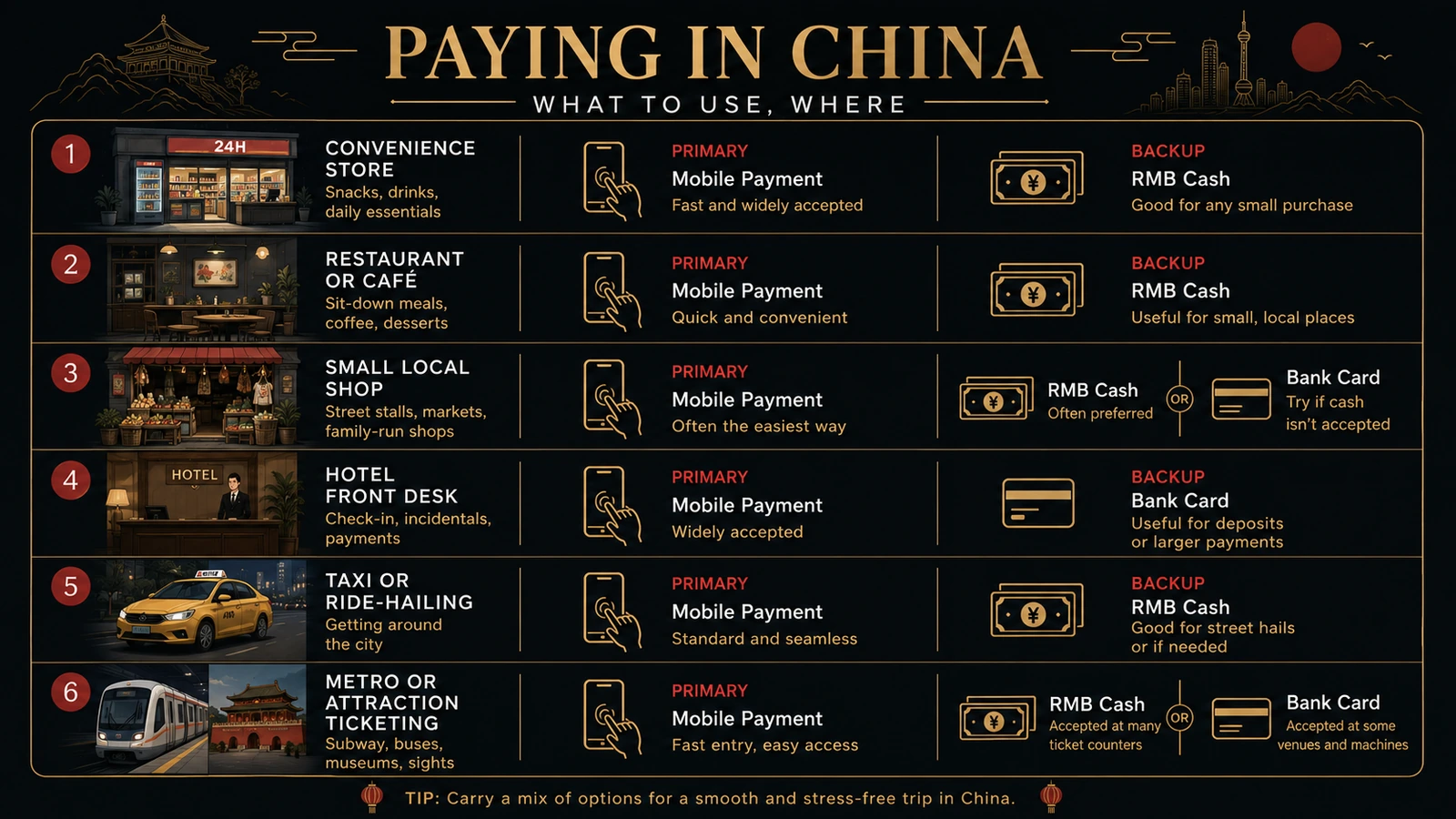
The safest choice changes with the situation. Mobile payment is usually the daily default; cash and a physical card are there when the normal path breaks.
Why One Method Cannot Cover Everything
It is tempting to think: “China accepts mobile payment, cash, and cards, so I only need to choose one.”
That is where many avoidable problems begin.
Mobile payment cannot help when the phone is unavailable
A perfect app setup is useless when your battery is dead or your network is down.
Cash cannot replace an online order
You cannot hand cash to an app and ask it to create a Didi ride, reserve a ticket, or submit a Mini Program order.
A physical international card is not accepted at every small merchant
A hotel may take it. A convenience store may take it. The small family restaurant next door may not.
A linked international card does not unlock a full local wallet
Merchant payment and personal transfer are different. Being able to pay a store does not mean you can send money to any personal QR code or use every local wallet feature.
This is why the goal is not to find one method that “works everywhere.” The goal is to make sure you always have another move.
What Payment Combination Should Tourists Prepare?
For most first-time visitors, this is enough.
Primary method: One working mobile-payment app
Prepare at least one:
- Alipay; or
- WeChat Pay.
“Prepared” means more than downloaded.
Make sure you can:
- log in;
- see the linked card;
- open the payment code;
- use the scan function;
- receive bank or app verification;
- access the account without depending on hotel Wi-Fi.
A second mobile-payment app is helpful, but the priority is getting one of them genuinely ready.
First backup: Some RMB cash
Carry enough for a few meals, short taxi rides, convenience-store purchases, or an unexpected phone problem.
Small notes are more useful than carrying only large ones.
Second backup: A physical bank card
Bring at least one card that is enabled for overseas use. Two cards from different issuers are better when available.
Do not keep every card, your phone, and all your recovery information in one bag.
Supporting conditions: Network, battery, and verification access
A payment setup also depends on:
- working mobile data;
- enough phone battery;
- access to your home phone number if the bank sends SMS codes;
- access to your bank app;
- a power bank;
- the ability to contact the card issuer.
Many “payment problems” are really network, battery, login, or verification problems.
What Should You Do If a Payment Fails?
When people are waiting behind you at a convenience-store counter, do not keep pressing the same button ten times.
Use this order:
- Read the error message once.
- Do not keep repeating the identical transaction.
- Try another linked card.
- Switch between Alipay and WeChat Pay.
- Ask whether cash or a physical card is accepted.
- Finish the purchase using the quickest working method.
- Step away from the counter, then check the bank alert, identity verification, QR-code type, or app problem.
For example, your Alipay payment fails while buying water. The priority is not to solve the entire account on the spot. Pay with WeChat, cash, or another card, leave the line, and troubleshoot afterward.
Finish the current payment first. Investigate the reason second.
For the full troubleshooting path, see why a foreign card can be linked but still fail to pay.
Bottom Line
Tourists in China can use:
- Alipay;
- WeChat Pay;
- RMB cash;
- foreign-issued physical bank cards.
The methods do not work in exactly the same places or for exactly the same jobs.
For most short-term travelers, the safest setup is:
One working mobile-payment app for daily use, some RMB cash, one physical bank card, working mobile data, and enough phone battery.
Do not rely on one app, one card, one QR code, or one phone-only plan.
When one route fails, switch routes, finish what you are doing, and check the cause afterward.
Frequently Asked Questions
Do tourists have to use Alipay or WeChat Pay in China?
No. Cash and bank cards are also available payment methods. But Alipay or WeChat Pay is usually more convenient for everyday shops, restaurants, ride-hailing, and app-based services.
Can tourists still use cash in China?
Yes. RMB cash is useful for simple face-to-face payments and as a backup when your phone or app fails. It may be less convenient when the service requires an online order, reservation, or transport code.
Can I use Visa or Mastercard everywhere in China?
No. International cards are more useful at hotels, airports, large retailers, and merchants with the relevant card-network support. Do not assume every small local shop accepts a foreign physical card directly.
Why can I pay a shop but not transfer money to a person?
Merchant payment and person-to-person transfer are different functions. International cards linked to Alipay or WeChat Pay are mainly intended for everyday purchases and do not automatically unlock transfers, red packets, or full local-wallet functions.
What should I prepare before traveling?
Prepare one working Alipay or WeChat Pay account, carry some RMB cash, bring at least one physical international card, keep mobile data working, and make sure you can receive bank verification messages.
Last updated: July 26, 2026. Travel platforms, entry rules, app behavior, prices, and service availability can change. Re-check official sources before departure.
Discussion
Ask a question, share recent experience, or flag information that may be outdated.
0 visible comments
No discussions yet.