Payment in China
Is China Mobile Payment Only? What Travelers Need to Know
China is not mobile-payment-only. Learn when cash or cards may work, why QR payment is usually easier, and which backup methods travelers should carry.
Quick Answer
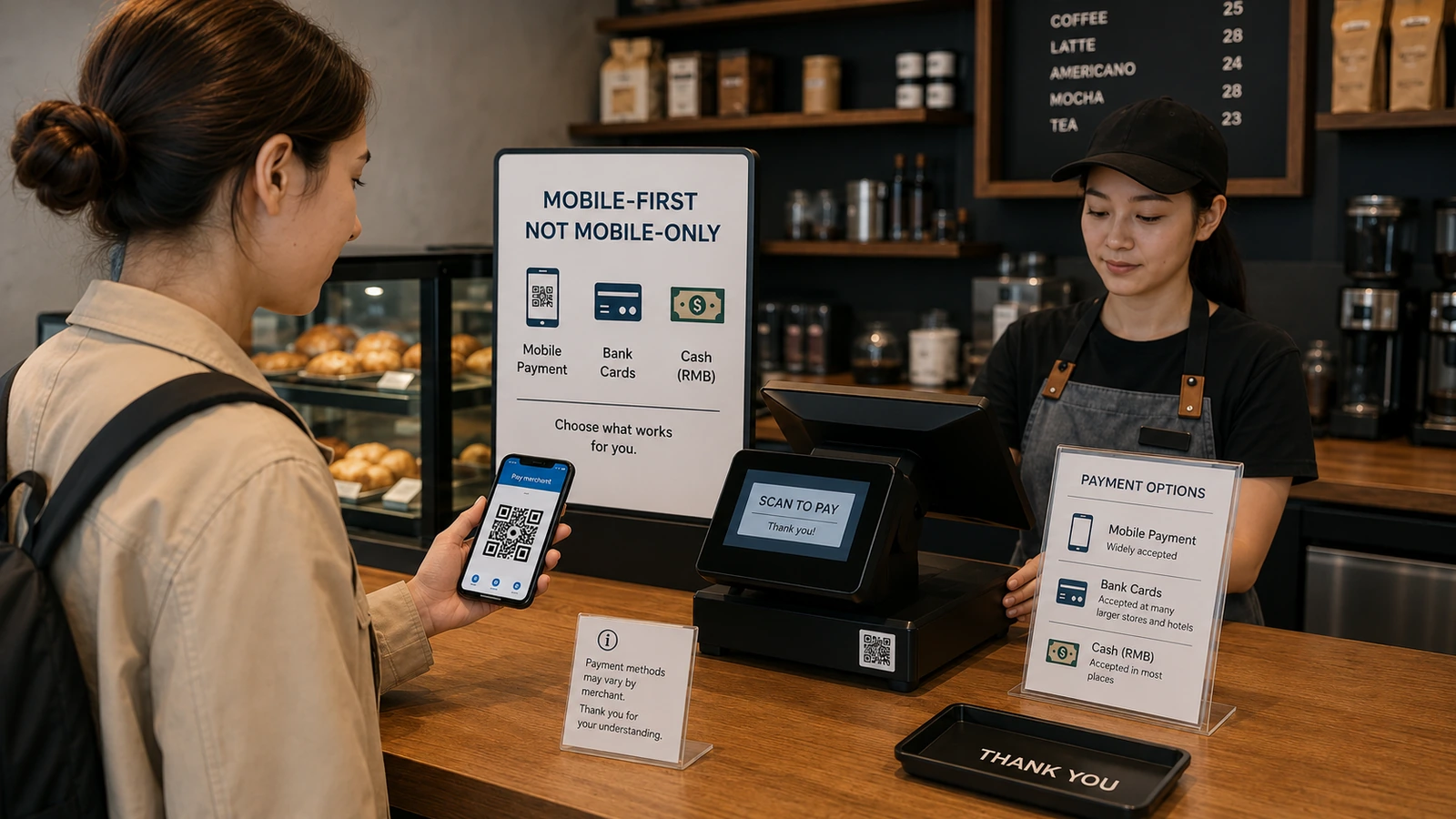
No. China is not mobile-payment-only. Official guidance for overseas visitors lists mobile payment, bank cards, and RMB cash as available ways to pay. Cash has not disappeared, and physical cards still work in some places.
But daily life in China is strongly mobile-first and often QR-first. At a convenience store, restaurant, taxi, or small shop, the normal rhythm is usually to scan a code or show a payment code. For travelers, Alipay or WeChat Pay is not a legal requirement, but having at least one working mobile-payment option usually makes ordinary purchases and app-based services much easier.
The most accurate way to think about China is:
Mobile-first and QR-first, but not mobile-payment-only.
China Is Not Officially Mobile-Payment-Only
China's official payment guidance for overseas visitors does not describe mobile payment as the only option. It lists several payment methods, including mobile payment, bank cards, and cash. A later government guide also identifies bank cards, mobile payment, cash, bank accounts, and e-CNY as basic payment methods for visitors.
That matters because three different ideas are often mixed together:
- Mobile payment is widely used.
- Mobile payment is usually convenient.
- Mobile payment is legally mandatory.
The first two are broadly true in daily travel. The third is not.
RMB cash still has a place. Bank cards also remain part of the official payment system, and China has continued working to improve overseas-card acceptance and cash access for foreign visitors. But official availability does not mean every merchant accepts every method in every situation.
A large hotel may accept mobile payment, cash, and an international card. A small noodle shop may have only a QR sign and a cash drawer. A roadside stall may accept RMB notes but have no card terminal. The practical answer depends on the merchant and the type of transaction.
Why Does China Still Feel Cashless?
Because most local customers do not begin by asking whether cash is allowed. They open Alipay or WeChat Pay.
At a convenience store, the cashier may expect you to show a payment code. In a small restaurant, a QR code may be printed on the table. At a tea shop, the staff may point to a code near the register. Even when cash is possible, the whole checkout routine is often designed around phones.
QR payments are easy for small merchants to accept. They do not need the same card-terminal setup that a foreign traveler may expect from a card-first country. That is why mobile payment appears everywhere—from supermarkets and chain stores to tiny shops and market counters.
Foreign physical cards are different. They are more likely to work at airports, major hotels, large malls, international chains, and other places set up to accept them. At an ordinary local shop, you should not assume the cashier can process your Visa or Mastercard directly.
This is why China can feel cashless even though it is not officially cashless: the default habit is mobile payment, while cash and foreign cards are secondary paths that vary by location.
China is mobile-first, but travelers should still keep another way to pay.
Cash Can Pay for a Purchase, but Not Always the Whole Task
This is the most important distinction for travelers.
Cash can settle many simple, face-to-face purchases. If you buy a bottle of water at a convenience store, order food directly from a staffed counter, or pay a taxi driver who accepts cash, the payment itself may be straightforward.
But many travel tasks in China are not only payments. They are complete digital workflows.
A convenience-store purchase
You choose an item, take it to the counter, and pay. Mobile payment is usually the smoothest option, but RMB cash may also work. Some larger stores may accept physical cards.
Scanning a restaurant table code
The QR code may not be a simple payment code. It may open a mini program where you choose dishes, select a table, submit an order, and then pay. Handing cash to a server does not automatically create that digital order. Some restaurants can take a manual order, but others are organized around the mini program.
Booking a Didi ride
The task begins before payment. You need to enter pickup and destination details, confirm the route, create the ride order, and complete the service inside the app. Cash cannot replace the location, order, and account steps that make the ride happen.
Buying a ticket or making a reservation
An attraction, event, or transport service may require a passport number, time slot, phone number, reservation, and online order. Cash at the gate cannot always replace a booking that had to be created earlier.
So:
Cash can pay for something, but cash cannot automatically complete every app-based travel task.
This is the point that disappears when people reduce the question to “Is cash legal?” or “Will shops take cash?”
What About Visa and Mastercard?
A physical foreign bank card and a foreign card linked inside Alipay or WeChat Pay are not the same payment path.
Paying directly with a physical card
You hand over or tap your Visa or Mastercard at a merchant's card terminal. This depends on whether the merchant has a compatible terminal and accepts that international card network.
This is more common at:
- major hotels;
- airports;
- large shopping centers;
- international chains;
- some major attractions and transport counters.
It is less predictable at small restaurants, local shops, market stalls, and ordinary low-value purchases.
Paying through a mobile wallet with a linked foreign card
You add an eligible foreign card to Alipay or WeChat Pay and then pay through the mobile wallet. Official visitor guidance says eligible international cards can be linked to these platforms, but the transaction still depends on the account, card issuer, merchant, and payment path.
The important point is not that one route is always better. It is that direct card acceptance and mobile-wallet acceptance are different systems. A shop that cannot swipe your physical foreign card may still accept your Alipay payment code. A hotel that accepts your physical card may handle deposits differently from a normal QR purchase.
This article does not cover card setup or deposits in detail, because those are separate problems.
Payment Options in Real Travel Scenarios
| Scenario | Commonly easier | Other possible ways | What to know |
|---|---|---|---|
| Convenience store or ordinary shop | Alipay or WeChat Pay | RMB cash; some merchants may accept cards | Acceptance depends on the merchant. Smaller shops often prefer QR payment. |
| Large international hotel | Mobile payment or bank card | RMB cash | A deposit or pre-authorization may follow a separate payment process. |
| Small stall or local shop | QR-code payment | RMB cash | Do not assume a foreign physical card will be accepted. |
| Didi or another app-based order | In-app payment | Depends on the service | Cash cannot replace the order-creation process. |
| Ticket or reservation service | App or online payment | Depends on the site or counter | Some services require advance booking, identity details, or online payment. |
| Mobile payment temporarily fails | Another prepared payment method | Cash or a physical card | Finish the current transaction first, then troubleshoot the app or card later. |
The words commonly, may, and depends matter here. China is too large, and merchant setups are too different, for one payment method to be guaranteed everywhere.
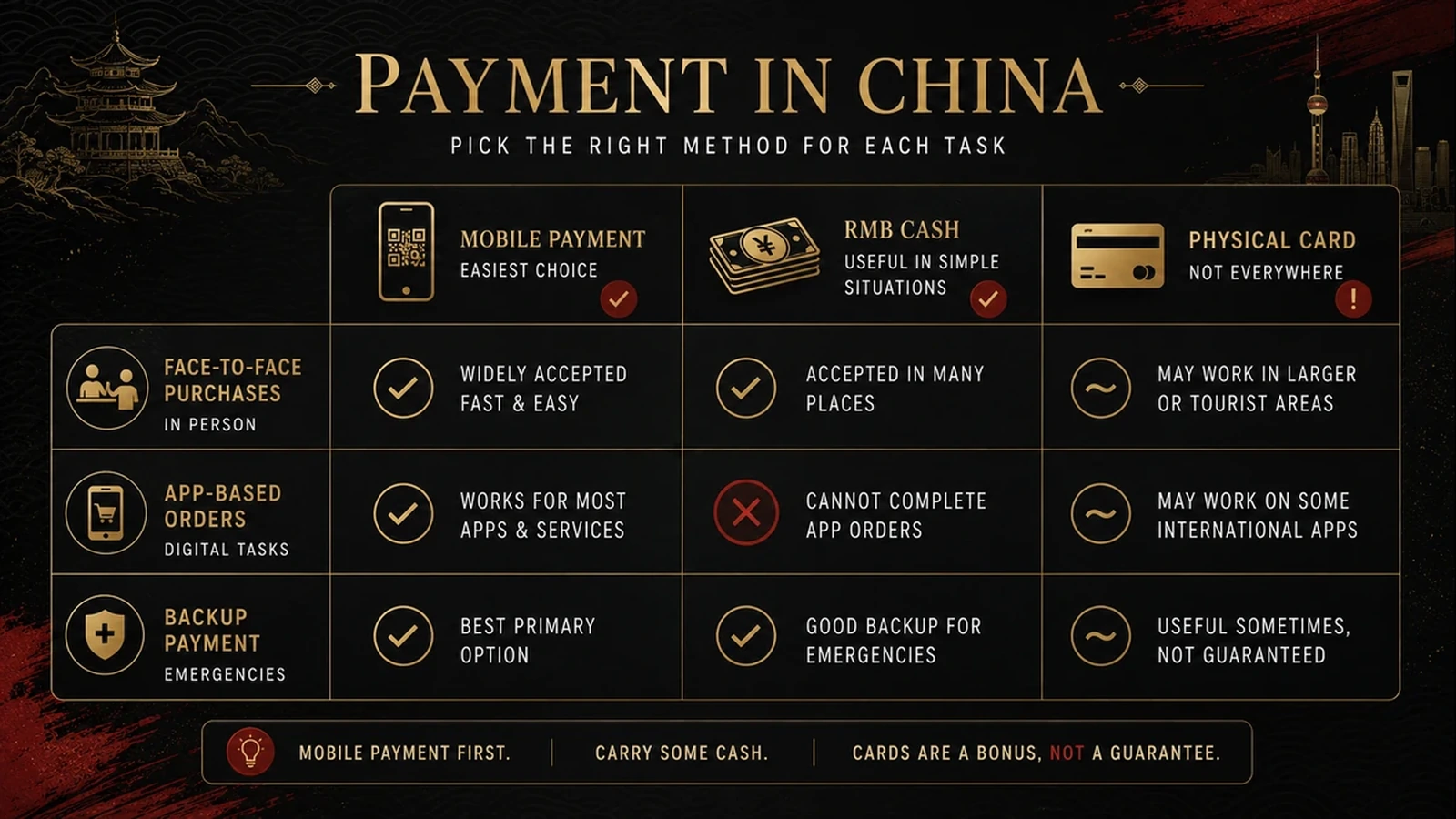
Different payment methods solve different parts of a trip. Cash can help at the counter, but it cannot replace every digital order process.
When Cash Is Still Genuinely Useful
Cash is not outdated. It is a practical backup when the digital path breaks.
It can help when:
- your phone battery is dead;
- your internet connection is unstable;
- Alipay or WeChat Pay temporarily fails;
- your bank blocks or delays a transaction;
- you have just arrived and your mobile-payment setup is not stable;
- you need to complete a simple face-to-face purchase immediately.
For example, if your payment app fails while you are buying water at a shop, using RMB cash may be much better than standing at the register and repeatedly changing settings. Finish the purchase first. Check the app, bank notification, network, or identity status after you step away from the queue.
Cash also has limits:
- a merchant may have limited change;
- a self-service machine may not accept notes;
- a mini-program order may still need to be created digitally;
- an app-based ride or reservation may not offer a cash route;
- cash cannot replace account login, identity details, location access, or online verification.
Carry a reasonable backup amount rather than treating cash as either useless or universal.
Do You Need Alipay or WeChat Pay?
Strictly speaking, not every payment in China requires Alipay or WeChat Pay.
Realistically, a first-time traveler should prepare at least one working mobile-payment app. It reduces friction in the places tourists use every day: convenience stores, restaurants, local transport, ticketing, and app-based services.
That does not mean one app is a complete guarantee. A linked card can fail. A QR code may lead to a payment path your foreign card does not support. Your phone may lose power or data. A bank may ask for verification.
The right conclusion is not “mobile payment is mandatory.” It is:
Mobile payment is usually the easiest primary tool, but it should not be your only tool.
Whether you should prepare both Alipay and WeChat Pay is a separate question. This article only establishes the minimum: having at least one usable mobile-payment route is usually worth the preparation.
A Realistic Payment Setup for a China Trip
You do not need a complicated wallet full of every possible option. Three layers are enough for most travelers to understand the basic strategy.
Primary: one working mobile-payment app
Prepare Alipay or WeChat Pay before you need it at a crowded counter. Make sure you can sign in, access your registered number, see your linked payment method, and open the payment function.
Backup: a reasonable amount of RMB cash
Carry enough for ordinary purchases, local transport, or a simple emergency—not your entire travel budget. Smaller notes are more useful than relying only on large notes.
Additional backup: a physical bank card
Bring at least one physical card, and keep access to your bank app, security messages, or verification method. A physical card may be useful at hotels, airports, larger merchants, and ATMs even when it is not accepted at every small shop.
The purpose is not to prepare more and more methods. It is to avoid placing your entire trip on one phone, one app, one card, or one network connection.
Bottom Line
China is not mobile-payment-only. RMB cash and bank cards still have a place, and official visitor guidance recognizes several ways to pay.
But China is mobile-first and often QR-first. Mobile payment is the normal path for many everyday purchases, and some travel tasks—from Didi rides to mini-program orders and online reservations—are digital from beginning to end.
Prepare one working mobile-payment app as your main tool, carry some RMB cash as a backup, and bring a physical bank card for additional flexibility. You do not need to fear traveling without a perfect setup, but you should not rely on only one way to pay.
Frequently Asked Questions
Is China completely cashless in 2026?
No. Official guidance for overseas visitors lists mobile payment, bank cards, and cash as available payment methods. Mobile payment dominates many daily situations, but it is not the only permitted method.
Will Chinese shops accept RMB cash?
Many face-to-face merchants may accept RMB cash, but convenience varies. A shop may have limited change, and a digital order or self-service process may not have a cash option. Acceptance and smoothness are not the same thing.
Can I travel in China with only Visa or Mastercard?
You should not assume a foreign physical card will work everywhere. International cards are more likely to be accepted at major hotels, airports, malls, and international businesses than at small local merchants. A mobile wallet with a linked foreign card is a different payment route.
Do I need both Alipay and WeChat Pay?
Not necessarily for every traveler, but having at least one working mobile-payment app is strongly practical. Whether setting up both is worthwhile depends on your itinerary and is best covered separately.
What should I do if mobile payment fails at the counter?
Do not keep retrying while people are waiting. Try another prepared payment method, such as cash, a physical card, or another payment app. Complete the current purchase first, then investigate the network, bank, account, or payment path afterward.
Last updated: July 16, 2026. Travel platforms, entry rules, app behavior, prices, and service availability can change. Re-check official sources before departure.
Discussion
Ask a question, share recent experience, or flag information that may be outdated.
0 visible comments
No discussions yet.