
eSIM
Is a Data-Only eSIM Enough for China, or Do First-Time Travelers Need a Chinese Phone Number?
Learn when a data-only eSIM is enough for a first China trip, which tasks still need your home number, and when a local +86 number is genuinely useful.
Quick Answer
For most first-time visitors taking a short leisure trip, a data-only travel eSIM is usually enough for mobile internet, and a Chinese phone number is not a universal requirement for normal tourist tasks. The practical setup is often a travel eSIM for data plus continued access to your home number for bank and account verification. A local +86 number becomes useful only when your itinerary depends on local SMS, ordinary calls, or a service that specifically accepts a mainland Chinese number.
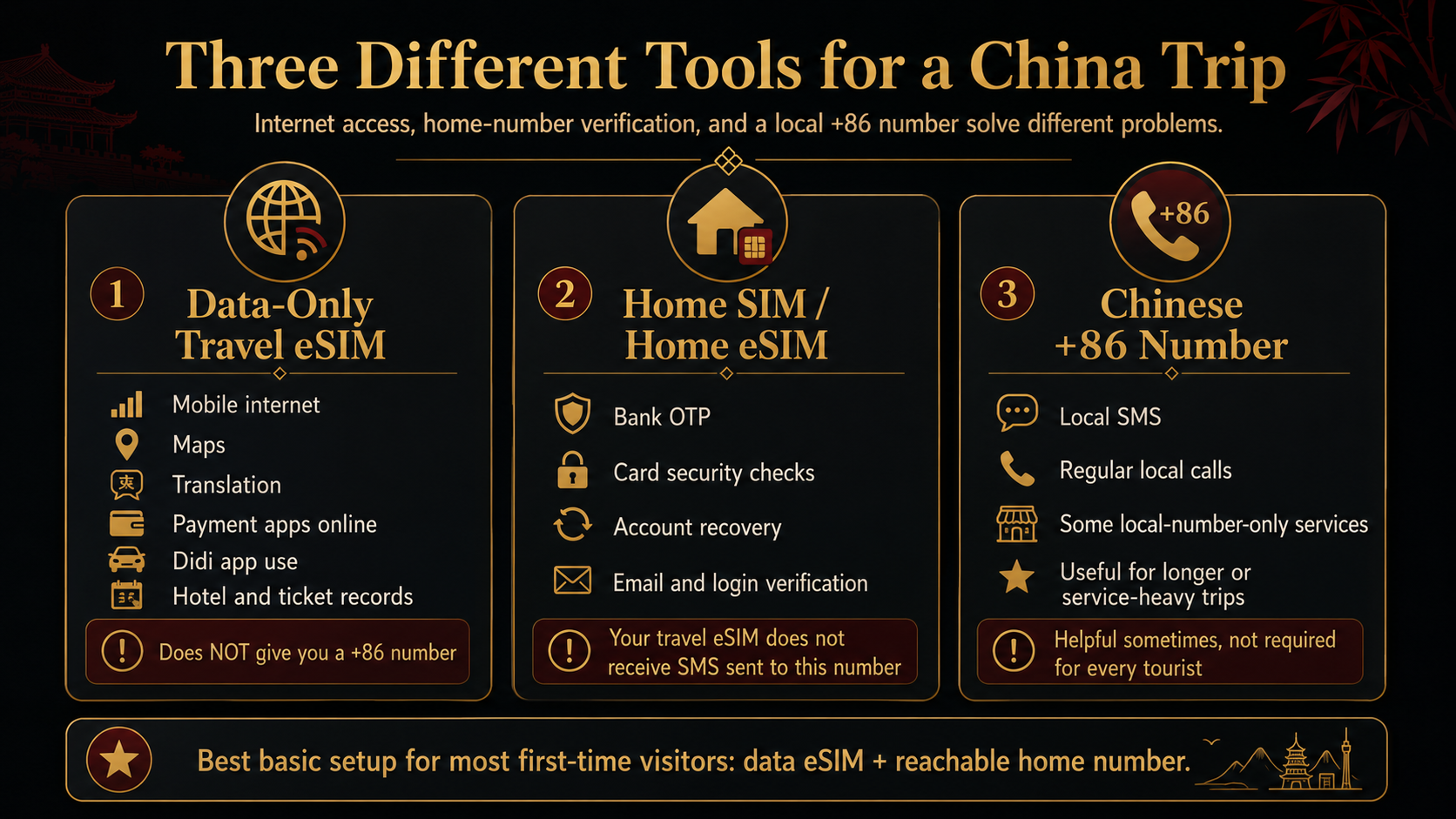
A data-only eSIM gives your phone internet access. It does not give you a Chinese number, ordinary cellular calls, or local SMS. It also cannot receive a code sent to your home number. A Chinese number does not automatically replace that home-number verification channel.
Data, Your Home Number and a Chinese Number Are Three Different Tools
Many travelers mix together three separate needs: mobile data, access to the number already attached to important accounts, and a Chinese local number.
| Tool | What it does | What it does not do | Who usually needs it |
|---|---|---|---|
| Data-only travel eSIM | Provides mobile data for maps, translation, payment apps, Didi, messages, and booking records | Does not provide +86, ordinary calls, local SMS, or texts sent to your home number | Most short-term tourists |
| Home physical SIM or home eSIM | Keeps your existing number available for bank, card, email, and account verification | Does not necessarily provide affordable China data or a Chinese local number | Travelers whose important accounts use their home number |
| Chinese +86 number | Handles local SMS, ordinary calls, and services that specifically require a mainland number | Does not receive codes sent to your home number or unlock every app | Travelers using local services heavily or staying longer |
The easiest way to remember it is:
The travel eSIM keeps you online. Your home number protects your existing accounts. A Chinese number handles local calls, SMS, and specific local-number services.
Most first-time tourists need the first two. The third is useful only when the trip creates a real reason for it.
What Can a Data-Only eSIM Handle During a China Trip?
The main benefit is simple: after landing, your phone can connect without waiting for hotel Wi-Fi or visiting a carrier shop first.
With working mobile data, you can usually:
- open maps and search for hotels, stations, attractions, and restaurants;
- use text, voice, and camera translation;
- open Alipay and WeChat Pay for supported payments;
- request a Didi ride and follow the driver in the app;
- read hotel confirmations, addresses, and platform messages;
- check train, flight, and other transport records;
- open attraction tickets and reservation pages;
- use email, online messaging, and internet calls;
- contact hotels and booking-platform support online.
A very normal first-trip setup is:
Data eSIM for internet + home number for verification.
A traveler can use maps, Alipay, Didi, and hotel records throughout a short city trip without obtaining a Chinese number.
Working data still does not guarantee that every account, card, reservation, or ticket will work. Payment may depend on identity checks and the issuing bank. A hotel booking must still be valid. Didi may behave differently depending on the account and entry point.
Your data plan is most useful when the essential apps are already installed and prepared. Before departure, prepare the core China travel apps before departure instead of trying to create every account after landing.
What Can a Data-Only eSIM Not Do?
If the plan is sold as data-only, expect data—not a full local phone service.
It normally does not provide:
- a mainland Chinese +86 number;
- ordinary cellular voice calls;
- Chinese local SMS;
- ordinary texts sent to your home number;
- bank OTPs sent to your home number;
- access to a service that accepts only a mainland number.
It also does not automatically solve:
- identity verification inside every Chinese app;
- bank and card security checks;
- every Mini Program’s account rules;
- access to every overseas website or app;
- offline backup for hotel addresses, tickets, and reservations.
This is why a phone can show strong mobile data while a payment still fails.
For example, a traveler opens the bank app over the travel eSIM, but the card issuer sends a security code to the home SIM that has been switched off. The eSIM is working. The broken link is the verification channel.
Not every travel eSIM is data-only. Some products may include a number or calling features. This article applies only to plans specifically described as data-only.
Which Core Tourist Tasks Usually Work Without a Chinese Number?
For a short trip, the biggest worries are usually payment, ride-hailing, navigation, translation, hotels, and tickets. Most travelers can prepare those core tasks using an overseas number and working data instead of treating a Chinese number as a compulsory first step.
Alipay and WeChat Pay
Overseas phone numbers can be used when preparing the main mobile-payment apps, and eligible international cards can be linked for supported merchant payments.
That does not mean every account behaves the same way. You may still face passport checks, an unsupported card, a bank decline, account-region differences, or a function that is not available to that account.
But none of those automatically means a Chinese number would solve the problem.
One visitor may pay restaurants and shops with an overseas-number account. Another may have a +86 number but still fail because the card issuer rejects the payment. The phone number is one part of the setup, not a master key.
For the full payment-account preparation, see how to prepare Alipay and WeChat Pay with an overseas number.
Didi and Ride-Hailing
Foreign visitors can use a foreign mobile number and an international card to register for Didi’s China service and request rides.
In everyday use, many tourists without a Chinese number can enter a destination, follow the car, message the driver in the app, and pay through an available method.
There can still be friction. A driver may call by ordinary phone. The independent Didi app and the entrances inside Alipay or WeChat may not show exactly the same flow. Account checks and order communication can vary.
For an ordinary city trip, app messaging is often enough. A Chinese number becomes more useful if you expect frequent calls from drivers, hotels, restaurants, or local organizations.
Maps, Translation, Hotels and Ticket Records
These tasks mainly depend on working data, a signed-in account, a valid booking, and the required identity information.
A particular hotel, attraction page, booking form, or Mini Program may still ask for a local contact number. When that happens, deal with that service specifically.
For example, your hotel confirmation, train record, map, and attraction ticket may all work normally, while one local reservation page accepts only +86 numbers. That means you need another route for that reservation—not that your entire trip requires a Chinese SIM.
App-Based Communication
With data, you can use app messages, email, online support, and internet calls.
You still cannot replace ordinary mobile calls, local SMS, a business that communicates only by phone, or a verification text sent to another SIM line.
If an important hotel, driver, or local service is likely to call rather than message, a Chinese number may make that part of the trip easier.
Keep Your Home Number for Bank and Account Verification
The number first-time visitors most often underestimate is not the Chinese number. It is their original home number.
Your bank, credit-card issuer, email account, airline login, payment account, or another important service may continue sending security codes to the number registered before the trip.
The travel eSIM does not receive those texts. A newly obtained Chinese number does not receive them either.
A common failure looks like this:
- maps work;
- Didi works;
- the payment app opens;
- the card issuer requests extra verification;
- the code goes to a switched-off home SIM;
- the payment stops at the final step.
Before departure, keep at least one usable verification route:
- leave the home SIM or home eSIM available;
- approve transactions inside the bank app;
- use email verification or an authenticator;
- save recovery codes;
- keep the issuer’s international support details.
On a compatible dual-SIM phone, the travel line can handle data while the home line remains enabled. Keeping the home line active may still create roaming charges, depending on the carrier and settings.
For device checks, dual-SIM setup, cost controls, and OTP troubleshooting, use the guide to keep your home number reachable while the travel eSIM handles data.
When Is a Chinese +86 Number Actually Useful?
A Chinese number becomes useful when your real itinerary starts depending on local communication.
Local SMS and ordinary calls
A data-only eSIM cannot help if a service specifically insists on a mainland number for an SMS code.
A Chinese number is also practical for:
- calls from a hotel, driver, restaurant, or local organization;
- ordinary local phone calls;
- local SMS;
- leaving a number that Chinese businesses can easily call.
One service requiring +86 does not mean every Chinese app has the same rule. Check the exact service you plan to use.
Delivery and local-service-heavy trips
A local number may be worth the extra setup if you expect to use local delivery, food delivery, courier, appointment, or local-only services repeatedly.
Imagine a traveler who originally plans only maps, payment, Didi, and hotel bookings. A data eSIM and reachable home number are enough. Later, the traveler decides to depend every day on a local delivery tool that only accepts +86 numbers. That is a real reason to add a local line.
The alternative may be simpler: buy in person, ask the hotel for help, use another platform, or choose a service that accepts an overseas number.
A Chinese number also becomes more practical on a longer stay, a repeat visit, or a trip involving regular local calls and services. For ordinary short sightseeing, it is usually an optional convenience rather than a condition for making the trip work.
A Chinese Number Does Not Replace Your Home Number
Even after getting a Chinese SIM, do not casually shut down or abandon your home number.
It may still be tied to bank accounts, credit cards, email recovery, airline accounts, your existing Alipay or WeChat account, insurance, and other overseas services.
A traveler may buy a Chinese SIM, switch off the home line to simplify the phone, and then discover that a card-security code was sent to the original number. The Chinese line cannot collect it.
A local number solves local communication and some local-service requirements. It does not inherit the account history built around your home number.
If the phone cannot keep both lines active, prepare another recovery route before departure instead of discovering the problem during a payment or login check.
Which Setup Fits Your Trip?
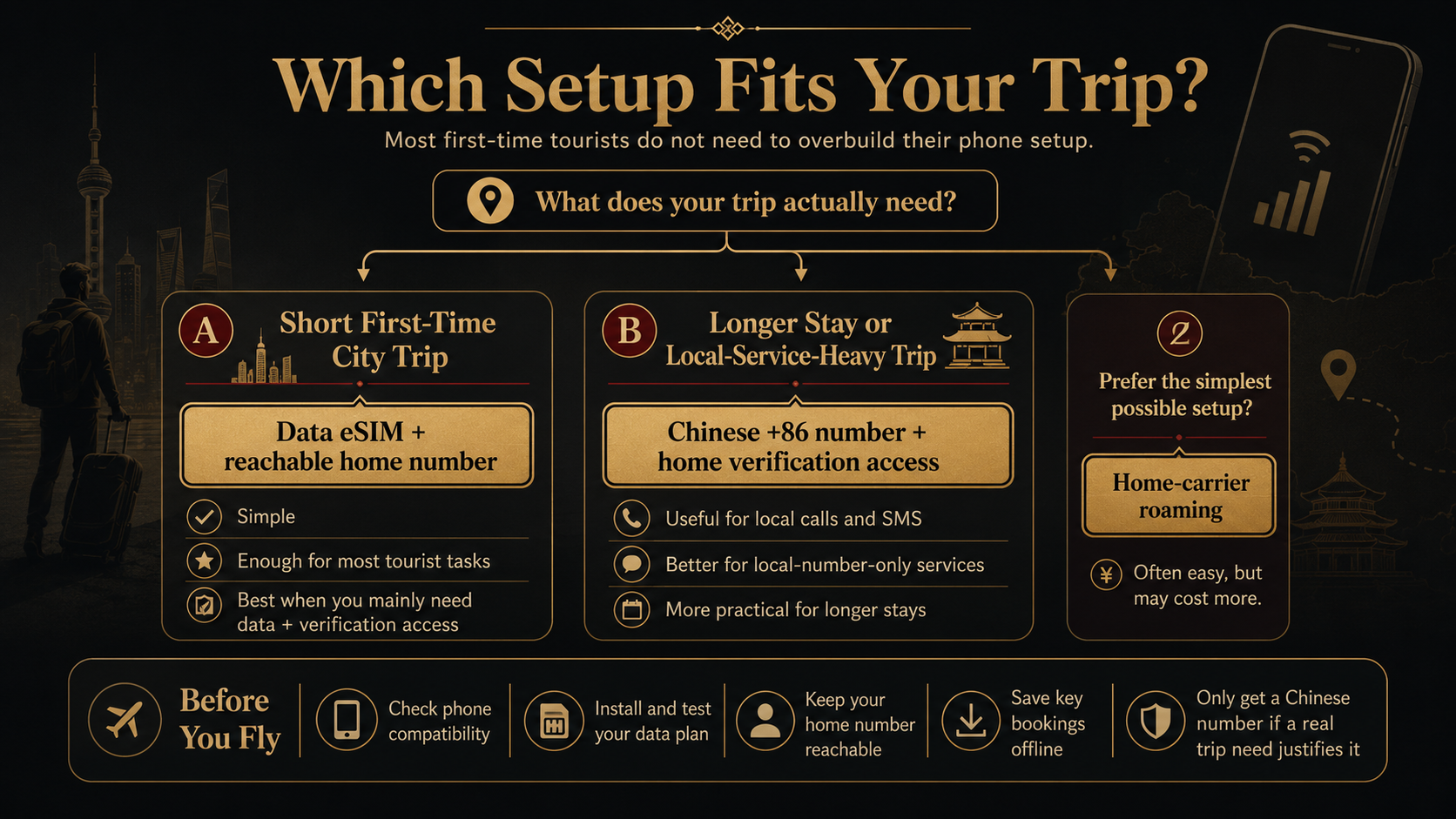
| Traveler profile | Recommended setup | Why | Main limitation |
|---|---|---|---|
| Short first-time city trip | Data eSIM + reachable home number | Covers internet and existing-account verification | No +86 number, local SMS, or ordinary local calls |
| Traveler who wants the simplest setup | Home-carrier roaming | Keeps the same line and needs little setup | Cost and data depend on the home carrier |
| Traveler relying on local deliveries or local-only services | Chinese number + home verification access | Gives local SMS and calls without losing home-account access | Requires managing two lines |
| Longer stay or repeat visitor | Local number + home backup | Better for regular local communication | More setup and ongoing line management |
| Phone without eSIM support | Roaming or a local physical SIM | Does not depend on eSIM compatibility | Swapping SIMs may affect access to the home number |
| eSIM-only phone with limited mainland-carrier compatibility | Confirm compatibility before departure | Avoids discovering an activation problem after arrival | May need to rely on a global travel eSIM or roaming |
For a first trip covering a few cities, with maps, translation, Alipay, WeChat Pay, Didi, and hotel bookings as the main needs:
Data eSIM + reachable home number
is usually enough.
For a longer stay built around local deliveries, ordinary calls, and local-number-only services:
Chinese number + home verification access
is more practical.
A phone without eSIM support can use roaming or a physical SIM. An eSIM-only phone needs a careful compatibility check before departure. Mainland carrier eSIM and a worldwide travel eSIM do not follow the same device and activation rules.
This article answers only whether you need a Chinese number. For the wider internet decision, compare eSIM, roaming, local SIM, Wi-Fi and VPN options.
Final Pre-Flight Decision Checklist
Before you fly:
- confirm the trip length and cities;
- list the apps you will genuinely use;
- check whether any irreplaceable service explicitly requires +86;
- confirm that your phone supports the chosen travel eSIM;
- confirm that the phone is carrier-unlocked;
- install and test the data plan;
- keep a working verification route for the home number;
- test bank-app, SMS, email, or authenticator access;
- save hotel, ticket, and address details offline;
- prepare a backup network option;
- get a Chinese SIM only when a real local-number need justifies it.
Most first-time tourists do not need a Chinese number simply to make the trip possible. They need working data, continued access to important verification channels, and a local number only when a specific part of the itinerary genuinely requires one.
For a systematic comparison of travel eSIMs, international roaming, local SIMs, VPN preparation, SMS-verification risks, and backup connections, use the China Internet Setup Guide. It helps you build a practical plan, but it does not promise permanent connectivity, successful delivery of every SMS, or access to every overseas service in every situation.
Last updated: July 28, 2026. Travel platforms, entry rules, app behavior, prices, and service availability can change. Re-check official sources before departure.
Discussion
Ask a question, share recent experience, or flag information that may be outdated.
0 visible comments
No discussions yet.