Essential Apps
Which Apps Do You Need for Traveling in China?
Planning a trip to China? Discover the essential apps travelers need for payments, maps, translation, transport, tickets and daily life before arrival.

Quick Answer
You do not need to download dozens of apps before your first trip to China. What you need is a small set of tools that match real travel tasks: payment, maps, ride-hailing, translation, transport, hotel bookings, and internet access.
The point is not to become a China app expert. The point is to avoid arriving at the airport with no easy way to find your hotel, call a ride, translate an address, pay for a meal, or manage a train or hotel booking.
For most first-time travelers, the safest approach is simple: prepare one working payment method, one map tool, one ride-hailing option, one translation tool, one hotel booking record, one transport or ticketing plan, and a reliable internet setup before you fly.
Why Apps Matter in China Travel
Many travel problems in China are not caused by a lack of service. The service is often there. The hard part is finding the right entry point.
At an airport, there may be taxis, ride-hailing pickup areas, buses, and metro lines. But if you cannot read the address, check the route, or call a ride, the first hour after landing can feel much harder than it needs to be.
At a restaurant, the food may be easy to order if there is a staffed counter. In other places, the table may have a QR code that opens a menu or mini program. You may need translation, mobile payment, or a staff member to help you place the order.
At a hotel, your booking may be confirmed, but a driver or receptionist may still need the Chinese name, Chinese address, phone number, or reservation details. A screenshot in English is not always enough.
This is why China travel apps should be understood as travel entry points, not just software. You prepare them because they help you move through real situations: arriving, finding places, getting around, ordering food, paying, checking in, and buying tickets.
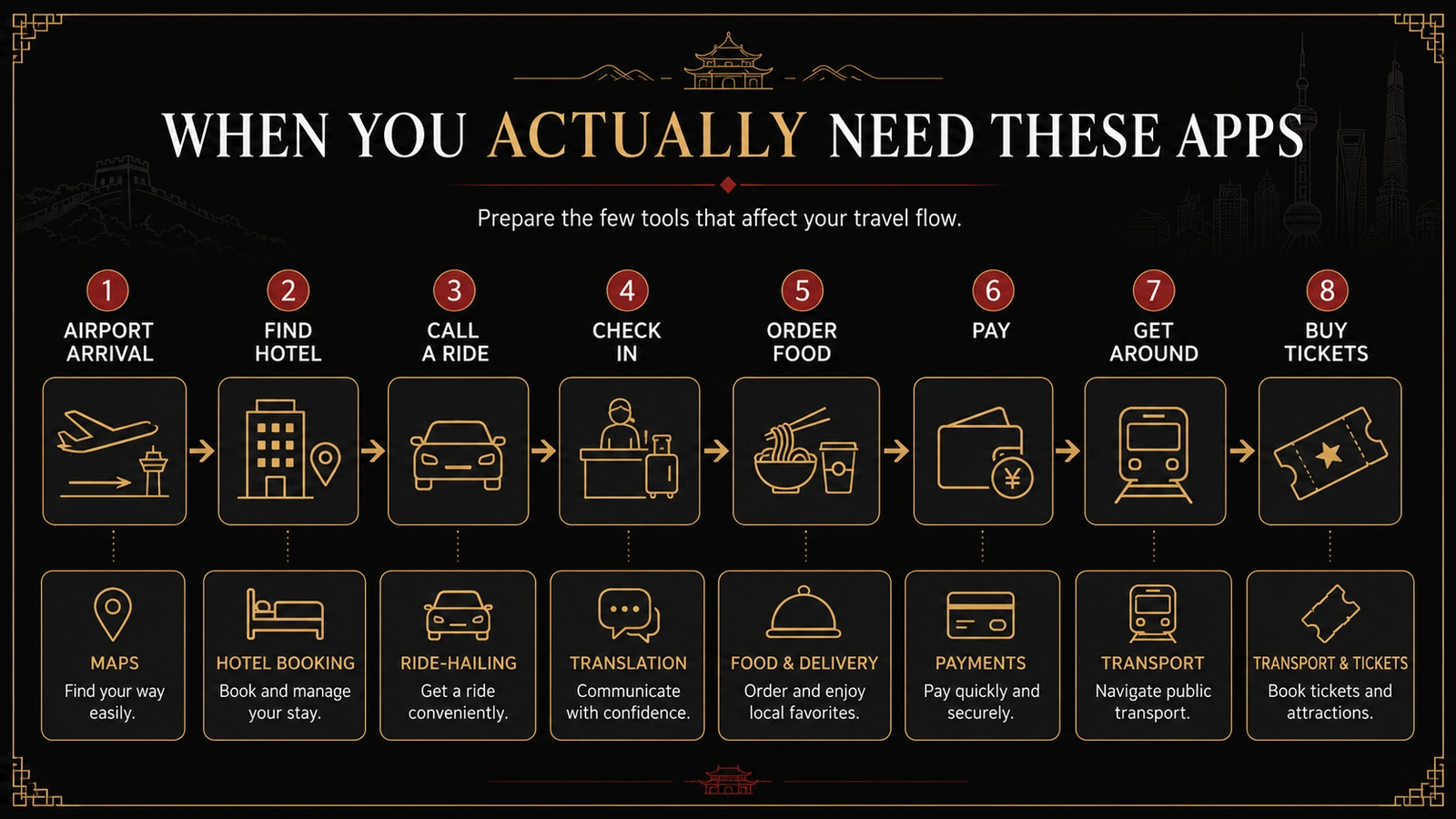
The most useful apps are the ones that connect to real travel moments: arrival, hotel, rides, food, payment, transport, and tickets.
You Do Not Need Dozens of Apps
A common mistake is to search for “best China travel apps” and then download everything: several map apps, several translation apps, multiple booking apps, social apps, food delivery apps, train apps, metro apps, airline apps, and local lifestyle platforms.
That is usually too much for a first trip.
More apps do not automatically mean a smoother trip. They can create more accounts, more logins, more verification codes, more card-binding attempts, and more confusion when you are tired after a long flight.
For a short or first-time China trip, focus on categories first:
- one payment setup;
- one map or navigation tool;
- one ride-hailing option;
- one translation tool;
- one hotel booking or order-management tool;
- one transport and ticketing plan;
- one reliable internet method.
Once those are ready, you can add extra apps only if your itinerary truly needs them.
Payment Apps: For Shops, Restaurants, Rides, and Some Online Services
Mobile payment is one of the most important app categories for China travel. Alipay and WeChat Pay are widely used for everyday purchases, and official visitor guidance explains that overseas users can link eligible international bank cards to major mobile payment platforms such as Alipay and WeChat Pay.
You may use mobile payment at convenience stores, restaurants, cafés, attractions, taxis, ride-hailing services, and some online services. In many places, the normal payment rhythm is either:
- you show a payment code and the cashier scans you; or
- you scan a merchant QR code and complete payment on your phone.
But downloading a payment app is not the same as being ready to pay.
Before you rely on it, you still need to think about:
- account registration;
- identity or passport verification if required;
- card linking;
- bank verification messages;
- whether your phone number can receive codes;
- whether the payment screen actually opens;
- whether you have tested the setup before you need it.
Do not treat this article as a full Alipay or WeChat Pay tutorial. The important point here is simpler: payment apps are not optional “nice-to-have” tools for many travelers. They are often the main doorway into daily purchases and several app-based travel services.
Map Apps: For Hotels, Routes, Restaurants, and Stations
A map app is not just for sightseeing. In China, it helps you solve basic travel questions:
- Where is my hotel?
- Which station entrance should I use?
- How far is the restaurant?
- Is this address in the right city district?
- Which metro line or route should I take?
- Where should I stand for pickup?
First-time visitors should not assume that their usual home-country map experience will work exactly the same way in China. Some overseas map tools may have limited local detail, weaker business listings, or less useful public-transport information depending on the city and the service.
You do not need to master every Chinese map app before you arrive. But you should have at least one map option that can help you search places, check routes, and confirm hotel or station locations.
A very practical habit is to save your hotel in both English and Chinese before departure. If a driver, hotel staff member, or station worker needs to help you, the Chinese name and address are much more useful than only an English booking title.
Ride-Hailing Apps: Especially Useful at Airports, Train Stations, and Late Arrivals
China has taxis and public transport, but ride-hailing can be especially useful when you are tired, carrying luggage, arriving late, or trying to reach a hotel from an airport or high-speed rail station.
Didi is the best-known ride-hailing app in China. Its public app store listings describe support for inbound users, English interface access, global mobile number login, and bilingual in-app communication features. Travelers may also find ride-hailing entry points inside larger apps such as Alipay or WeChat.
The main travel value is not just “a car comes to you.” It is that the app can help with:
- entering pickup and destination locations;
- showing the route;
- reducing address pronunciation problems;
- communicating with the driver through text or translation;
- paying through a linked method;
- keeping a trip record.
This matters most in places where a simple address mistake can become stressful: airports, train stations, large hotels, residential compounds, night arrivals, and rainy days.
Do not wait until you are standing outside the terminal with luggage to discover that you cannot log in, cannot receive a code, or cannot find the correct pickup point.
Translation Apps: Good Enough to Keep the Trip Moving
A translation app does not need to be perfect. It needs to help you keep moving.
Use translation for:
- menus;
- signs;
- hotel front desks;
- driver messages;
- station questions;
- allergy or dietary notes;
- simple emergency explanations.
For many travel moments, you do not need elegant language. You need a clear sentence, a photo translation, or a phrase that lets a local person understand what you are trying to do.
For example, a translation app can help you show:
- “This is my hotel address.”
- “Can you help me order this?”
- “I do not eat peanuts.”
- “Where is the entrance?”
- “Can I pay by card or mobile payment?”
Translation is also useful when a Chinese app, menu, or sign has no English version. Even if you cannot fully use a local app, photo translation can help you understand enough to ask for help or make a safer choice.
Transport and Ticket Apps: Trains, Metro, Attractions, and Reservations
China’s transport system is efficient, but many parts of the journey are digital or identity-based.
For high-speed rail, the official 12306 website provides ticket search and railway ticket services, and the 12306 English website and mobile app are available for holders of foreign passports recognized by the Chinese government, with account activation and identity verification required for convenient use.
That does not mean every traveler must use 12306 directly for every booking. Some travelers use third-party travel platforms, hotel concierge help, or ticket counters depending on the trip. The point is that transport and ticketing often involve more than showing up with cash.
You may need to manage:
- passport information;
- train times;
- station names;
- ticket changes or refunds;
- reservation records;
- attraction entry times;
- online booking confirmations.
For city transport, some travelers use local metro apps, transport QR codes, map apps, or payment apps depending on the city. You do not need to understand every city’s system before your first trip, but you should know that transport is often connected to apps, QR codes, identity documents, or digital tickets.
Hotel and Booking Apps: Keep the Chinese Name and Address Ready
Your hotel booking app or travel platform is more important than many travelers realize.
It is not only for making the reservation. It also stores information you may need at the worst possible moment: when you land, call a ride, check in, or contact the hotel.
Before you travel, save:
- hotel English name;
- hotel Chinese name;
- Chinese address;
- hotel phone number;
- booking confirmation;
- check-in date;
- passport name used for booking;
- arrival notes if you will arrive late.
The Chinese address is especially important. A driver may not recognize the English hotel name. A hotel may have several branches. A shopping mall or station may share a similar English name with another location.
If you only prepare one hotel-related item before arrival, prepare the Chinese address and phone number of your first-night hotel. The first night matters more than the rest of the itinerary because it is your safe endpoint after arrival.
Internet Access: The App Setup That Supports Every Other App
Apps do not help much if your phone is offline when you need them.
Before arrival, make sure you have a basic internet plan. This could be international roaming, an eSIM, a physical SIM, or another reliable mobile data option. Hotel WiFi is useful at night, but it will not help when you are outside trying to find a taxi pickup point, check a map, or contact your hotel.
Internet access also affects login and verification. Some payment apps, bank apps, booking apps, and transport apps may require SMS codes, email access, or app-based security checks. If your original phone number cannot receive verification codes while abroad, even a perfectly downloaded app may not be ready when you need it.
This is why app preparation and internet preparation belong together. Downloading the app is only the first step. You also need the app to open, log in, receive verification, and work when the trip depends on it.
What You Do Not Need to Download Before Your First Trip
You do not need every Chinese lifestyle app before a normal first trip.
You probably do not need to install multiple food delivery apps, shopping platforms, entertainment apps, social platforms, bike-sharing apps, every airline app, every metro app, every attraction app, and several local service apps before you know your actual itinerary.
Travel is not an exam on the Chinese internet.
Start with the core tasks:
- pay;
- navigate;
- call a ride;
- translate;
- manage hotel information;
- handle transport and tickets;
- stay online.
If a specific city, hotel, attraction, or ticket requires another app, you can decide case by case. But do not make your first trip harder by creating twenty accounts you may never use.
Minimum App Setup Before You Fly
Here is a realistic first-trip checklist.
Prepare one payment method
Download and set up at least one payment route you can actually open and test. Do not wait until a cashier is staring at you to discover that your card, identity verification, or phone number is not ready.
Prepare one map tool
Save your first hotel, major stations, and arrival airport. Keep Chinese names and addresses where possible.
Prepare one ride-hailing option
Install or identify your ride-hailing entry point before arrival. This is especially useful for airports, train stations, late arrivals, and hotels that are not next to a metro stop.
Prepare one translation tool
Make sure it can work when you need it. Offline language packs or screenshot/photo translation can be helpful, depending on the app you use.
Prepare your hotel booking information
Save the booking confirmation, Chinese name, address, and phone number. Take screenshots in case the app does not load immediately.
Prepare one transport or ticket plan
Know how you will manage trains, city transport, and attraction reservations. You do not need every app, but you do need a plan.
Prepare one internet method
Apps depend on data. Have mobile internet ready before you leave the airport, not after you already need a ride or map.
Bottom Line
For a first trip to China, the goal is not to download the most apps. The goal is to prepare the few tools that keep your trip moving.
You need apps for the real moments that matter: landing at the airport, finding your hotel, calling a ride, checking in, ordering food, paying, translating, moving around the city, and managing tickets or reservations.
If you prepare payment, maps, ride-hailing, translation, hotel booking, transport, and internet access before you fly, you will avoid many of the small problems that make a first day in China feel stressful.
Do not become a China app collector. Prepare the entry points you will actually use.
Frequently Asked Questions
Do I need to download WeChat before traveling to China?
WeChat can be useful for communication, local services, mini programs, and payment features, but this article does not treat it as a mandatory app for every single traveler. Think about what you need it for: payment, messaging, mini programs, or hotel and local contact support.
Is Alipay enough for a first trip?
Alipay may cover many payment and travel-service needs, especially if your account and card setup work correctly. But no single app should be your only backup. Keep another payment option, hotel information, and cash or a physical card where appropriate.
Do I need Didi if I can take taxis?
Not always. But Didi or a ride-hailing entry point is very helpful when you have luggage, arrive late, do not speak Chinese, or need to enter an exact destination. It reduces the pressure of explaining an address out loud.
Can I use my usual map app in China?
You may be able to use it for some tasks, but do not assume the experience will be identical to what you use at home. Prepare a map option that can handle local place search, public transport, and Chinese addresses well enough for your itinerary.
Should I download apps after I arrive?
Some extra apps can wait. Core travel tools should not. Payment, maps, ride-hailing, translation, hotel booking, transport planning, and internet access are easier to prepare before you are tired, offline, or trying to solve a problem in public.
Last updated: July 16, 2026. Travel platforms, entry rules, app behavior, prices, and service availability can change. Re-check official sources before departure.
Discussion
Ask a question, share recent experience, or flag information that may be outdated.
0 visible comments
No discussions yet.