
Internet & VPN
Do You Need Internet Preparation Before Traveling to China?
Learn why internet preparation matters for China travel, how eSIMs, SIM cards, roaming, WiFi and VPNs differ, and what to prepare before arrival.
Quick Answer
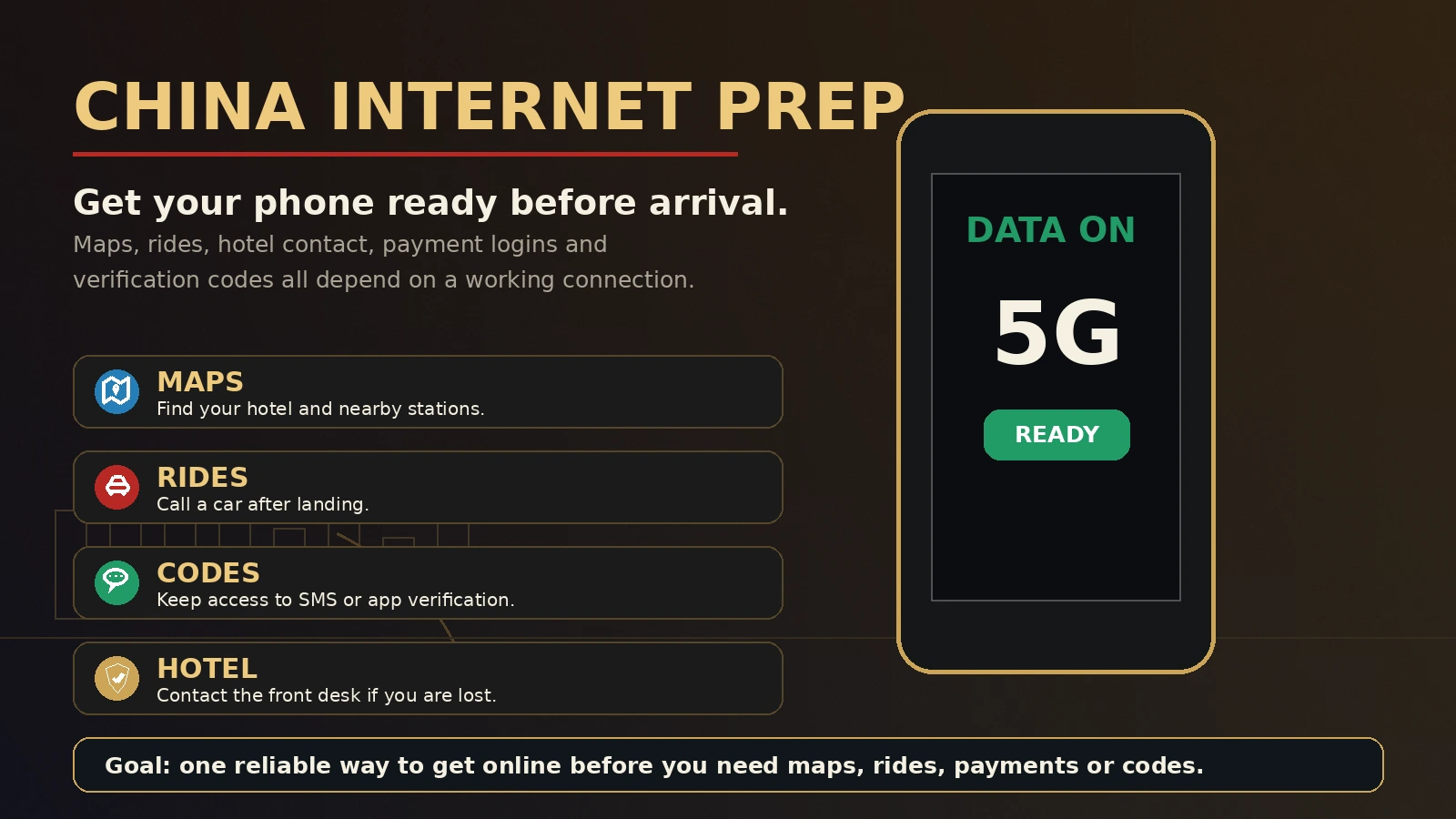
Yes, you should prepare your internet before traveling to China, but you do not need to make it complicated.
The real goal is simple: your phone should be online when you leave the airport, find your hotel, open a map, call a ride, log in to important apps, contact your hotel, and receive verification codes if needed.
For most first-time visitors, the safest setup is one reliable mobile data method, continued access to your home phone number for bank or account verification, and a backup plan that does not depend only on hotel WiFi.
Why Internet Preparation Matters in China
Many travelers think of internet preparation as a browsing problem. They ask whether they can check email, use social media, or open Google.
Those questions matter, but they are not the first problem after landing.
The first problem is usually more practical: can your phone help you move through the first few hours of the trip?
When you arrive in China, you may need internet to:
- open a map and check where your hotel is;
- call a Didi or find the normal taxi area;
- send your hotel address to a driver;
- log in to Alipay or WeChat;
- receive a bank or account verification code;
- show a booking confirmation;
- contact your hotel if you are delayed;
- translate a short message at the counter.
That is why internet preparation is not a separate technical topic. It sits under almost everything else: maps, payments, transport, hotel check-in, tickets, and communication.
You do not need to become a network expert. You just need to avoid landing with no working plan.
The Real Question: What Must Work After Landing?
Before choosing eSIM, SIM card, roaming, hotel WiFi, or VPN, ask a simpler question:
What do I need my phone to do when I am tired, carrying luggage, and trying to reach my hotel?
For most travelers, the answer is not “watch videos” or “download large files.”
It is:
- load a map;
- call or message someone;
- use a ride-hailing app or transport app;
- open payment apps;
- receive verification codes;
- access hotel and ticket bookings;
- check important emails or messages.
Once you think in those terms, the options become easier to understand.
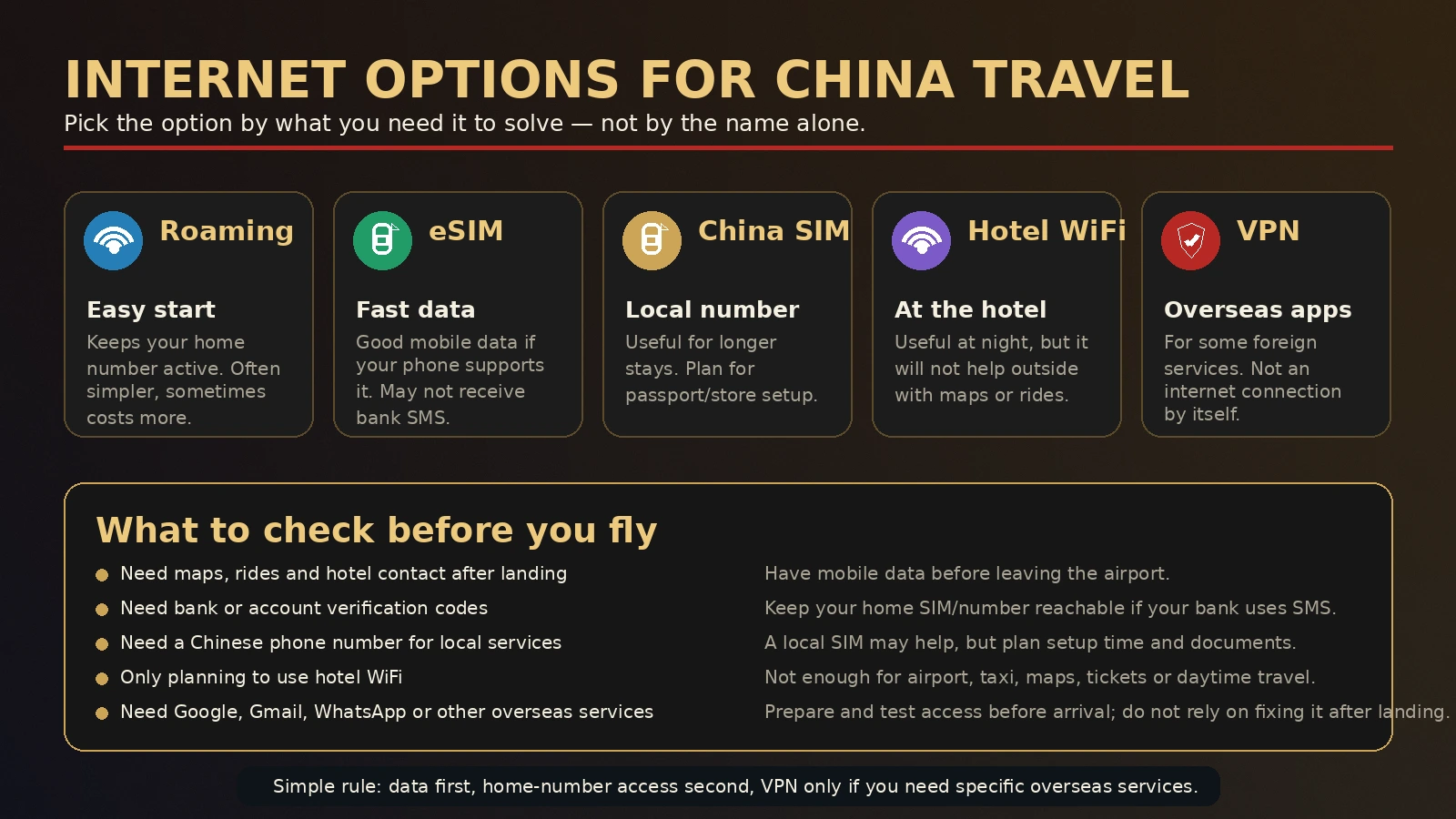
International roaming, eSIMs, China SIM cards, hotel WiFi, and VPNs do not solve the same problem. Some give you mobile data. Some help keep your original phone number reachable. Some may help with overseas services. Some only work when you are inside a building.
Do not choose based only on the product name. Choose based on what you actually need to keep working.
International Roaming: The Easiest Start for Some Travelers
International roaming means you keep using your home mobile carrier while you are in China.
For a short trip, this can be the simplest option. Your phone number stays the same, your bank and travel accounts may still recognize your number, and you may not need to change SIM cards or install a new plan.
This is useful if your bank sends SMS codes to your original number. It is also useful if your airline, hotel, or card issuer may contact you during the trip.
The downside is usually cost and data limits. Some roaming plans are expensive, slow after a small data allowance, or not included by default. Before you leave, check your carrier’s China roaming price, data amount, speed policy, and whether roaming is turned on for your account.
Roaming is not always the cheapest plan. But for some travelers, especially short-stay visitors who do not want to adjust phone settings, it can be the least stressful way to stay connected immediately after landing.
Travel eSIM: Good for Data, Not a Magic Fix
A travel eSIM can be a good option if your phone supports it and you want mobile data ready before you arrive.
The big advantage is timing. You can usually buy and install an eSIM before your flight, then activate it when you arrive. That means you are not standing at the airport looking for a SIM counter before you can open a map.
But this is where many travelers misunderstand eSIMs.
An eSIM mainly solves mobile data.
It does not automatically solve:
- bank SMS codes sent to your home number;
- Alipay or WeChat account verification;
- every login problem;
- access to every overseas website or app;
- phone-number requirements inside some Chinese services.
If your bank sends a security code to your original SIM and you turn that line off, your eSIM data plan may not help. You may have internet but still fail a bank or payment verification step.
Also check your device. eSIM support depends on your phone model, where it was purchased, and your carrier. Apple’s eSIM support pages note that eSIM availability and support vary by device and region, and mainland-China iPhone models have special limitations. If you use an iPhone or any eSIM-only phone, confirm compatibility before buying a plan.
For many travelers, a travel eSIM is a strong first choice for data. Just do not treat it as the answer to every account, payment, or verification issue.
China Local SIM Card: Useful, but Not Always the First Move
A China local SIM card can be useful for longer trips, repeat visits, or travelers who need a Chinese phone number.
A local number may help in some China-based services, local delivery flows, or situations where a Chinese contact number is more convenient. It can also be a better value if you need a lot of data for a longer stay.
But it is not always the easiest choice for a first-time short trip.
You may need to visit a counter or store, present your passport, complete registration, and make sure your phone is unlocked and compatible. The exact process can depend on the provider, location, and plan type.
There is another practical issue: if you replace or disable your home SIM, you may lose access to SMS codes from your bank, credit card, airline, or email account. That can create a new problem at the exact moment you are trying to fix another one.
A local SIM is not bad. It is just not automatically better for every traveler.
If your trip is short and you mainly need maps, rides, messaging, and payment app access, roaming or a travel eSIM may be simpler. If your stay is longer or you expect to use more China-only services, a local SIM may be worth the setup time.
Hotel WiFi: Helpful at Night, Weak as Your Only Plan
Hotel WiFi is useful. You should use it when it works well.
At night, it can help you download offline maps, back up photos, check tomorrow’s route, update apps, or message family.
But hotel WiFi should not be your only internet plan for China.
The reason is obvious once you picture the day.
You do not need internet only when you are sitting in your room. You need it when you leave the airport, walk out of a train station, find the hotel entrance, scan a restaurant code, open a ride app, show a ticket, or contact the front desk from the street.
WiFi may also require a login page, a room number, a phone verification step, or staff help. Public WiFi can be inconsistent. Airport WiFi may work, or it may be slow exactly when you need it most.
Think of hotel WiFi as support, not the foundation of your trip.
Do You Need a VPN?
A VPN is not the same thing as internet access.
This is an important distinction.
Your phone first needs a working connection through roaming, eSIM, SIM card, or WiFi. A VPN only matters after you already have an internet connection.
For many travelers, VPN questions are really about access to overseas services. The UK government’s China travel advice notes that some services and websites are blocked in mainland China, including Google, Facebook, YouTube, and X. Other websites may also be affected.
So if you rely heavily on Gmail, Google Maps, Google Drive, WhatsApp, Instagram, Facebook, YouTube, X, or work tools, think about access before you arrive.
But do not let the VPN question hide the more urgent travel problem.
A VPN will not call your Didi ride if you have no mobile data. It will not receive a bank SMS code if your home number is unreachable. It will not make a hotel WiFi login page work if the WiFi itself is unstable.
For ordinary travel, first make sure your phone can get online. Then think about whether you need access to specific overseas services.
Do not buy a random VPN at the airport in a panic. If you need one, research it before travel, understand the legal and practical limitations, and test your important accounts before departure.
How Internet Affects Payment Apps, Maps, Transport, and Hotels
Internet problems in China often appear as another kind of problem.
A traveler may think “Alipay is broken,” but the real issue is that the phone has no working data. Another traveler may think “Didi does not work,” when the app simply cannot load the map or confirm the pickup location.
Here are common examples.
At the airport, you may need mobile data to send your hotel address to a driver. If you only have hotel WiFi, that does not help yet.
At a restaurant, you may need internet to open a QR-code ordering page or translate the menu. Cash does not fix the ordering screen.
At a hotel, you may need to show an email confirmation, message the booking platform, or find the Chinese address. If your phone is offline, a small check-in issue becomes more stressful.
When paying, you may need internet to open Alipay or WeChat, complete a verification step, or load the payment page. The Chinese government’s payment service guide for overseas visitors lists mobile payment, bank cards, and cash as available payment options, and notes that foreign users can link international cards to Alipay and WeChat Pay. That setup still depends on your phone being able to connect when you actually need the app.
When traveling by train or visiting attractions, you may need access to ticket confirmations, booking pages, maps, or messages from the platform you used.
This is why the internet plan matters. It keeps the travel process moving.
Minimum Internet Preparation Before You Fly
You do not need a complicated setup. Start with a simple checklist.
Before departure, prepare one main way to get mobile data after landing. This could be roaming, a travel eSIM, or a local SIM plan you know how to activate.
Keep your original phone number reachable if your bank, card issuer, email, or important accounts use SMS codes. If you plan to switch SIMs, think through how you will still receive those codes.
Download key apps before you leave. Do not wait until you are tired at the airport and trying to connect to public WiFi.
Log in to important accounts before departure. Test your email, maps, payment apps, hotel app, airline app, and ride or transport tools while you still have normal access.
Save your hotel name, Chinese address, booking number, and phone number offline. A screenshot is better than hoping an email loads later.
Download offline copies where possible: hotel details, passport copy, insurance contact, train tickets, attraction bookings, and emergency contacts.
Decide whether you need access to overseas services such as Google, Gmail, WhatsApp, Instagram, or work tools. If yes, prepare that before arrival, not after your first login fails.
And finally, do not rely on hotel WiFi alone.
A Simple Setup for Most First-Time Travelers
For a short first trip to China, a realistic setup can be simple:
- one working mobile data option for arrival and daytime travel;
- access to your home number for bank or account verification;
- hotel WiFi as a useful evening backup;
- offline copies of hotel, ticket, and emergency information;
- a plan for overseas services if you rely on them.
That is enough for many travelers.
You do not need to buy every possible product. You do not need to understand every mobile network rule. You do not need to turn your phone into a technical project.
You just need to avoid the worst situation: landing in China with no working data, no accessible verification code, no offline hotel address, and no idea how to call a ride.
What Not to Do
Do not wait until you land to think about internet.
Do not assume airport WiFi will carry you through your first day.
Do not assume an eSIM will receive your bank SMS code.
Do not disable your home number before checking how your bank verifies transactions.
Do not rely on VPN alone and forget that you still need mobile data.
Do not install apps for the first time while standing outside the airport or train station.
Do not keep all hotel and ticket information only inside your email inbox.
The goal is not to prepare everything perfectly. The goal is to remove the obvious weak points before your trip starts.
Bottom Line
You do need internet preparation before traveling to China, but it does not have to be complicated.
Think of it this way: your internet plan is what keeps your maps, rides, hotel communication, payment apps, verification codes, and bookings reachable when you need them.
For most travelers, one reliable mobile data option, continued access to important verification codes, and offline copies of key travel details are more useful than chasing the “perfect” technical setup.
Choose a simple plan before you fly. Test the important accounts while you still have normal access. Then use hotel WiFi as support, not your only lifeline.
That is usually enough to make your first day in China much smoother.
FAQ
Do I need internet immediately after landing in China?
You do not need it for every single action, but it helps a lot. The airport-to-hotel stage often involves maps, ride-hailing, hotel contact, payment apps, and booking confirmations. Having mobile data ready before you leave the airport reduces stress.
Is an eSIM enough for traveling in China?
An eSIM can be enough for mobile data if your phone supports it and the plan works well. But it may not receive SMS codes sent to your home number, and it does not automatically solve every app login, payment verification, or overseas-service access issue.
Should I keep my home SIM active?
If your bank, credit card, email, airline, or payment account sends verification codes to your home number, keeping that number reachable can be important. Check this before replacing or disabling your home SIM.
Can I just use hotel WiFi?
Hotel WiFi is useful, but it is not enough as your only plan. You need internet outside the hotel for maps, transport, tickets, payment apps, and communication during the day.
Is VPN the most important thing to prepare?
Not for every traveler. VPN may matter if you need certain overseas websites or apps. But first make sure you have actual internet access through roaming, eSIM, SIM card, or WiFi. A VPN does not replace a mobile data connection.
Last updated: July 16, 2026. Travel platforms, entry rules, app behavior, prices, and service availability can change. Re-check official sources before departure.
Discussion
Ask a question, share recent experience, or flag information that may be outdated.
0 visible comments
No discussions yet.