
Alipay
Can You Pay a Chinese Alipay Merchant QR Code From Outside China?
A remote Alipay merchant payment may work before you reach China, but one success or failure only tells you about that specific transaction.
Quick Answer
Yes, it may work.
Some international travelers have completed a real Alipay payment to a mainland Chinese merchant before arriving in China. Others have tried the same kind of remote payment and had it declined.
So the honest answer is not a guaranteed yes or an absolute no.
Alipay clearly supports eligible international cards for everyday merchant spending in mainland China. What it does not publicly guarantee is that every traveler sitting abroad can remotely pay every mainland Chinese merchant.
A successful remote test proves that one transaction worked with that account, card, merchant, amount, and payment path. A failed test proves only that one transaction did not complete.
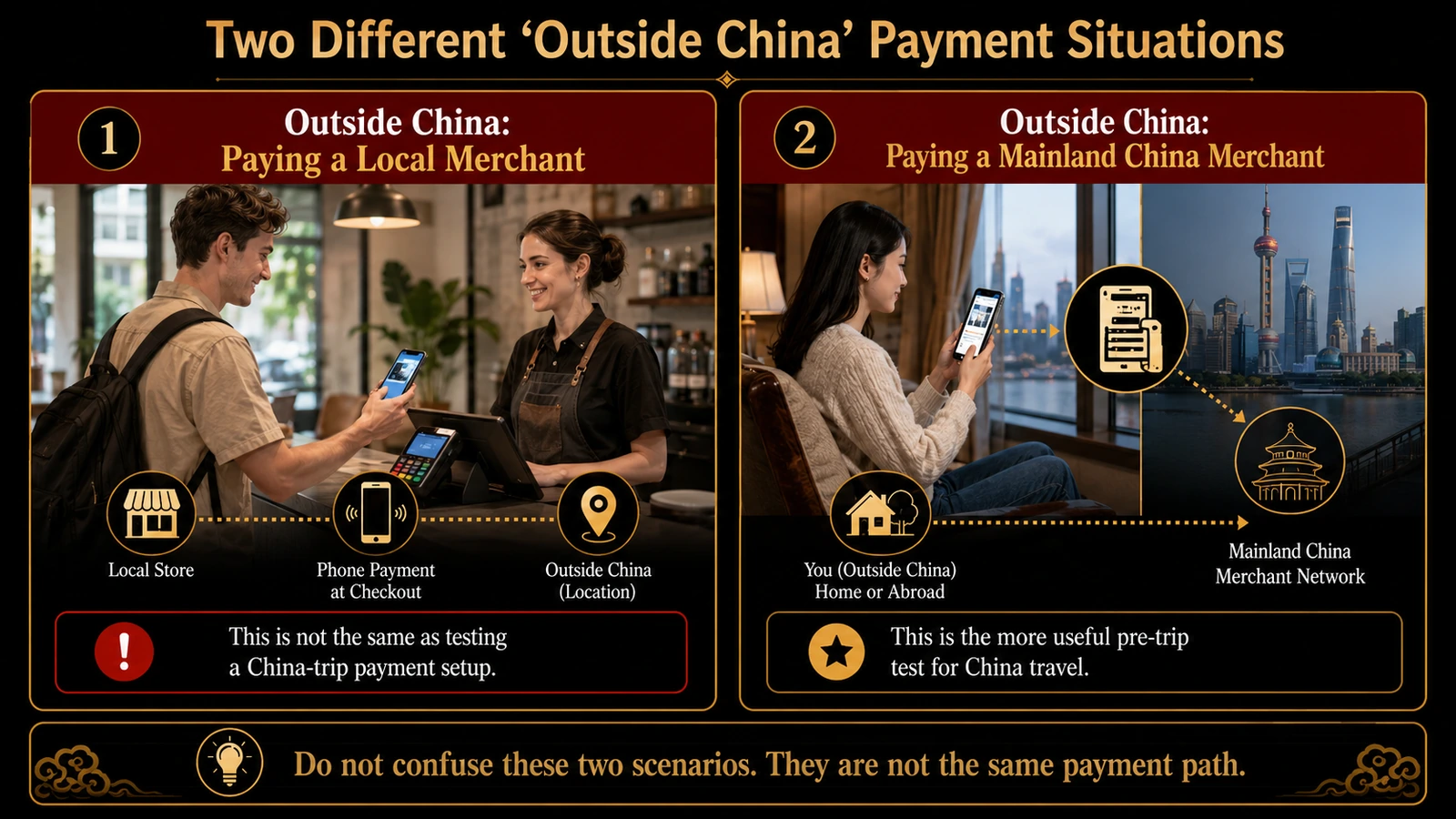
First Separate Two Different “Outside China” Scenarios
A lot of confusion comes from using the phrase “using Alipay outside China” for two different situations.
They are not the same payment path.
Paying a Local Merchant Outside China
Imagine that you are in the United States, Canada, France, the Philippines, or Australia.
You walk into a local shop in that country and ask whether you can pay the local merchant with Alipay.
That is an overseas local-merchant payment.
Whether it works depends on the merchant’s own payment setup, the local network, and whether your Alipay account is eligible for that type of overseas use.
This is not the same as testing whether your China-trip payment setup can pay a mainland Chinese merchant.
Paying a Mainland Chinese Merchant While You Are Abroad
Now imagine a different situation.
You are still at home, but a mainland Chinese merchant sends you a merchant QR code. You scan it in Alipay and try to pay with the international card linked to your account.
You are outside China, but the receiving merchant belongs to the mainland Chinese payment network.
That is the situation this article is about.
For example, a traveler may have already:
- registered Alipay;
- completed the identity checks currently required for the account;
- added an international bank card;
- found the Scan and Pay functions;
- received a mainland Chinese merchant QR code for a small real transaction.
The traveler then scans that code from home.
That is very different from walking into an ordinary shop in another country and trying to use Alipay there.
So this statement is too broad:
Foreign travelers cannot use Alipay outside China, so a mainland Chinese merchant payment must fail whenever the payer is abroad.
The reverse statement is also too broad:
Some travelers succeeded, so every foreign account and card can reliably pay mainland Chinese merchants from abroad.
Both conclusions go beyond the available evidence.
What Alipay Clearly Supports—and What It Does Not Promise
International visitors can add eligible overseas credit and debit cards to Alipay for normal merchant spending in mainland China.
That use case covers everyday merchant payments rather than every feature available to a local Chinese wallet user.
A linked foreign card does not automatically give you access to:
- personal transfers;
- payments to every personal QR code;
- red packets;
- balance top-ups;
- every financial feature;
- every app-based service.
Merchant payment and person-to-person money movement are different functions.
You can review Alipay’s current visitor payment information on its Pay in the Chinese Mainland page.
The important boundary for this article is simple:
Alipay clearly describes linked international cards as a way to pay for everyday spending in mainland China. It does not publish a blanket promise that every overseas user can remotely pay a mainland Chinese merchant before entering the country.
That does not prove remote payment is technically impossible.
It means remote payment should be treated as a possible pre-trip test, not as a guaranteed feature for every account, bank, country, or merchant.
Why a Remote Mainland Merchant Payment May Succeed
A remote payment may go through when several parts of the transaction line up correctly.
For example:
- the QR code belongs to a mainland Chinese registered merchant;
- the transaction uses a normal merchant-payment route;
- the Alipay account is in good standing;
- the required identity checks are complete;
- the linked international card is eligible;
- the issuing bank approves the transaction;
- the merchant accepts that payment route;
- the amount and transaction pattern do not trigger extra checks;
- the current security review allows the payment to continue.
When all of those pieces line up, a traveler abroad may be able to complete a real mainland Chinese merchant payment.
Independent travelers have reported successful pre-arrival payments involving mainland Chinese merchants, railway purchases, or other China-based services.
Those reports are useful because they show that remote payment can happen.
They do not establish a guaranteed success rate, a country whitelist, or a universal rule.
Why the Same Kind of Test May Fail
Another traveler can scan a similar-looking mainland merchant QR code and still receive a decline.
The problem may sit at several different levels.
The issuing bank may decline the transaction
A card appearing successfully inside Alipay does not mean the issuing bank will approve every later payment.
The bank may consider:
- overseas transaction settings;
- merchant category;
- amount;
- account status;
- fraud checks;
- an unfamiliar cross-border payment pattern;
- an extra verification requirement.
The card can be linked and still have one payment declined.
Alipay or another security layer may stop the transaction
A transaction may also be ended by a security or risk-control check.
If the screen says something like:
Transaction terminated due to suspicious activity
the safe conclusion is only:
This transaction was stopped by a security or risk-control check.
That message alone does not tell you whether the specific reason was:
- your IP address;
- your GPS location;
- your country;
- the card type;
- the issuing bank;
- the Alipay account;
- the merchant setup;
- the amount;
- the transaction pattern.
It is not responsible to choose one of those explanations without more evidence.
The QR code may not be the merchant path you expected
A QR code can look simple while representing a different type of payment.
A traveler may believe they are testing a normal mainland merchant payment when the code is actually connected to a personal collection route or another unsupported transaction type.
A foreign card that can pay a merchant does not automatically support personal transfers.
This article does not cover personal QR codes in detail, but the distinction matters when interpreting a failed test.
The account may still need verification
Being able to log in and see a linked card does not prove that every required account step is complete.
The account may still need:
- additional identity information;
- a security confirmation;
- a card check;
- an updated phone verification;
- another current account requirement.
The merchant or transaction type may differ
A small convenience-store purchase is not the same transaction as:
- a personal service;
- a hotel deposit;
- a large payment;
- a restricted merchant category;
- an in-app order;
- another specialized digital service.
A remote test only tests the merchant and route used in that transaction.
Repeated attempts may make the result harder to interpret
If a payment fails, rapidly scanning again, switching cards repeatedly, or submitting the same transaction many times can create a messier pattern.
Stop after a small number of sensible attempts.
Save the exact error text, check the bank app, and investigate before trying again.
For a deeper troubleshooting path, see how to check whether the decline came from your bank, account, or payment path.
What a Successful Remote Test Actually Proves
Suppose you are still at home and successfully pay a small amount to a mainland Chinese merchant.
That result proves:
- the current Alipay account initiated the payment;
- the current identity and account state allowed it;
- the selected card was approved for this transaction;
- the merchant accepted the payment;
- the current amount and payment route went through.
In plain language:
This real merchant transaction worked.
That is more useful information than simply seeing “card linked” inside the app.
But it does not prove that:
- every Chinese merchant will accept your payment;
- every merchant QR code will work;
- every amount will be approved;
- another card will behave the same way;
- Didi payment will work;
- hotel deposits will work;
- every train, attraction, or in-app order will work;
- every payment after arrival will avoid security checks.
One successful payment is a positive signal, not a guarantee for the entire trip.
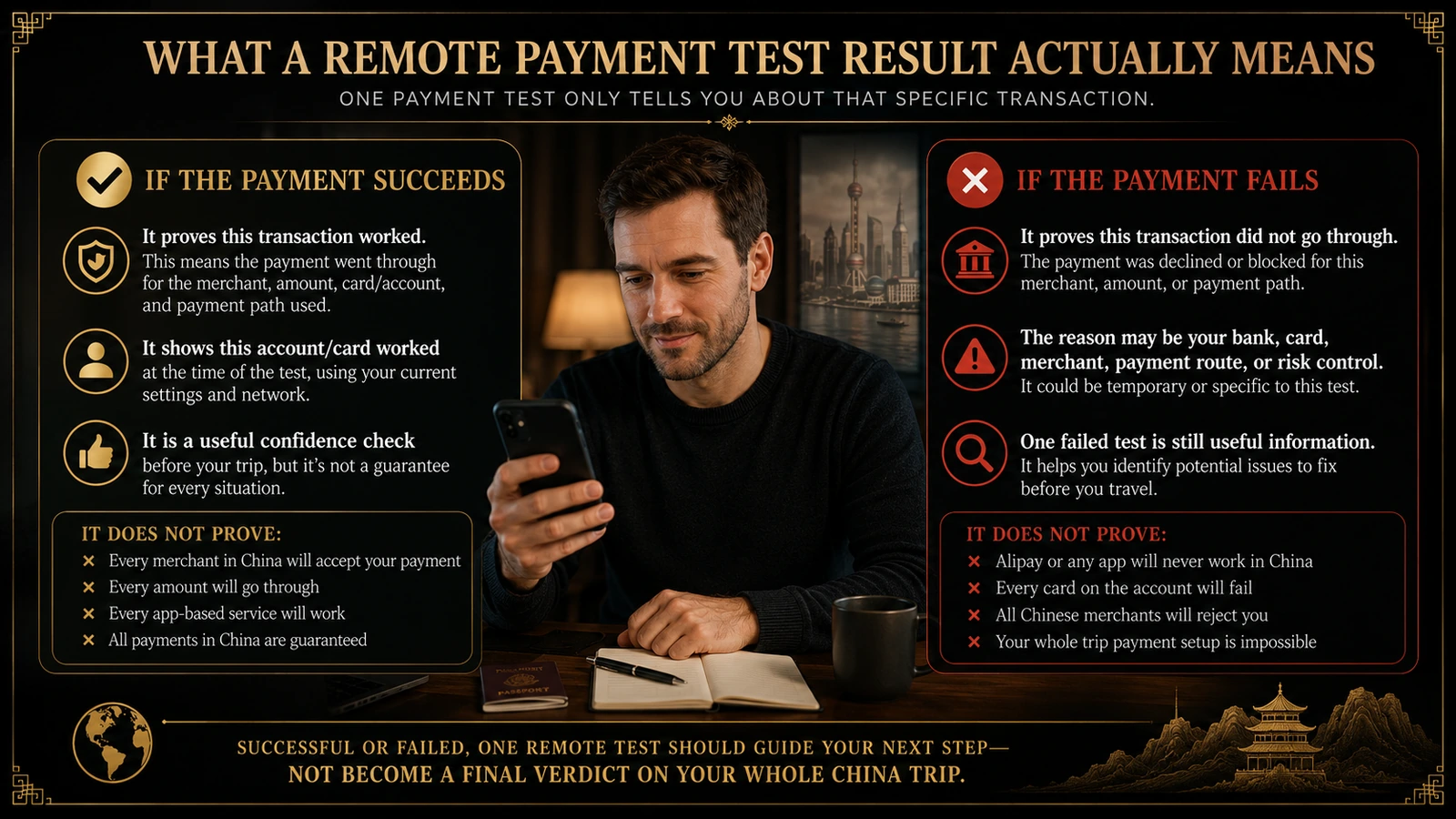
One remote test gives you information about that transaction. It does not issue a final verdict on your whole China payment setup.
What a Failed Remote Test Does Not Prove
A failed remote test does not automatically mean your Alipay setup is useless.
It only means that the current combination of:
- account;
- card;
- merchant;
- amount;
- payment route;
- security checks
did not complete that transaction.
It does not prove that:
- the Alipay account can never work;
- all international cards on the account will fail;
- every mainland merchant QR code will fail;
- your account has been permanently blocked;
- the failure was caused by your country;
- the same card will fail after you arrive in China;
- a normal convenience-store purchase in China will also fail.
A remote payment from abroad and an ordinary in-person merchant payment inside mainland China are not identical test conditions.
That is why an overseas failure should not replace a small in-person test after arrival.
What to Do If the Payment Succeeds
A successful remote payment is useful. Treat it as a checkpoint, not a reason to keep testing repeatedly.
Do this:
- Open the Alipay transaction record.
- Confirm that the status shows the payment completed.
- Check which linked card was actually charged.
- Open the bank app and confirm the charge.
- Save the result or a non-sensitive screenshot for your own records.
- Stop repeating the same test.
- Keep WeChat Pay, another card, and RMB cash ready.
- After arriving in China, make one small purchase at a normal convenience store or established merchant.
You can also review how to set up and test Alipay before traveling to China without treating one successful result as proof that every future payment will work.
What to Do If the Payment Fails
Do not keep scanning and submitting the same payment over and over.
Use a calmer sequence:
- Save the exact error text or a screenshot.
- Check whether Alipay created a transaction record.
- Open the bank app and look for a decline, verification request, or fraud alert.
- Confirm that the code belongs to a mainland Chinese merchant rather than a personal collection account.
- Review the account’s current identity-verification status.
- Confirm that overseas transactions are enabled on the card.
- Try a second eligible card if you have one.
- Do not interpret the remote decline as proof that Alipay will fail after arrival.
- Once in China, test a low-value purchase at a normal convenience store or established merchant.
If departure is close, keep working on the Alipay setup, but also prepare:
- WeChat Pay;
- a second physical card;
- RMB cash;
- a clear first-night payment backup.
Do You Need to Load RMB Into Your Alipay Balance First?
Usually, no.
For normal merchant payments, an international visitor generally pays through the eligible bank card linked to Alipay.
Preloading RMB into an Alipay balance should not be treated as a standard requirement for testing a normal merchant purchase.
Balance functions, personal transfers, red packets, and merchant payments are different features.
For this question, focus on:
- the account state;
- the linked card;
- the merchant QR code;
- the actual transaction result.
Do not turn a simple merchant test into a balance or transfer workaround.
Is There a Country Whitelist for Remote Merchant Payments?
There is no public country-by-country list guaranteeing that travelers in certain countries can remotely pay mainland Chinese merchants before arrival.
There is also no reliable basis for claims such as:
- travelers in the Philippines always fail;
- travelers in the United States always succeed;
- European cards work better than Asian cards;
- Visa always works better than Mastercard;
- credit cards always work better than debit cards.
Remote results can depend on the account, card, issuing bank, merchant, amount, and current transaction checks.
A country label is not enough to explain every success or failure.
What an Optional Pre-Trip Payment Test Can Tell You
After understanding the limits above, an optional pre-trip payment readiness test can show whether one basic merchant transaction works with your current account and card.
It cannot guarantee:
- every Chinese merchant;
- every amount;
- every QR code;
- every app-based service;
- every card;
- every payment after arrival.
You do not have to buy or complete a remote test.
For travelers who want one real transaction result before departure, it can provide an extra data point. It should never replace WeChat Pay, another card, RMB cash, or a small in-person test after arrival.
Bottom Line
A foreign traveler outside China may be able to scan a mainland Chinese Alipay merchant QR code and complete a real payment.
It may also be declined.
The remote transaction is not a guaranteed use case for every overseas account, bank, country, and merchant.
The important part is interpreting the result correctly:
A successful test proves that one transaction worked. A failed test proves that one transaction did not.
If it succeeds, save the result and stop repeating the payment.
If it fails, check the bank, account, QR-code type, and exact error message. Do not assume that Alipay will also fail once you reach China.
Whatever the result, keep a second payment app, another card, and RMB cash ready for the trip.
Last updated: July 20, 2026. Travel platforms, entry rules, app behavior, prices, and service availability can change. Re-check official sources before departure.
Discussion
Ask a question, share recent experience, or flag information that may be outdated.
0 visible comments
No discussions yet.