
City Combinations
How Many Cities Are Realistic for a First 7–10 Day Trip to China?
See how many core cities realistically fit into a first 7–10 day China trip, including transfer days, hotel changes, day trips and pacing.

Quick Answer: Two Cities for 7 Days, Three for 10
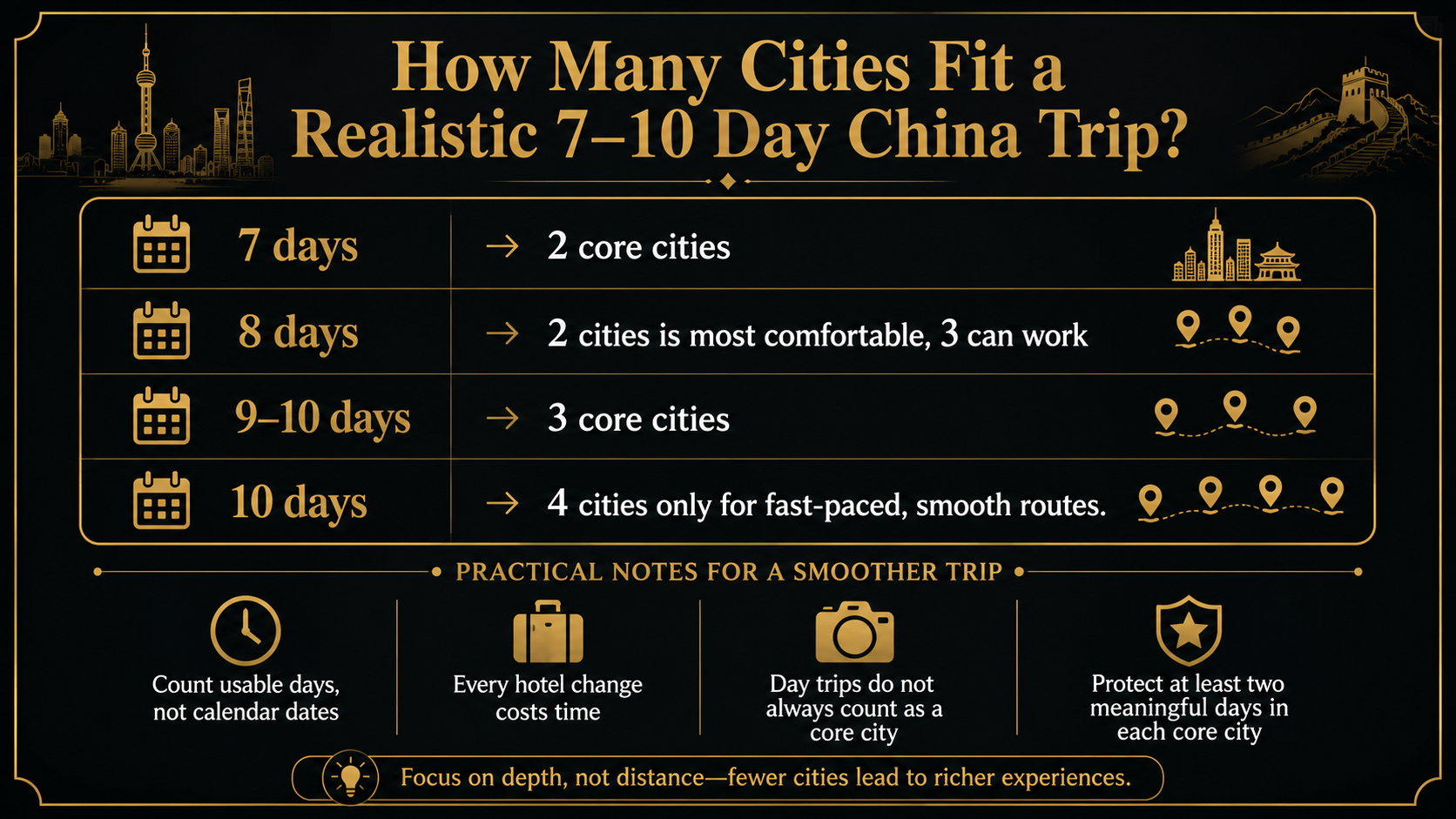
For a first independent trip to China, plan around two core cities in 7 days, two comfortable or three faster-paced cities in 8 days, and three core cities in 9–10 days.
Four cities in 10 days can work, but only when the route is direct, the transfers are simple, the arrival and departure times are favorable, and you are comfortable changing hotels every couple of nights.
The better way to count is not “How many city names can I fit?” It is:
- How many full days can I actually use?
- How many times will I move my luggage?
- How much door-to-door transfer time sits between the cities?
- Will each core city still have at least two meaningful days?
A nearby place visited as a day trip does not always need to count as another core city.
| Trip length | Realistic starting point | Faster option |
|---|---|---|
| 7 days | 2 core cities | 3 only with a very smooth route |
| 8 days | 2 is most comfortable | 3 can work |
| 9 days | 3 core cities | Keep one stop shorter |
| 10 days | 3 core cities | 4 only for a fast, efficient trip |
What Counts as a Core City?
A core city is a place where you change your hotel base and give the destination a real part of the trip.
It usually means that you:
- stay overnight;
- move your luggage;
- check into another hotel;
- spend at least one or two useful sightseeing days there;
- treat it as a separate part of the route.
A place does not automatically become a core city just because you visited it.
If you stay in one hotel, take a reasonable day trip nearby, and return that evening, you still have one hotel base. That is often easier than adding another checkout, train, taxi, and check-in.
An overnight stop used only to catch a flight or change trains is also not the same as a city you properly visited.
This distinction matters because “three cities” can describe two very different trips. Three hotel bases with two or three nights each can feel manageable. Three hotels in three consecutive nights usually feels like a luggage-moving exercise.
Count Usable Days, Not Calendar Dates
A seven-day trip rarely gives you seven full sightseeing days.
Your arrival day may include immigration, baggage collection, the airport transfer, hotel check-in, food, and basic phone or payment setup. If the flight lands in the evening, that day may only be useful for reaching the hotel.
The departure day is also limited. Checkout, the airport or station transfer, security, and the departure time can remove most of it.
Before choosing cities, divide the trip into:
- full usable days;
- partial arrival or departure days;
- intercity transfer days.
A trip listed as seven calendar days might contain only five full days. Once that is clear, two core cities usually makes much more sense than three.
For a first trip, try to protect at least two meaningful days in each main city. This is not a rule that every city must have exactly three nights. It is simply a way to stop the route from becoming a sequence of late arrivals and early departures.
Why Every Extra City Costs More Than the Train Time
A two-hour high-speed train does not mean the city move takes only two hours.
The real sequence is closer to this:
Pack → check out → reach the station → enter and pass security → wait → take the train → leave the station → reach the new hotel → store luggage or check in
A short train ride can still use half a day door to door.
Large Chinese stations add another layer. The station closest to your hotel may not be the station used by the train you selected. A major terminal can also require a long metro or taxi ride, security time, and a substantial walk inside the building.
That is why the fastest train is not always the fastest move overall.
Use the wider transport guide to understand the door-to-door cost of moving between Chinese cities. When rail is part of the route, also prepare the full China train booking and boarding process.
If you are deciding how to buy several intercity tickets, you can also choose between 12306 and Trip.com for intercity tickets.
High-speed rail makes multi-city travel easier. It does not remove checkout, luggage, station access, waiting, and a second hotel arrival.
When Can Three Cities Work in Seven or Eight Days?
Three cities in eight days can work when most of the trip is helping you rather than fighting you.
The route should be close to a straight line. The trains should be direct. The hotels should not be far from the stations you will actually use. Your arrival should not be late, and your departure should not remove most of the final day.
It also helps when:
- you travel light;
- you are comfortable changing hotels every two or three nights;
- one city is intentionally shorter;
- the trip does not include a difficult mountain or rural transfer;
- you do not need a recovery day after arrival.
Three cities in seven days is possible, but it is a different kind of trip. You are likely to have two city-transfer periods, one short stay, and very little room for a delayed train, bad weather, tiredness, or a changed plan.
That may suit an experienced, fast-moving traveler. It is not the default I would use for a first independent trip.
Natural areas need more caution. A scenic destination may appear close on the map but still require a train, road transfer, park shuttle, cable car, and walking. Giving it one rushed night often creates more transport than experience.
When Should You Remove One City?
Remove a city when the route only works by treating partial days as full days.
Common warning signs are:
- you land late on day one;
- you leave early on the final day;
- several cities have only one usable day;
- you change hotels every one or two nights;
- two intercity moves happen back to back;
- the route includes long station or airport transfers;
- the trip includes children, older travelers, heavy luggage, or limited mobility;
- a nature stop needs several transport stages;
- every delay would damage the next booking.
The best city to remove is not always the least famous one.
Start with the stop that:
- sits furthest away from the natural route;
- adds a hotel change for only a short stay;
- repeats an experience already covered elsewhere;
- has no full day;
- was added mainly because it felt wasteful to leave it out.
Deleting one city does not waste the trip. It may turn two rushed stops into two places you can actually enjoy.
A useful test is simple: remove the weakest city and look at the route again. If the remaining trip suddenly has calmer mornings, fewer luggage moves, and more full days, the answer is already clear.
Choose the Right Route Shape
Once the number of cities looks realistic, check the shape of the route.
A simple direction usually works best:
City A → City B → City C
Try to avoid:
City A → City B → City C → back to City A
When flights and prices allow, arriving in the first city and departing from the last city can remove an unnecessary return journey. It may also remove one extra hotel night near the original airport.
Day trips can help too. If a nearby destination is easy to visit without moving hotels, using one stable base may be better than adding another core city.
But a day trip is not automatically easy. If it requires several transfers, a very early start, a late return, and most of the day in transit, an overnight stay may still be the better choice.
Before keeping a city, ask:
- Does it move the route toward the departure point?
- Does it create backtracking?
- Is the stay long enough to be worth another hotel?
- Can it work as a sensible day trip?
- Does the arrival or departure airport support this route?
A good route should feel like one journey, not several unrelated trips connected by trains.
Final City-Count Check
Before booking hotels and transport, run through this list:
- How many full usable days are there?
- What can realistically happen on the arrival day?
- How early must you leave on the departure day?
- How many hotel changes are required?
- Does every core city have meaningful time?
- Have you counted door-to-door transfer time?
- Are there back-to-back travel days?
- Are children, older travelers, heavy luggage, or mobility limits involved?
- Does a nature stop need extra road or local transport?
- Can you depart from the final city instead of returning?
- Is one city included only because it feels difficult to delete?
- Does removing one city make the whole route noticeably better?
A realistic first-trip starting point is:
- 7 days: 2 core cities;
- 8 days: 2 comfortably, or 3 with a smooth route;
- 9–10 days: 3 core cities;
- 10 days with 4 cities: only when the route is efficient and you genuinely want a fast pace.
Fewer cities does not mean seeing less. It often means spending more of the trip in the places you came to visit instead of checking out, moving luggage, and finding the next hotel.
Travelers who already have a complete route and want the city count, order, stay length, and transport intensity checked can use the China Itinerary Risk Review. It reviews an existing itinerary rather than building a new trip from scratch.
Last updated: July 30, 2026. Travel platforms, entry rules, app behavior, prices, and service availability can change. Re-check official sources before departure.
Discussion
Ask a question, share recent experience, or flag information that may be outdated.
0 visible comments
No discussions yet.