City Combinations
Should a First-Time Multi-City China Trip Use Beijing-In, Shanghai-Out Flights Instead of a Round Trip?
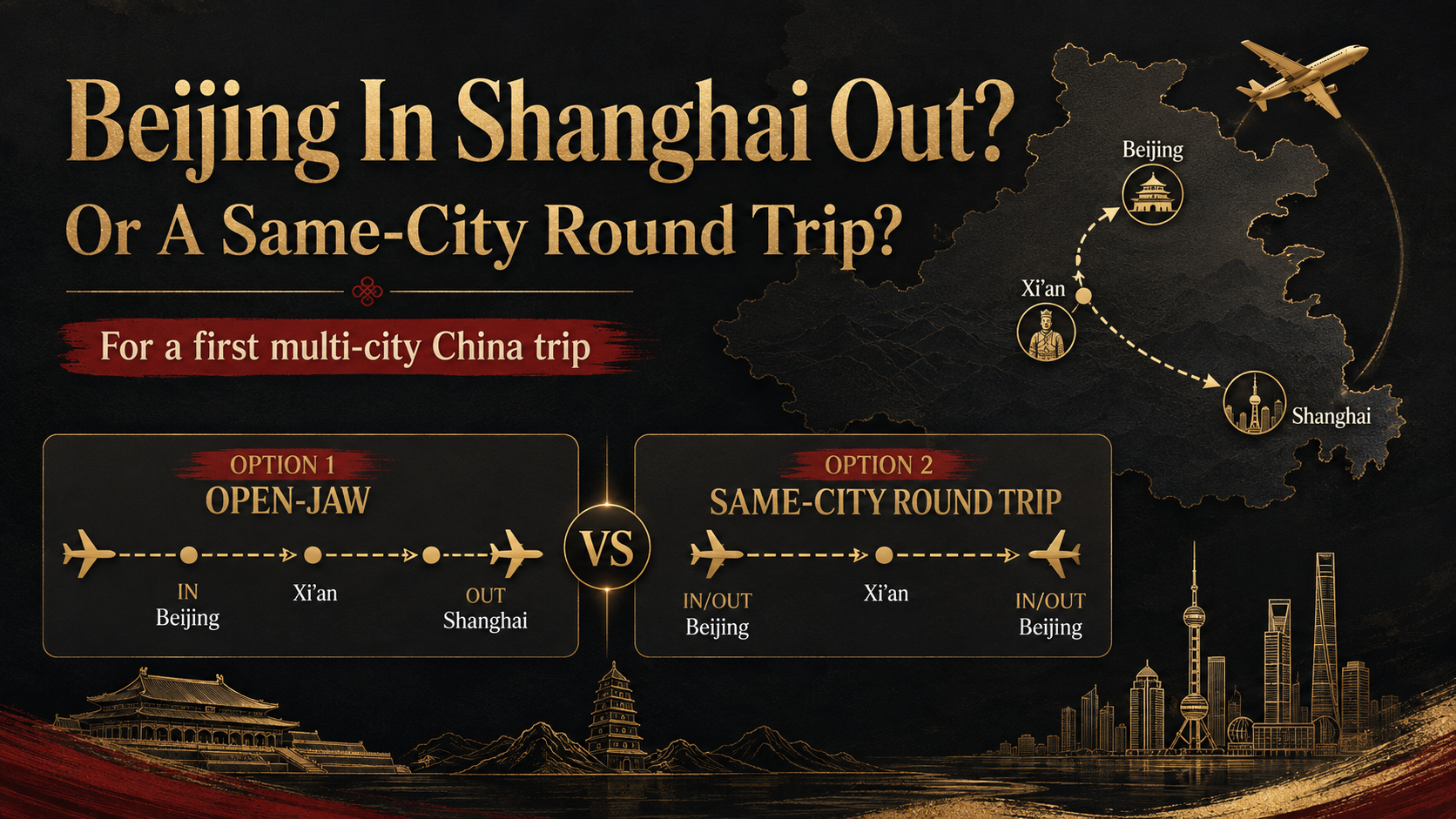
A Beijing-in, Shanghai-out ticket can reduce backtracking on a linear China route, but travelers should compare the full cost of open-jaw flights with a same-city round trip.
Quick answer
If your route looks like this:
Beijing → Xi’an → Shanghai
you should compare three flight structures before booking:
- arrive in Beijing and depart from Shanghai;
- arrive in Shanghai and depart from Beijing;
- use a same-city round trip from Beijing or Shanghai.
Flying into one city and home from another is often called an open-jaw itinerary. It can remove the final trip back to your starting city.
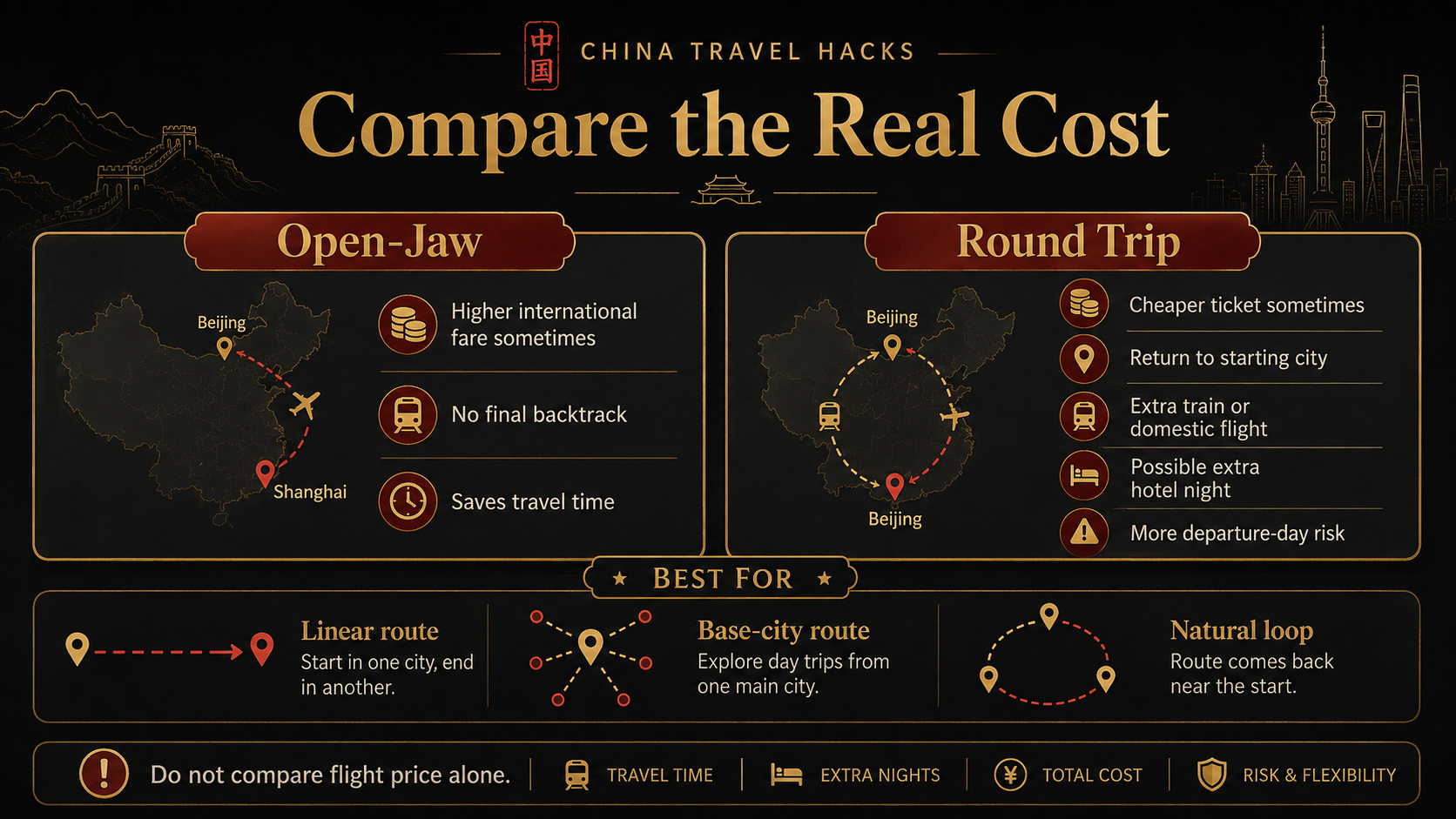
That does not make it automatically better. Compare the extra price of the open-jaw ticket with the full cost of returning to your starting city: train or domestic flight, station and airport transfers, a possible hotel night, lost travel time, luggage effort, and the risk of a tight final connection.
What does “Beijing in, Shanghai out” mean?
A traveler might book:
Home country → Beijing Travel through China Shanghai → Home country
The reverse also works:
Home country → Shanghai Travel through China Beijing → Home country
Most flight-search tools place this under multi-city rather than round trip.
The international flights may be issued together, while you arrange the travel between Beijing and Shanghai yourself. That middle section could include Xi’an, Luoyang, Chengdu, Hangzhou, Suzhou, or other cities.
An open-jaw itinerary is not exactly the same as buying any two separate one-way tickets. Check whether the flights are on one ticket or separate tickets, and compare:
- checked-baggage allowance;
- cancellation and change rules;
- connection protection;
- who handles schedule changes;
- the final total price.
Start with the shape of your China route
Linear route
A linear route starts in one city and ends in another.
Examples:
- Beijing → Xi’an → Shanghai;
- Beijing → Luoyang → Xi’an → Shanghai;
- Beijing → Xi’an → Chengdu → Shanghai;
- Shanghai → Hangzhou or Suzhou → other cities → Beijing.
This is the strongest case for comparing open-jaw flights. You keep moving forward instead of returning to a city you already visited.
These are route-shape examples, not fixed itineraries. The number of cities still has to fit your available days and travel pace.
Base-city route
A base-city trip uses one main city and returns there after short side trips.
Examples:
- Beijing with nearby day trips;
- Shanghai with Suzhou and Hangzhou;
- one main hotel with several short regional visits.
A same-city round trip often makes sense here.
Natural loop
Some routes naturally return close to the starting point. In that case, a round trip may fit without adding an artificial backtrack.
Messy backtracking
If your route keeps crossing the same part of China in different directions, fix the city order first.
A cheap international flight does not make an inefficient route good.
Compare the real total cost
Do not compare only the international ticket prices.
Real cost of a same-city round trip
Round-trip international ticket
- transport back to the starting city
- station and airport transfers
- possible final hotel night
- food and luggage costs during the transfer
- half a day or a full day of travel
- departure-day connection risk
Real cost of an open-jaw itinerary
Multi-city international ticket
- the normal transport already needed for your linear route
For example, a Beijing round-trip ticket may look cheaper. But if your trip ends in Shanghai, you still need to return to Beijing.
That return includes more than the train or domestic-flight ticket:
- travel from the hotel to the station or airport;
- security, check-in, and waiting;
- moving luggage through another transfer;
- transport after arriving in Beijing;
- a possible extra hotel night;
- time that could have been used in your final city.
An open-jaw ticket may still be the better value when it costs more but removes a long backtrack.
A same-city round trip may be better when the open-jaw fare is much higher, the schedule is poor, it adds difficult connections, or its baggage and change rules are worse.
There is no single acceptable price difference for every traveler.
Should you start in Beijing or Shanghai?
Either direction can work.
Compare:
- flight options from your home country or region;
- arrival and departure times;
- number and length of connections;
- total fare;
- baggage allowance;
- cancellation and change conditions;
- whether the first city suits your arrival-day energy;
- whether the final city offers a practical international departure;
- bookings you have already fixed;
- the most logical city order.
Beijing in and Shanghai out often works well for a route that moves from northern historical sites through central China and finishes in a large international gateway.
Shanghai in and Beijing out can be just as practical. The direction itself is not the deciding factor.
Also check the actual airport codes. Beijing and Shanghai each have more than one airport, and the wrong airport assumption can add a long city transfer.
When is a same-city round trip reasonable?
A round trip may be the better choice when:
- you are visiting only Beijing and nearby places;
- you are visiting only Shanghai, Suzhou, and Hangzhou;
- one city will be your main base;
- your route naturally returns to the start;
- the open-jaw fare or schedule is much worse;
- returning to the starting city is easy and inexpensive;
- the trip is too short for several distant cities;
- you have another fixed arrangement at the same airport.
The problem is not the round trip itself.
The problem is saving a little on the international ticket while creating a long domestic transfer that adds no real travel value.
Multi-city booking versus two separate one-way tickets
A multi-city search may produce an itinerary issued by one airline or by partner airlines under one booking.
Two separate one-way tickets may look similar on the screen, but the rules can be different.
Before paying, check:
- whether checked baggage is included;
- whether the flights can be changed or refunded;
- whether missed connections are protected;
- whether the flights are on one ticket;
- who is responsible if a schedule changes.
Do not compare only the lowest number shown in the search results.
Protect the final international departure
A same-city round trip often creates one final long transfer back to the departure city.
Avoid a plan like this:
Long-distance train or domestic flight in the morning Non-refundable international flight later the same day
High-speed trains and domestic flights can change or be delayed. You also need time for:
- travel from the hotel to the station or airport;
- security and walking inside large terminals;
- collecting and moving luggage;
- transfers after arrival;
- changing airports when applicable.
When a long return trip is necessary, the safer structure is usually to spend the final night in the international departure city.
There is no universal number of buffer hours. The correct margin depends on the distance, station, airport, season, flight time, and ticket arrangement.
Check this before buying international flights
Before paying for a non-refundable ticket:
- Confirm the total number of days in mainland China.
- Remove cities that do not realistically fit.
- Write the cities in travel order.
- Decide whether the route is linear, base-city, a natural loop, or messy backtracking.
- Search Beijing in and Shanghai out.
- Search Shanghai in and Beijing out.
- Search same-city round trips.
- Check the exact airport codes.
- Compare baggage, refund, change, and connection rules.
- Calculate the train or domestic flight needed to return to the starting city.
- Add station and airport transfers.
- Check whether an extra hotel night is needed.
- Review the final international-departure risk.
- Confirm that the route also works with your visa or visa-free conditions.
- Buy the international ticket only after it matches the China route.
To decide between rail and domestic flights inside China, compare high-speed rail and flights for your China route.
After the route is fixed, use the separate guide to book China high-speed rail with a foreign passport.
Bottom line
For a clear Beijing-to-Shanghai or Shanghai-to-Beijing route, compare open-jaw flights first.
For a regional trip, a base-city plan, or a route that naturally returns to the beginning, a same-city round trip may be the better fit.
Do not ask only:
Which international ticket is cheaper?
Ask:
After I include backtracking, transfers, hotel nights, travel time, and departure risk, which flight structure fits my route better?
Travelers planning a 6–10 day trip with usually 2–4 core cities can have a realistic 6–10 day China route built around their actual flights through the US$499 Standard China Trip Planning service. It builds the route from scratch but does not book flights or guarantee the lowest fare or any third-party transport result.
Information checked: August 6, 2026
Last updated: August 6, 2026. Travel platforms, entry rules, app behavior, prices, and service availability can change. Re-check official sources before departure.
Discussion
Ask a question, share recent experience, or flag information that may be outdated.
0 visible comments
No discussions yet.