Transportation
How Does Transportation Work in China? A Traveler’s Guide to Trains, Metro, Taxis and More
Planning a trip to China? Learn when to use high-speed rail, flights, metro, Didi, taxis and buses, and how first-time travelers can move around more smoothly.
Quick Answer
Transportation in China feels complicated before your first trip because there are many options, not because you need to master all of them.
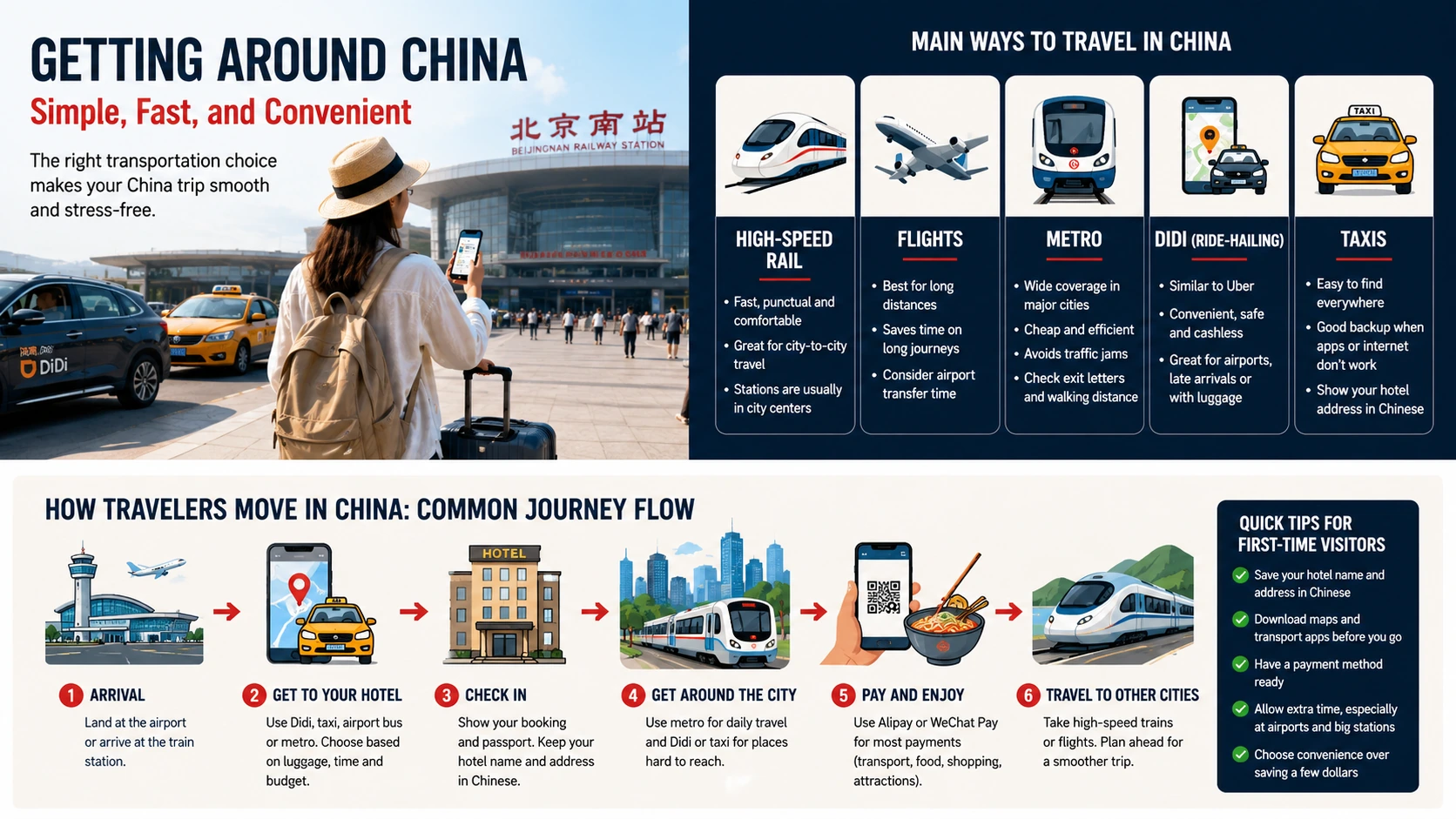
For most travelers, the working pattern is simple: airport to hotel by Didi or taxi, city-to-city by high-speed rail or flight, and city travel by metro plus occasional rides. You do not need to learn every transport system in China. You just need to know when each option makes sense.
If you are visiting China for the first time, focus on a small traveler-first setup: a map app, one ride-hailing option, your hotel name and address in Chinese, a working payment method, and a basic idea of when to choose high-speed rail, flights, metro, taxis, or Didi.
The Most Common Transportation Combo for Travelers
Most first-time visitors do not move around China in one single way.
A more realistic pattern looks like this:
- Airport to hotel: Didi or taxi
- Between cities: high-speed rail or flights
- Inside the city: metro for simple daytime trips, plus Didi or taxi when you are tired, carrying luggage, arriving late, or going somewhere awkward
- Backup: taxi when your app, network, or payment setup is not cooperating
This is the combination that solves most real travel moments: landing after a flight, checking in, visiting attractions, moving between cities, and getting back at night.
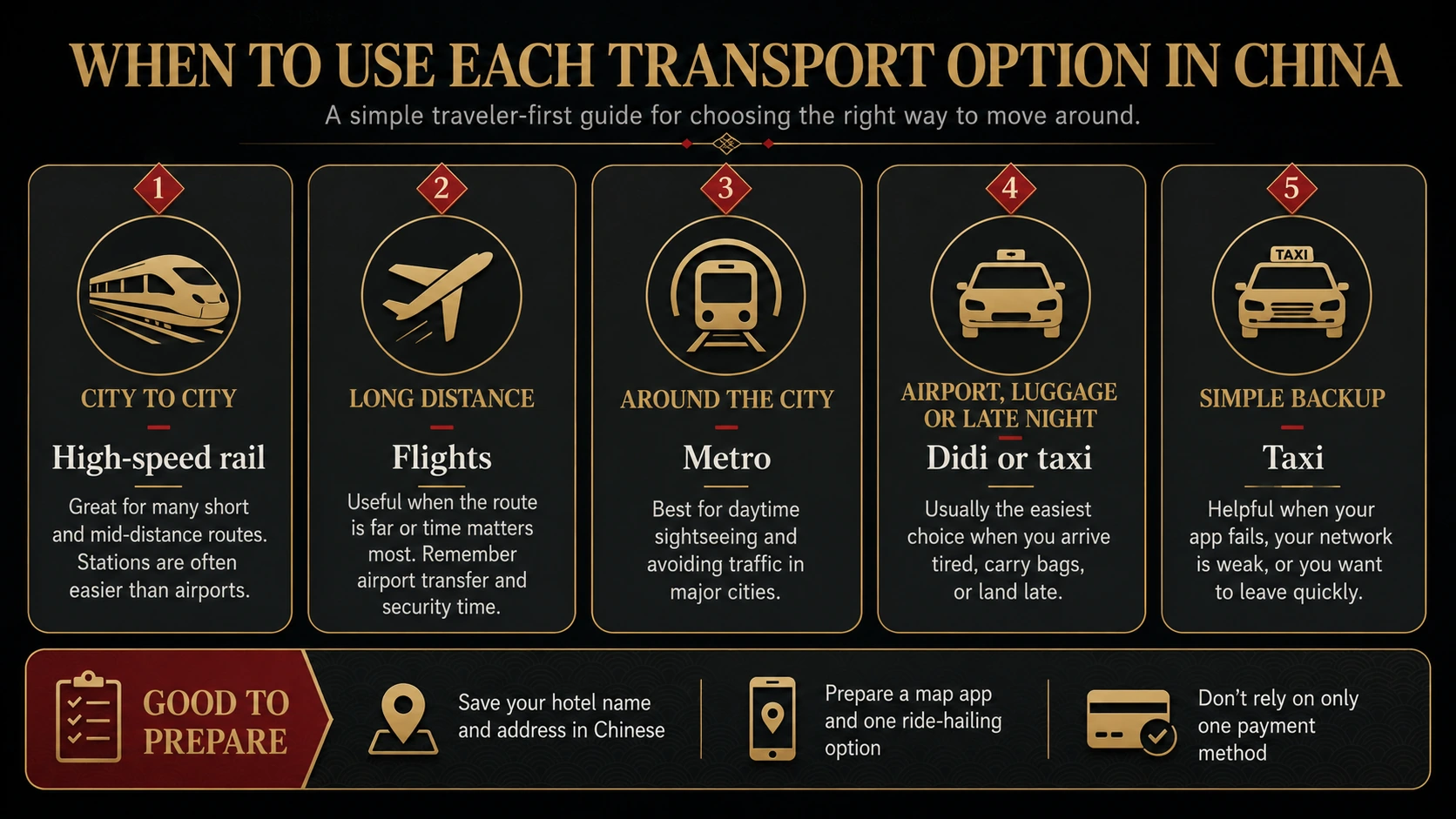
You do not need every transport option at once. You need the right one for the moment: rail or flight between cities, metro for easy city travel, and Didi or taxi when convenience matters more.
Why Transportation Feels Harder Than It Really Is
Many travelers worry that China transportation will be too complex because the cities are big, the stations are large, and the services run through apps, maps, QR codes, and digital payments.
That anxiety is understandable, especially if you are arriving in a new country after a long flight. But the real problem is usually not that transport is unavailable. The real problem is that the first hour can be messy if you arrive with no plan.
At the airport, you may need to find the right exit, understand where the taxi queue is, compare metro versus ride-hailing, and show your hotel address. At a huge rail station, you may need time for security, ticket checks, and finding the right waiting area. At night, the cheapest option is not always the best option.
China transportation works best when you reduce the decision load before you travel.
High-Speed Rail: The Main Choice for Many City-to-City Trips
High-speed rail is one of the most useful transport tools for China travel. It is often the easiest option for many short and mid-distance routes between major cities.
Why travelers like it:
- trains are usually punctual;
- the ride is comfortable and easy to understand once you are inside;
- many rail stations are better placed for city travel than airports;
- you avoid some of the airport transfer time that makes flights feel longer than expected.
For many first-time visitors, high-speed rail works well when:
- you are moving between two cities that are not extremely far apart;
- you want a smoother city-center-to-city-center journey;
- you prefer a predictable travel day over airport logistics.
What travelers often underestimate is station size and timing. China rail stations can be very large. You still need time for entry checks, security, finding the right area, and walking to your platform or gate. Do not treat a high-speed rail trip like stepping onto a local commuter train at the last minute.
A good practical rule is simple: if you choose rail, give yourself a time buffer, keep your passport ready, and do not arrive at the station in a rush.
Flights: Useful for Long Distances, but Not Automatically Faster
Flights make sense when the route is long or when time matters more than convenience.
They are often the better choice when:
- the cities are far apart;
- you are crossing a large part of the country;
- rail would take much longer than you want.
But do not assume a flight is automatically faster just because the time in the air is shorter.
With a flight, you also have to think about:
- getting to the airport;
- arriving early enough for the airport process;
- security and waiting time;
- getting from the airport to your hotel or next destination after landing.
For some routes, high-speed rail feels easier because the total trip is simpler. For other routes, flights save a lot of time. The best choice is not “train good, plane bad” or the other way around. The best choice is the one that fits the distance, your energy level, and how much transfer friction you want that day.
Metro: Usually the Best Tool for Daytime City Travel
In many Chinese cities, metro systems are one of the easiest ways for travelers to move around.
They are usually best for:
- sightseeing during the day;
- moving between major neighborhoods;
- avoiding traffic in large cities;
- getting around on a predictable budget.
Why metro works well:
- wide coverage in many big cities;
- clear route structure once you understand the line and exit;
- lower cost than repeated rides;
- helpful for normal point-to-point city movement.
The main problem is not that metro is hard. The main problem is that big stations can have many exits and long walking connections.
For a first trip, metro is excellent when:
- you are not overloaded with luggage;
- it is daytime;
- you have a map app ready;
- you are not arriving too exhausted to deal with station navigation.
If you are tired, carrying large bags, or checking into a hotel for the first time, a ride may be the better choice even if metro is technically possible.
Didi: Great for Airports, Luggage, Late Arrivals, and Hard-to-Reach Places
Didi is the ride-hailing option most travelers compare to Uber.
For first-time visitors, Didi is especially useful when:
- you need to go from the airport to your hotel;
- you have luggage;
- you arrive late at night;
- the metro is inconvenient;
- you want a direct trip to a place that is awkward by public transport.
This is also where many travelers make a small but important mistake: they focus too much on saving a little money and choose the cheapest or most complicated ride option.
For a first trip, the safer default is usually:
- Express / standard ride; or
- Taxi inside the app if available.
It is usually better to avoid pooled rides on your first trip, especially after arrival, with luggage, or when you are tired. The price difference is often not worth the extra complexity.
Didi is not just about transport. It also depends on your phone, internet, map access, and payment setup. That is why transportation preparation is connected to your other travel systems.
Taxis: A Useful Backup, Not an Obsolete Option
Some travelers assume taxis no longer matter because ride-hailing is common. That is not true.
Regular taxis are still a useful backup in China, especially when:
- you do not want to troubleshoot an app;
- your network is weak;
- your phone battery is low;
- you land or leave late;
- you want to leave a station quickly;
- your ride-hailing app is not working.
The key to using taxis more smoothly is preparation, not language perfection.
Before you travel, save:
- your hotel name in Chinese;
- the full Chinese address;
- a map screenshot;
- the phone number if useful.
If you can show the destination clearly, many taxi situations become much easier.
Bus: Possible, but Usually Not the Main Tool for a First Trip
Buses exist everywhere in China and can be useful for short local trips or very budget-conscious travelers.
But for most first-time visitors, buses are usually not the main transport method to rely on.
The reason is not that buses are bad. It is that they are often less intuitive for someone who is new to the city, new to the language, and trying to move efficiently.
Bus routes, stop names, and boarding flow can be more tiring to decode than simply taking metro, Didi, or a taxi.
If you already know exactly where you are going, a bus may be fine. But if you are visiting China for the first time, metro and rides are usually easier primary tools.
Tram and Light Rail: Useful in Some Cities, Not a National Default
Some Chinese cities have tram or light-rail systems, and they can be perfectly useful in the places where they exist.
The important point is not to treat them as a standard national transport category you must prepare for in advance.
If your city uses them, you can decide on the ground whether they are helpful. For most travelers, they are a city-specific extra rather than a core preparation item.
From the Airport to Your Hotel: What Should You Choose?
This is one of the most important transportation decisions of the whole trip, because it shapes your first impression of China travel.
If you arrive in daytime
You may have more choices: metro, airport transport, Didi, or taxi.
If you travel light, feel comfortable with maps, and your hotel is straightforward to reach, public transport may work well.
If this is your first day, though, do not feel pressured to choose the cheapest option if it adds confusion.
If you have large luggage
Didi or taxi is usually the easier choice.
Dragging bags through a large station, changing lines, and searching for the correct exit often costs more energy than travelers expect.
If you arrive late at night
Taxi or Didi is usually the better starting point.
At that hour, simplicity matters more than squeezing out the lowest price.
If it is your first night in China
The best transport choice is often the one that gets you to the hotel with the least friction.
A smooth arrival is more valuable than proving you can optimize every transfer.
What If You Don’t Speak Chinese?
Not speaking Chinese can make transportation feel more stressful, but it does not mean you cannot move around.
What helps most is not perfect language skill. It is good preparation.
Keep these ready on your phone:
- hotel name in Chinese;
- hotel address in Chinese;
- screenshots of key destinations;
- a map app;
- a translation app.
This helps in taxis, hotel arrivals, ride-hailing pickup points, and station navigation.
If a driver or staff member cannot easily understand your English hotel name, the Chinese address usually solves the problem much faster.
Transportation Is Not a Separate Topic
Transport in China connects directly to several other parts of your trip.
To move smoothly, you may also need:
- internet access for maps and ride-hailing;
- a working payment method for metro, rides, tickets, or small purchases;
- a map app for routes and exits;
- your booking details and hotel address;
- enough phone battery to get through transfers.
That is why transportation planning is not only about trains, taxis, and metro lines. It is also about the small systems that make those transport choices usable in real life.
Minimum Transportation Preparation Before You Fly
Before your trip, keep the setup simple.
Prepare these six things:
- a map app you can actually use;
- one ride-hailing option or a clear taxi fallback;
- your hotel name and address in Chinese;
- a basic plan for high-speed rail if you will travel between cities;
- a working payment method;
- a reliable internet setup.
That is enough to prevent many of the transport problems first-time visitors worry about.
Bottom Line
China transportation is not something you need to study in full.
For most travelers, the real goal is much simpler: know which option fits which moment.
- Use high-speed rail for many city-to-city trips.
- Use flights when the distance is long or time matters more.
- Use metro for normal daytime travel inside large cities.
- Use Didi when you have luggage, arrive late, or want the easiest airport or hotel transfer.
- Use taxis as a practical backup.
You do not need every transport detail before you go. You need a traveler-first plan that helps you move without unnecessary stress.
Last updated: July 16, 2026. Travel platforms, entry rules, app behavior, prices, and service availability can change. Re-check official sources before departure.
Discussion
Ask a question, share recent experience, or flag information that may be outdated.
0 visible comments
No discussions yet.