
Foreign Passport Check-in
Is It Normal for a China Self-Check-In Host to Request Passport Photos or an ID Selfie Before Arrival?
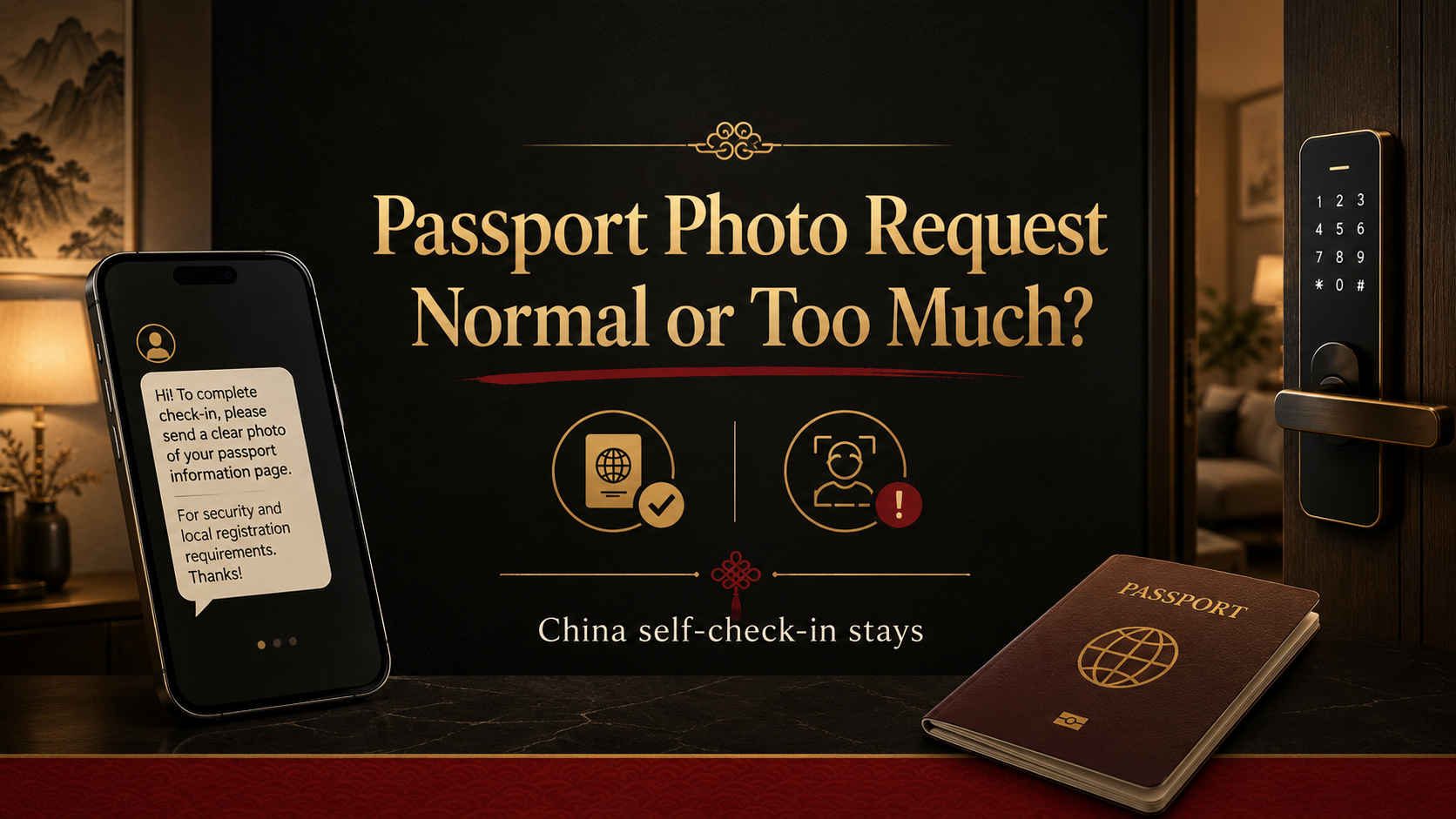
A China self-check-in host may need passport details for guest registration, but a passport-in-hand selfie is more sensitive. Verify the purpose, recipient, data requested, submission channel, and safer alternatives before sending anything.
Quick answer
A China self-check-in host asking for a photo of your passport information page may be part of a real guest-registration process.
An ID selfie or a photo of you holding your passport needs closer checking. It combines your passport details, face, and proof that the document belongs to you. China requires accommodation registration, but there is no single nationwide rule saying every foreign guest must send a passport selfie to a host before arrival.
Before sending anything, confirm:
- who is collecting it;
- why it is needed;
- exactly what they want;
- how you will submit it;
- whether a safer alternative is available.
If the host cannot explain the request clearly, pause before uploading your documents.
Why may a self-check-in property ask for passport details?
Foreign guests staying in Chinese hotels must be registered, and the hotel normally handles that process after checking the guest’s valid passport.
A homestay, apartment, private residence, or another place outside the normal hotel system also has accommodation-registration requirements. The foreign guest or the person providing the accommodation generally needs to complete registration within 24 hours after arrival.
In March 2026, online registration for non-hotel accommodation began as a pilot in Hebei, Liaoning, Zhejiang, Hubei, Guangxi, Chongqing, and Sichuan. Other locations may still use local online or in-person procedures, so the exact process depends on where the property is located.
A self-check-in property has no normal front desk. The host may therefore ask for information before releasing:
- the full unit address;
- building-entry instructions;
- a door code;
- room details;
- other arrival instructions.
That explains why an early passport request can be genuine. It does not prove that every collection method is reasonable or secure.
Passport page versus ID selfie
Passport information page
A passport-page request is more understandable when:
- it comes through the confirmed booking conversation;
- the host account, property, dates, and booking number match;
- the host says it is for foreign-guest accommodation registration;
- the request covers only the people who will actually stay;
- only information relevant to registration is requested;
- the upload method belongs to the platform, an official registration channel, or a property system you can verify.
These are positive signals, not a guarantee.
ID selfie or passport-in-hand photo
An ID selfie is more sensitive because it links:
- your passport information;
- a clear image of your face;
- you personally to that document.
Passport details and facial data are both high-risk personal information. Facial and other biometric information receives stricter protection because it cannot be replaced as easily as a password.
Accommodation registration requires identity verification. It does not automatically justify collecting a passport-in-hand selfie from every foreign guest.
If a host asks for one, ask:
- Why is the passport information page alone not enough?
- Is the image being used for facial recognition?
- Who will receive and store it?
- How long will it be kept?
- Will it be deleted after registration?
- Can you show the original passport on arrival instead?
A vague statement such as “the police require it” is not a complete answer.
Platform verification is a different process
A booking platform may separately ask for a government ID and selfie to verify the account holder.
For example, Airbnb says it may request an ID and selfie for identity verification and that those verification images are not shown to hosts. A host requesting documents after booking is a separate collection process.
Keep these two purposes apart:
- platform verification checks the platform account;
- accommodation registration records the people staying at the property;
- private host collection means the host or property receives the information directly.
Completing platform verification does not always replace local accommodation registration. At the same time, a registration requirement does not give a host unlimited reason to collect extra documents.
Check five things before sending anything
1. Who is asking?
Match the request against:
- the host account inside the booking platform;
- the property name and address;
- the reservation number and dates;
- the public phone number on the listing;
- the domain or name of the upload system.
If a new number contacts you unexpectedly, return to the original booking conversation and ask the host to confirm it there.
2. Why do they need it?
Ask whether the information is for:
- foreign-guest accommodation registration;
- a door lock or building-access system;
- platform identity verification;
- another specific purpose.
“Required for check-in” is too vague when the request includes a facial image.
3. What exactly are they collecting?
Do not treat every document as the same.
The host may ask for:
- the passport information page;
- visa or entry information;
- the passport cover;
- other passport pages;
- a separate selfie;
- a passport-in-hand selfie;
- a phone number or address.
Provide only what is directly needed for the stated process. Do not volunteer every page of your passport.
Each person who will actually stay may need to be registered. The lead guest’s passport does not automatically cover the other travelers.
4. How will you send it?
Prefer, when available:
- an official platform upload;
- the booking platform’s internal message or controlled form;
- a verifiable property-management or registration system;
- showing the original passport on arrival.
A request through WeChat, WhatsApp, or normal email is not automatically fraudulent. It does require more verification because the recipient and storage process may be less clear.
Do not upload through an unknown shortened link, a misspelled domain, or a form whose owner you cannot identify.
5. Is there a safer alternative?
Ask whether you can:
- upload through the booking platform;
- use an official registration link;
- show the original passport on arrival;
- provide only the required registration fields;
- complete non-hotel registration through the available official channel;
- use a purpose-limited watermark.
A possible watermark is:
For accommodation registration at [property name] for stay [dates] only
Ask first. A property system may reject an image if required fields are covered, and a watermark does not remove all risk.
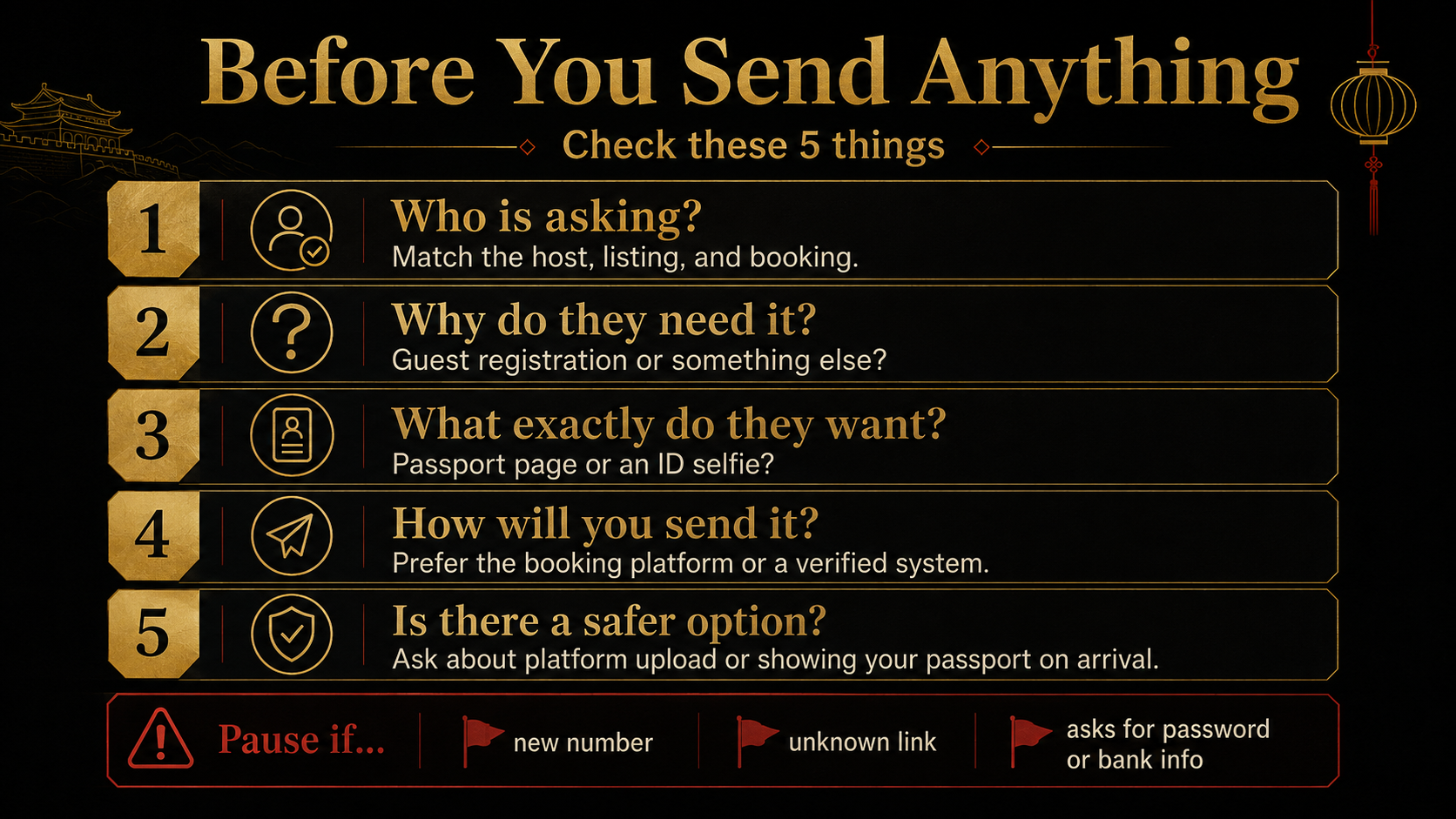
Pause if you see these red flags
Do not keep submitting documents when:
- a new number unrelated to the booking contacts you;
- the host refuses to confirm the request inside the original platform;
- the upload link cannot be verified;
- the host asks for every passport page;
- someone requests bank-card details, passwords, or SMS verification codes;
- documents must be sent to several unrelated private accounts;
- the host will not explain why an ID selfie is necessary;
- the host claims every property in China must use the same selfie process;
- cancellation is threatened while platform support is refused;
- the requested names, dates, property, or guest count do not match the booking.
Contact the booking platform and verify the request through the property’s published contact details.
If the check-in process remains unclear, changing to a property with a normal front desk or a clearer process may be the lower-risk option—especially for a first night, late arrival, or unattended building.
What can you say to the host?
You can send:
I understand that passport details may be needed for guest registration. Can I upload them through the booking platform or an official registration system instead? If an ID selfie is required, please explain why it is needed, who will store it, and whether I can show my original passport on arrival.
This does not refuse registration. It asks the host to explain the process and use a clearer submission method.
What if you already sent the documents?
Sending a passport image does not mean it will definitely be misused.
Take these practical steps:
- save the conversation and upload confirmation;
- record the date, account, and destination used;
- confirm the stated purpose;
- ask whether the files can be deleted when no longer needed;
- watch for unusual login, verification, or payment requests;
- do not provide passwords, full bank-card details, or SMS codes.
If something clearly suspicious happens, contact the booking platform and seek further advice from the authority that issued your passport.
Still carry the original passport
Uploading a photo does not replace the original passport in every situation.
The property may still need to check your identity on arrival. Every person staying should carry their own valid travel document.
For the wider differences between hotels, apartments, and self-check-in stays, see how hotels and self-check-in stays work differently in China.
Also save your self-check-in instructions and booking records offline, including the booking, host messages, entry instructions, address, and backup accommodation.
Bottom line
A request for a passport information page may be a normal part of preparing foreign-guest registration.
A passport-in-hand selfie needs more explanation because it combines identity-document data with a clear facial image.
Judge the request by five questions:
- Is the purpose clear?
- Is the information necessary?
- Can you verify the recipient?
- Is the submission channel credible?
- Is a safer alternative available?
Travelers who want their first-night property, arrival time, public contact details, and check-in process reviewed can have their first-night check-in setup reviewed before departure through the US$69.90 China Arrival Readiness Review.
The service does not accept passport numbers, passport photos, or selfies. It does not decide whether a host is legal or fraudulent, and it cannot guarantee check-in. It only reviews whether the published arrival and check-in preparation is clear and whether a simpler backup stay may be useful.
Information checked: August 6, 2026
Last updated: August 6, 2026. Travel platforms, entry rules, app behavior, prices, and service availability can change. Re-check official sources before departure.
Discussion
Ask a question, share recent experience, or flag information that may be outdated.
0 visible comments
No discussions yet.