
Where to Stay
Who Must Register a Foreign Traveler Staying in a Private Home or Apartment in China?
Learn whether the foreign guest or host must complete China’s 24-hour accommodation registration for private homes, apartments and stays with friends.

Quick Answer: One Person Must Complete the Registration Within 24 Hours
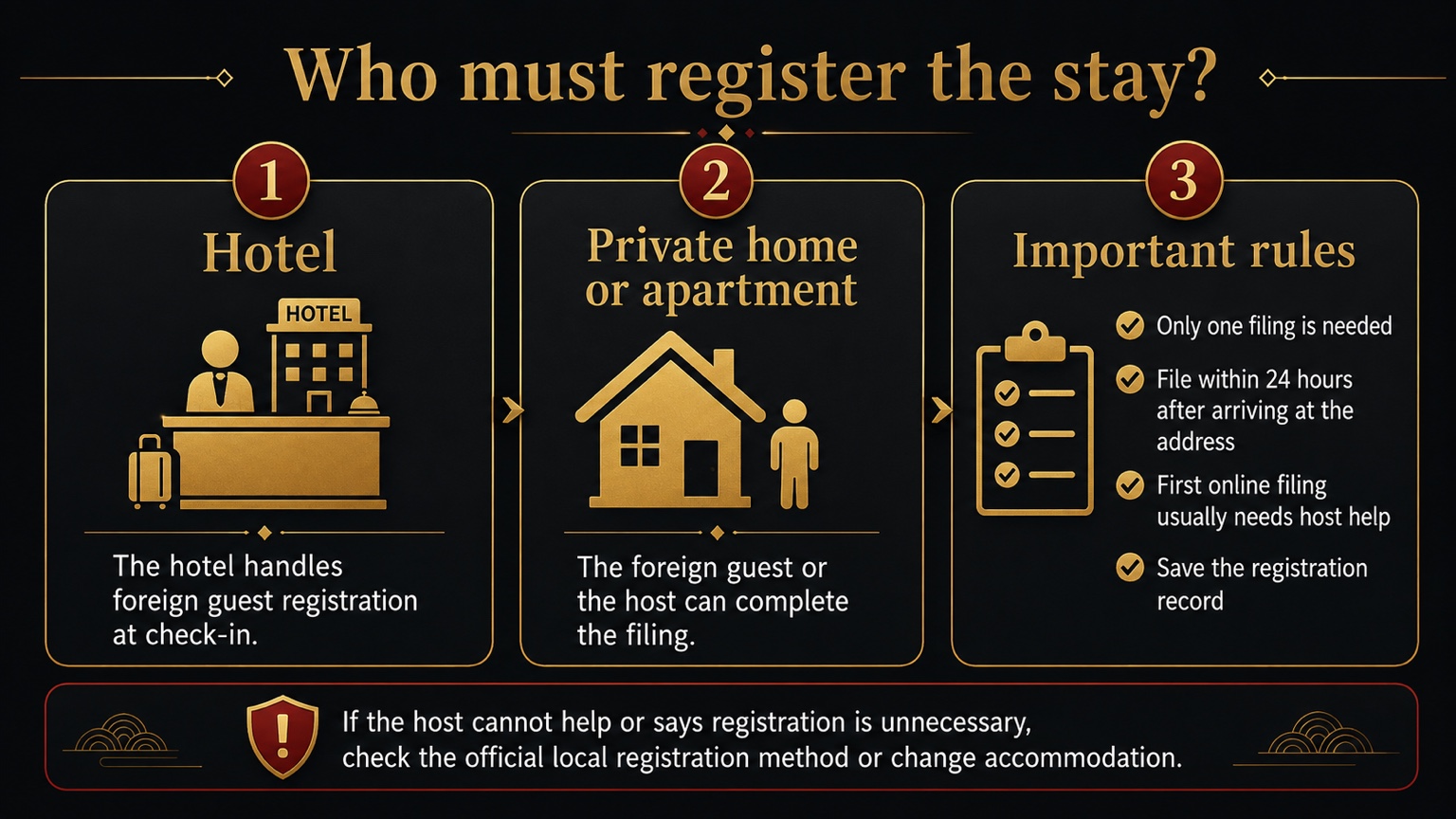
If you stay in a regular hotel in China, the hotel handles the foreign-guest accommodation registration during check-in.
If you stay with a friend, partner, or relative, or in a private home or apartment that does not register guests like a hotel, either you or the person hosting you can file the registration.
You do not both need to submit it. What matters is that one of you actually completes it within 24 hours after you arrive at that address and can show that the record exists.
Before arrival, agree on three things:
- who will file;
- whether the local method is online or in person;
- how you will confirm that the filing was completed.
For a first online filing at a private address, the host will usually need to help because the host is more likely to know the exact property and address details.
Hotel Stay and Private Stay Are Not the Same
A normal hotel has a clear responsibility. It checks the guest's passport, records the stay, and reports the foreign-guest accommodation information through the hotel system.
A private stay works differently.
This includes:
- staying at a friend's or relative's home;
- staying with a partner;
- using a privately rented apartment;
- booking a short-term apartment or homestay without hotel-style registration;
- using a self-check-in property whose registration process is unclear.
The property name does not decide the answer.
A place may call itself a serviced apartment, guesthouse, residence, or homestay. Some operate like hotels and register foreign guests at check-in. Others only send a door code or key instructions and expect the guest or host to handle the private-address registration.
A booking confirmation is not proof that the registration has been filed. Uploading a passport to a booking platform, sending it to the host, completing a building visitor form, or using a real-name smart lock is also not the same as the official accommodation registration.
Before booking an apartment or self-check-in stay, ask:
Do you register foreign guests with the local public security authority?
And:
Will you complete the accommodation registration after I check in?
“Foreign guests can stay here” is not a complete answer. You need to know who will file and how you will confirm it.
For a first night, especially after a late flight, a regular hotel with a staffed front desk is often easier. The wider accommodation guide can help you choose a lower-friction first-night stay in China.
Either the Guest or the Host Can File
For a private address, the foreign guest or the person providing the accommodation can complete the filing.
The host may be:
- a Chinese friend or relative;
- a foreign friend living in China;
- a partner;
- a landlord;
- the person operating the apartment or homestay.
Only one filing is required for that stay.
A simple arrangement is:
- the host provides the property and address information;
- one person submits the registration;
- both keep a copy of the completed record.
The 24-hour period begins when the traveler arrives and starts staying at that address. It does not begin after the traveler has already stayed for 24 hours.
Visa-free entry does not remove this requirement. A short stay of one or two nights does not remove it either.
If you move from one private address to another, the new address may require a new registration because the record follows the place where you are actually staying.
The exact documents can vary by location. A valid passport and accurate address are basic, while local authorities may also ask for host, lease, or property information.
Use the National Online Service Only Where It Is Available
Starting March 20, 2026, the National Immigration Administration began a pilot online service for non-hotel accommodation registration in seven provincial-level regions:
- Hebei;
- Liaoning;
- Zhejiang;
- Hubei;
- Guangxi;
- Chongqing;
- Sichuan.
In those pilot regions, the foreign guest or host can use:
- the National Immigration Administration government service website;
- the NIA 12367 app;
- the NIA 12367 WeChat mini program;
- the NIA 12367 Alipay mini program.
An online filing has the same legal effect as an in-person filing.
For the first online registration at a private address, the host should usually assist. The official guidance explains that the host is normally more familiar with the property information.
A guest may be able to file independently in specific situations, such as returning to the same address previously registered through the platform or staying in a home owned by the guest or the guest's spouse.
The seven-region pilot is not a single nationwide service. As of the information check date, the national authority had said it would expand the system gradually, but had not announced full nationwide coverage.
Outside those pilot areas:
- check whether the local city or province has its own official online channel;
- ask the local public security office or police station responsible for the address;
- have the host provide the property information required locally.
The NIA 12367 service can provide consultation, including English support, but asking for advice does not complete the registration.
Ask Before Arrival and Save the Completed Record
For a stay with friends or relatives, confirm:
- the full Chinese address;
- the district and local area;
- who will file;
- whether the host can provide the property details;
- whether the address uses the national pilot service, a local system, or an in-person process;
- when the filing will be completed if you arrive late.
For a private apartment or homestay, ask:
- Do you register foreign guests like a hotel?
- If not, who handles the private-address filing?
- Can you provide the property documents or details needed?
- Will I need to visit a local police station?
- Can you send me the completed record?
After filing, check that:
- your name and passport information are correct;
- the address is correct;
- the arrival date is correct;
- the submission is completed rather than waiting for more information.
For an online filing, save the confirmation page or record screenshot. For an in-person filing, keep whatever receipt or confirmation the local office provides.
There is no need to insist on one national paper format. The useful result is a clear, completed record for the correct guest and address.
If the host says, “I handled it,” ask for the confirmation screen or record.
If the Host Will Not Help, Do Not Rely on a Verbal Promise
A host may say:
- “You are visa-free, so you do not need it.”
- “You are only staying for two nights.”
- “The platform already has your passport.”
- “Nobody registers guests here.”
None of those statements proves that the accommodation registration has been completed.
First check the official method for the address. Call 12367, use the official platform in a pilot region, or contact the local police station or public security office.
If the local process requires property details and the host refuses to provide them, the stay may be difficult to register properly.
The practical choices are:
- use a different host who will cooperate;
- choose an apartment that clearly handles foreign-guest registration;
- stay in a regular hotel with a staffed front desk.
Do not keep a private booking only because it is cheap or well located if the host cannot explain the registration process.
Failure to complete the required registration may lead to a warning and a fine of up to RMB 2,000. The useful response is not to argue with the host. It is to complete the filing or move to accommodation where the process is clear.
Remember:
Hotel stay: the hotel registers you. Private stay: the guest or host completes one filing. The stay is ready only when the registration can be confirmed.
Last updated: August 3, 2026. Travel platforms, entry rules, app behavior, prices, and service availability can change. Re-check official sources before departure.
Discussion
Ask a question, share recent experience, or flag information that may be outdated.
0 visible comments
No discussions yet.