Hotels & Accommodation
Where Should You Stay in China? A Practical Guide to Booking and Check-In
Planning a trip to China? Learn how to choose accommodation, confirm passport check-in, handle late arrival, deposits, hotel addresses and first-night backup plans.

Quick Answer
A confirmed hotel booking is only the first step. For a smooth first trip to China, you also need to make sure you can find the property, check in with your passport, arrive after hours if needed, pay the room charge or deposit, and reach a real person if something goes wrong.
This is especially important for your first night. After a long flight or train ride, you may be tired, carrying luggage, still testing your mobile payment setup, and trying to use a map or ride-hailing app in a new country. Your first-night hotel should be easy to reach, easy to confirm, and easy to enter.
The goal is not to overthink accommodation. The goal is to make sure “booking confirmed” turns into “checked in and inside the room.”
Booking Confirmed Is Only the First Step
When a booking platform or hotel shows “confirmed,” it usually means an order has been created. That is useful, but it does not automatically solve every real-world check-in step.
A confirmed booking does not always prove that:
- you are going to the correct branch or entrance;
- the front desk knows you will arrive after midnight;
- every guest’s name matches their passport clearly;
- the property has a person on site when you arrive;
- the room payment and deposit method will work for you;
- a homestay or apartment host has already sent key or door-code details;
- your driver can find the correct Chinese address;
- you have a nearby backup if the first plan fails.
This does not mean you should panic about Chinese hotels. It means hotel preparation should cover the full path: booking, location, arrival time, passport registration, payment, and backup.
What Types of Accommodation Can Travelers Choose in China?
China has many accommodation styles. For a first trip, the question is not “which one is best?” The better question is: which one gives you the smoothest check-in for your situation?
Regular hotels
Regular hotels are usually the easiest choice for first-time visitors, first-night stays, late arrivals, and trips with luggage.
They are more likely to have a staffed front desk, clearer check-in hours, better address information, and someone who can help if your room, payment, or booking needs attention.
If you are arriving in China for the first time, a normal hotel with a real front desk is often the lowest-friction choice.
Hostels
Hostels can work well for budget travelers, backpackers, and solo travelers who are comfortable with simpler facilities.
Before booking, check the room type, shared or private bathroom, front-desk hours, late-arrival rules, luggage storage, and whether the property clearly handles passport check-in.
Hostels can be friendly and practical, but they are not all the same. The arrival process matters as much as the price.
Guesthouses and homestays
Guesthouses and homestays are common in ancient towns, villages, scenic areas, smaller cities, and more local neighborhoods.
They can offer a better sense of place, but they may also require more communication before arrival. The host may need to explain the entrance, pickup point, key process, or check-in arrangement.
For the first night after an international flight, a guesthouse can be fine if the process is clear. If you arrive late, tired, or without stable internet, it may be less forgiving than a regular hotel.
Serviced apartments and self-check-in stays
Serviced apartments can be useful for longer stays, families, or travelers who want laundry, kitchen space, or more room.
Self-check-in accommodation needs extra care. You may need to submit information before arrival, contact the host online, receive a door code, pick up a key from another location, or find a specific building entrance without front-desk help.
If this is your first night in China, avoid making the process too clever. Simple is often better.
What Should You Check Before Booking?
Do not judge a China hotel only by price, room photos, or a map pin.
Before booking, check the details that affect whether you can actually arrive and enter smoothly:
- recent guest reviews;
- exact location;
- distance to the nearest metro station, airport link, rail station, or taxi pickup point;
- whether the front desk is open 24 hours;
- late-arrival policy;
- cancellation policy;
- whether the booking is prepaid or pay-at-property;
- whether a deposit may be required;
- room type and bed type;
- whether the room has a window;
- smoking or non-smoking room information;
- private bathroom;
- elevator availability;
- luggage storage;
- hotel contact method.
You do not need to read every facility line like a dictionary. Focus on the items that could affect arrival, check-in, payment, and the first night.
For example, a hotel that is slightly more expensive but has a 24-hour front desk, clear Chinese address, and easy airport access may be a better first-night choice than a cheaper property with unclear check-in instructions.
Can Travelers Check In With a Foreign Passport?
For normal hotel stays, foreign travelers should expect to present a valid passport at check-in. China’s official guidance states that foreigners staying in hotels can complete accommodation registration through the hotel by presenting a valid passport or other international travel document, and China’s Exit and Entry Administration Law requires hotels to register foreigners’ accommodation information and submit it to the local public security organs.
In plain language, do not treat passport check-in as a small detail. It is part of the official lodging process.
Before arrival:
- carry your original passport, not only a photo;
- book under the same name used in your passport;
- keep all travelers’ passports ready if several people are staying;
- contact the property if your name order, spelling, or booking details may be confusing;
- confirm the process if the stay is a guesthouse, homestay, apartment, or self-check-in property.
Do not assume a phone photo of your passport can replace the original document. Do not assume every accommodation type handles foreign-guest registration in exactly the same way. Hotels, serviced apartments, homestays, and self-check-in stays can have different procedures.
Official information also distinguishes hotels from non-hotel lodging. When foreigners stay somewhere other than a hotel, accommodation registration may need to be handled through local public security channels or other official registration methods. For travelers, this is one reason to be more careful with private apartments and informal stays.
Why Your First-Night Hotel Matters More Than the Rest
Your first-night hotel is not just a place to sleep. It is your safe landing point.
On your first day in China, you may be dealing with:
- a long flight;
- immigration and baggage time;
- mobile data just starting to work;
- payment apps not fully tested;
- unfamiliar maps;
- luggage;
- language pressure;
- a delayed arrival;
- a late-night ride from the airport or rail station.
This is not the best moment to test a complicated self-check-in apartment, a hard-to-find homestay, or the cheapest property at the edge of the city.
For the first night, choose practical over impressive.
A good first-night hotel should be:
- easy to reach from the airport or high-speed rail station;
- clear on the map;
- listed with a Chinese name and full Chinese address;
- staffed 24 hours, or clearly confirmed for late arrival;
- reachable by phone or platform message;
- simple enough to check into with luggage;
- clear about room payment and deposit methods;
- close to basic services such as convenience stores or simple food.
The first night is not the time to maximize scenery, trendiness, or savings. It is the time to reduce friction.
How Should You Judge the Hotel Location?
Do not only look at “distance from city center.” That number can be misleading.
Instead, ask practical questions:
- How far is it from the nearest metro station?
- Can you walk that distance with luggage?
- How many transfers are needed from the airport or rail station?
- Will public transport still run if you arrive late?
- Is it easy to call a Didi or taxi there?
- Is the entrance on a main road, inside a mall, down a small lane, or in an apartment building?
- Are there several branches with similar names?
- Does the map pin point to the real entrance or just the general building?
Before you fly, save:
- hotel English name;
- hotel Chinese name;
- complete Chinese address;
- hotel phone number;
- booking confirmation;
- map screenshot;
- entrance or exterior photo if the booking page shows one clearly.
The Chinese name and address are not just “extra information.” They can help drivers, hotel staff, station workers, and local people understand where you are going.
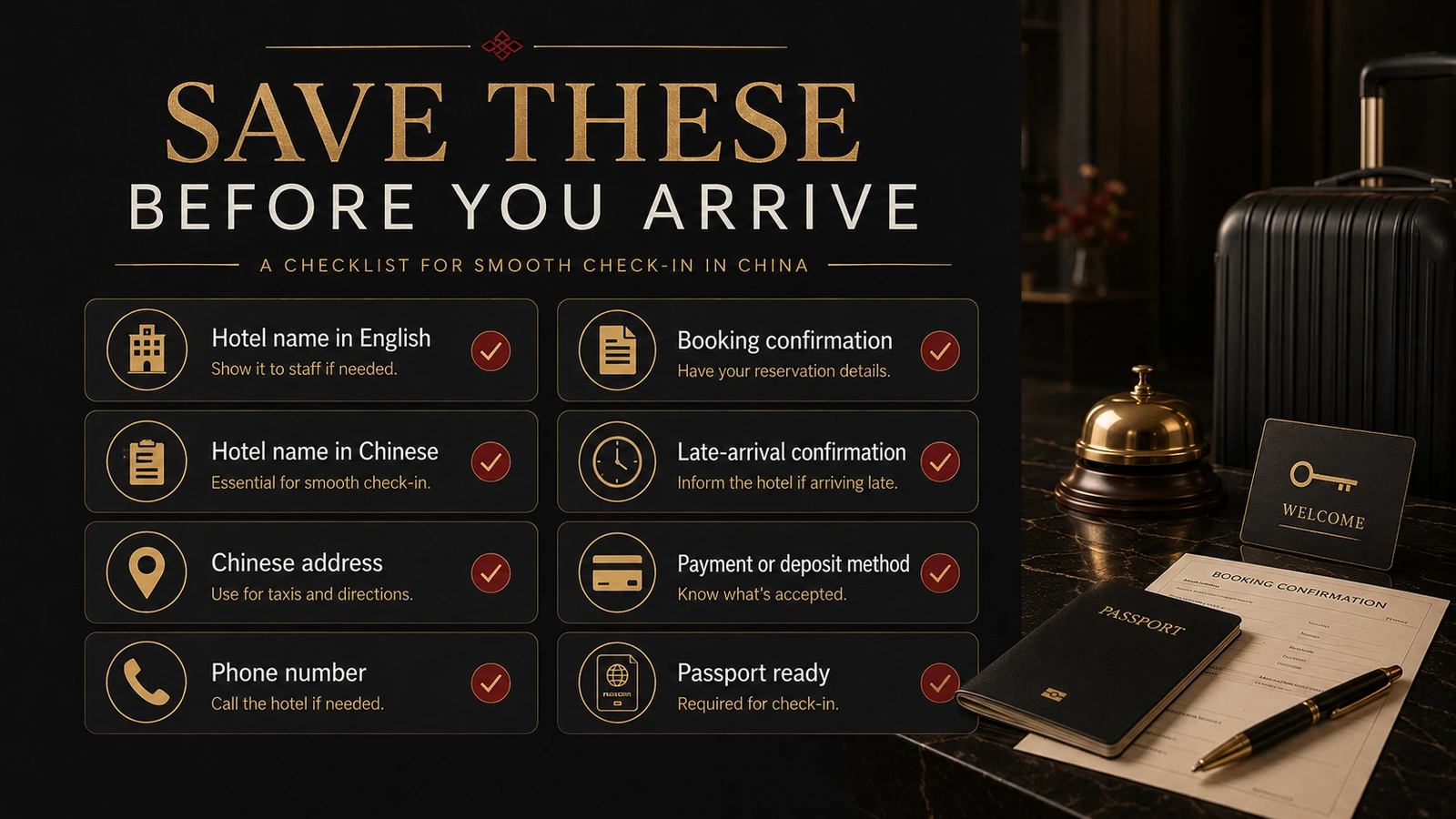
Save the details that help you reach the hotel and complete check-in, not just the booking number.
What Should You Do If You Arrive Late?
Late arrival is common. Flights are delayed, immigration takes time, baggage can be slow, and trains may get in after dark.
Do not assume a booking note is enough for an important late arrival.
Before departure, especially for your first night:
- tell the property your expected arrival time;
- confirm whether the front desk is staffed 24 hours;
- ask whether the room will be held after midnight;
- save the hotel phone number;
- save the booking-platform customer support entry;
- provide your flight or train number if the property requests it;
- keep the hotel’s written confirmation if possible.
This matters even more for guesthouses, homestays, serviced apartments, and self-check-in stays. Those properties may require advance contact, door codes, key pickup, or staff scheduling.
If you expect to arrive after midnight, a regular hotel with a 24-hour front desk is often the safer first-night choice.
How Do Hotel Payments and Deposits Work?
Hotel payment can involve several different things. Do not mix them together.
Online prepaid booking
You may have already paid the room charge through the platform. Even then, the hotel may still need identity check-in and may still ask for a deposit.
Pay at the property
You may reserve online but pay the room charge when you arrive. In that case, check which payment methods the property accepts.
Room charge
This is the cost of the stay itself.
Security deposit
A deposit is separate from the room charge. It may cover room damage, minibar use, unpaid items, or other incidental charges.
Card pre-authorization
Some hotels may temporarily hold an amount on a card rather than charging it immediately. Release timing can depend on the hotel and card issuer.
Additional hotel spending
Breakfast, laundry, minibar, late checkout, or other services may be charged separately.
Do not assume one payment method works for every part of the hotel transaction. A hotel might accept one method for the room charge and another for the deposit. A foreign card may work at some hotels but not all. Mobile payment, cash, and physical cards can all depend on the specific hotel, transaction type, and account or card setup.
Do not rely on a single payment path for your first night.
Hotels, Guesthouses, and Self-Check-In Stays Are Not the Same
A regular hotel usually has a front desk, a predictable check-in process, and a person who can help when something goes wrong.
A guesthouse, homestay, serviced apartment, or self-check-in stay may work differently.
It may require:
- sending information before arrival;
- contacting a host online;
- receiving a door code;
- collecting a key or card from another location;
- finding a unit inside a residential or mixed-use building;
- using a specific phone number or messaging tool;
- completing registration without normal hotel-front-desk support.
These stays can be good, but they are not always ideal for every situation.
Be more cautious if:
- it is your first night in China;
- you arrive late;
- you travel alone;
- your Chinese is limited;
- your mobile network is not stable yet;
- your payment setup is untested;
- you have heavy luggage.
A complicated check-in can feel charming at 3 p.m. and terrible at 1 a.m.
What If the Hotel Cannot Check You In?
If you arrive and check-in does not work, do not start by arguing for an hour in the lobby or on the street.
Use a calm sequence.
First, confirm you are at the correct branch, building, floor, and entrance. Many hotels, apartment hotels, and chain properties have similar names or multiple locations.
Second, show your booking confirmation, passport, and any message from the property.
Third, contact the front desk or the number listed on the booking page.
Fourth, contact the booking platform’s customer support.
Fifth, save evidence: messages, screenshots, payment records, names, and photos of relevant signs if useful.
If it is late at night and you are still not getting into a room, switch priorities. Find a nearby regular hotel with a front desk that can take you in. Get yourself and your luggage settled first. Refunds, responsibility, and complaints can be handled after you are safe indoors.
The rule is simple: solve the night first, then solve the dispute.
A Minimum Accommodation Checklist Before Traveling to China
Before you leave for China, make sure you have:
- booked an easy-to-reach first-night hotel;
- confirmed passport check-in if anything looks unclear;
- told the property if you will arrive late;
- saved the hotel’s Chinese name and full Chinese address;
- saved the phone number and booking confirmation;
- checked whether you prepaid or need to pay at the property;
- checked whether a deposit may be required;
- confirmed the front-desk or self-check-in process;
- saved screenshots in case your app or network is slow;
- identified one nearby backup property for the first night.
This checklist is not about fear. It is about reducing the number of things you must figure out while tired, offline, or standing outside with luggage.
Bottom Line
China accommodation is manageable for first-time travelers, but “booking confirmed” is not the same as “everything is ready.”
Before arrival, make sure you can find the hotel, check in with your passport, handle late arrival, pay the room charge or deposit, and use a backup plan if something fails.
For the first night, choose simple and reliable over complicated and impressive. A clear address, staffed front desk, confirmed late arrival, and realistic payment plan are worth more than saving a small amount of money.
Once you are checked in and rested, you can handle the rest of the trip with much more confidence.
Frequently Asked Questions
Can foreign travelers check in to hotels in China with a passport?
For normal hotel stays, travelers should expect to present a valid passport at check-in. Hotels are responsible for registering foreign guests’ accommodation information with local public security authorities. Carry the original passport rather than relying on a photo.
Does a confirmed booking guarantee check-in?
Not by itself. A confirmed booking usually means the reservation was created, but you still need to reach the right property, meet check-in requirements, handle payment or deposit if required, and arrive when the property can receive you.
Should I choose a hotel or homestay for my first night in China?
For a first night, especially after a long flight or late arrival, a regular hotel with a front desk is usually simpler. Homestays and self-check-in apartments can be fine, but they often require more communication and clearer arrival instructions.
What hotel information should I save before arrival?
Save the English name, Chinese name, full Chinese address, phone number, booking confirmation, late-arrival confirmation, payment or deposit notes, and map screenshot. The Chinese address is especially useful for taxi and ride-hailing situations.
What should I do if I arrive late and cannot check in?
First confirm you are at the correct property, then contact the hotel and booking platform. If it is late and the problem is not solved quickly, prioritize finding a nearby staffed hotel for the night. Handle refunds or complaints after you and your luggage are safely inside.
Last updated: July 16, 2026. Travel platforms, entry rules, app behavior, prices, and service availability can change. Re-check official sources before departure.
Discussion
Ask a question, share recent experience, or flag information that may be outdated.
0 visible comments
No discussions yet.