Cash & Cards
Can I Use Cash in China, or Do I Need WeChat Pay?
Cash still works in China, but mobile payment is usually more convenient. Learn whether you need WeChat Pay, when cash is useful and what payment backups to prepare.
Quick Answer
Yes, you can use RMB cash in China, and no, you do not specifically have to use WeChat Pay.
But relying only on cash is not the most convenient plan for an independent trip.
In everyday life here, Alipay and WeChat Pay are the two payment methods people reach for most often. At a convenience store, restaurant, café, supermarket, or shopping centre, opening a payment code is usually the normal, quickest way to check out.
Cash has not disappeared. It is still useful, especially when your phone is out of power, your network is temporarily weak, or you simply want to finish a small purchase without troubleshooting an app.
For most tourists, the practical setup is:
Use Alipay as your main mobile-payment option, prepare WeChat Pay as a second option if possible, carry some small RMB notes, and bring a physical bank card as another backup.
This is not a choice between cash and WeChat Pay. They do different jobs.
What Does Paying in China Look Like Today?
For most everyday purchases, local people use Alipay or WeChat Pay.
The normal checkout flow is usually one of these:
- you open a payment code and the cashier scans it;
- you scan the merchant’s code and confirm the amount or order.
You will see this in convenience stores, supermarkets, restaurants, cafés, shopping centres, taxis, and many small local businesses.
That does not mean cash is strange or unusable. It means most checkout counters are now used to customers paying by phone.
A simple way to understand the roles is:
- Alipay and WeChat Pay: normal everyday spending;
- RMB cash: useful backup and simple face-to-face payments;
- physical bank card: more useful at hotels, airports, larger shops, and merchants that support international cards.
As a visitor, you do not need to copy every local habit. But knowing what normally happens at the counter makes the trip easier.
Can Tourists Still Use Cash in China?
Yes.
You can still pay with RMB notes and coins in many face-to-face situations.
Cash may work for:
- buying water at a convenience store;
- paying at a staffed restaurant or small shop;
- paying a taxi driver who accepts cash;
- buying a ticket at a staffed counter;
- handling a small purchase when mobile payment is temporarily inconvenient.
You do not need to worry that every RMB note in your wallet will be useless.
The practical issue is not whether cash exists. It is whether cash is the easiest option in that particular situation.
A small merchant may not have much change ready. A self-service machine may not have a cash slot. A restaurant may expect customers to order through a phone before they pay.
That is why small RMB notes are more useful than carrying only large notes.
If you are buying one bottle of water, handing over a large note may create an unnecessary change problem. The shop is not necessarily refusing cash; the cashier may simply not have enough small notes in the till.
Is Cash a Good Main Payment Method for a China Trip?
Cash is useful, but it is not the best only payment method for most independent travelers.
The reason is not that cash cannot buy things.
The reason is that many travel services now start on the phone before you reach the payment step.
At a normal shop counter, the process is simple:
- choose the item;
- hear the price;
- pay.
If the merchant takes cash, cash completes the whole transaction.
But many other situations have more steps.
You may need to locate yourself, search for a destination, create an order, enter passport details, reserve a time slot, contact a driver, or retrieve a digital ticket.
Cash can sometimes cover the final amount, but it cannot complete those earlier steps for you.
So the more accurate answer is:
Cash can cover many simple payments, but cash alone gives an independent traveler fewer options.
Do You Really Need WeChat Pay?
No, you do not specifically need WeChat Pay if Alipay is already working for you.
Alipay and WeChat Pay are both normal, widely used mobile-payment tools in China. A visitor does not have to choose WeChat Pay as the one compulsory app.
For many short-term travelers, a working Alipay account can handle a large share of ordinary merchant payments:
- convenience stores;
- restaurants;
- cafés;
- shopping centres;
- taxis;
- attraction shops;
- some transport and app-based services.
The more useful rule is:
Prepare at least one of the two. Prepare both if it is easy for you.
Alipay can be your main option. WeChat Pay can give you another route.
Is Alipay Enough Without WeChat Pay?
For many tourists, yes.
If Alipay is set up properly and can complete normal merchant payments, you can use it as your everyday payment tool.
You do not need to worry that a trip becomes impossible just because WeChat Pay is not ready.
Still, WeChat Pay is useful to have for a few reasons:
- some restaurants and services operate through WeChat Mini Programs;
- a merchant or staff member may find the WeChat route easier to explain;
- you have another app if Alipay temporarily asks for a check;
- you are not placing all mobile-payment access in one account.
But WeChat Pay is not a magic rescue button.
If both apps use the same bank card and the bank is blocking the transaction, switching apps may not immediately solve it. If your phone is dead or offline, neither app can help.
That is why the full setup still includes cash and a physical card.
When Is Cash Genuinely Useful?
Cash is most valuable when it helps you finish a simple transaction without wasting time.
When your phone has no power
This is the clearest example.
Alipay and WeChat Pay may be fully set up, but neither one helps when the phone is off.
A few RMB notes let you buy a drink, a simple meal, or pay another small expense while you charge the phone.
A power bank is therefore part of your payment preparation, not just a phone accessory.
When the network is temporarily weak
You may occasionally find weak data coverage underground, inside a large building, or in a more remote area.
If the merchant accepts cash, paying directly is easier than repeatedly refreshing the app.
When the payment app needs attention
Sometimes an app may ask you to log in again, confirm something, or complete a bank check.
That does not mean the account is seriously broken.
It simply means the checkout counter is not the best place to investigate it.
Use cash or another available method, finish the purchase, and look at the message afterward.
When one bank-card transaction does not go through
A bank may pause or decline one transaction for its own checks.
That does not mean every later payment will fail.
If the current merchant accepts cash, use it and continue with the day.
In a normal street taxi
A normal taxi and Didi are not the same thing.
Didi requires a phone to create the ride. A street taxi may accept mobile payment or RMB cash, depending on the vehicle and local practice.
When taking a normal taxi, keep these ready:
- your destination in Chinese;
- mobile payment;
- some RMB cash.
That gives you more than one way to finish the ride.
At a staffed ticket counter
Some transport stations and attractions have staffed counters where cash may be accepted.
Do not assume every machine or counter works the same way. Check the sign or ask the staff.
For a quick, small purchase
Cash is good for simple things:
- a bottle of water;
- a snack;
- a small local purchase;
- a short taxi fare when cash is accepted.
You do not need to carry a large amount to get this benefit.
When Is Mobile Payment More Convenient?
Convenience stores and supermarkets
Mobile payment is normally the quickest option.
Open Alipay or WeChat Pay, show the code, and the cashier scans it.
Cash may still work, but mobile payment avoids the change problem and matches the checkout routine staff use all day.
Restaurants and cafés
At a staffed counter, mobile payment is usually easy.
Some restaurants also use table QR codes for ordering. In those places, the phone may be needed to open the menu, choose dishes, and submit the order—not just to pay.
If you cannot use the QR ordering flow, ask the staff whether they can take the order directly. You do not need to panic just because a QR code is on the table.
Small local shops
Many small shops are comfortable with Alipay and WeChat Pay even when they do not have a card terminal that accepts your foreign physical card.
Cash can be a backup, especially if you have small notes.
Hotel front desks
Hotels are different from ordinary shops.
Your room may be prepaid, paid at check-in, or paid through a booking platform. The deposit may be handled separately.
Depending on the property, the hotel may take:
- Alipay;
- WeChat Pay;
- a physical bank card;
- RMB cash.
Do not assume the method used for the online booking will automatically cover every front-desk charge.
Didi
Didi is a digital service before it is a payment method.
The phone is used to:
- confirm your location;
- enter the destination;
- choose a vehicle;
- match with a driver;
- see the car and plate number;
- contact the driver;
- view the order.
Cash cannot replace these steps.
If you do not want to use Didi, or the app is inconvenient at that moment, take a normal taxi instead.
Metro and buses
Transport payment is not identical in every Chinese city.
Depending on the city, you may use:
- a single-journey ticket;
- a transport card;
- an Alipay or WeChat transport code;
- a local transport app;
- a ticket machine;
- a staffed service counter.
You do not need to learn every Chinese city’s system before the trip. Check the local method when you arrive.
Tourist attractions and tickets
Some attractions sell tickets at the entrance. Others require advance booking, a selected time, passport information, or a digital confirmation.
Cash may work at a staffed ticket window, but it cannot guarantee that you can skip the reservation process.
Cash Can Pay the Bill, but It Cannot Create the Service
This is the most important distinction.
The final payment
At the end of a transaction, you may be able to:
- hand over cash;
- scan a payment code;
- use a card.
The digital steps before payment
Before reaching that point, you may need to:
- log in;
- use location services;
- search for a destination;
- select a service;
- enter passport details;
- book a time;
- contact a driver;
- retrieve an electronic ticket;
- confirm an order.
Cash mainly helps with the first part.
Your phone often handles the second part.
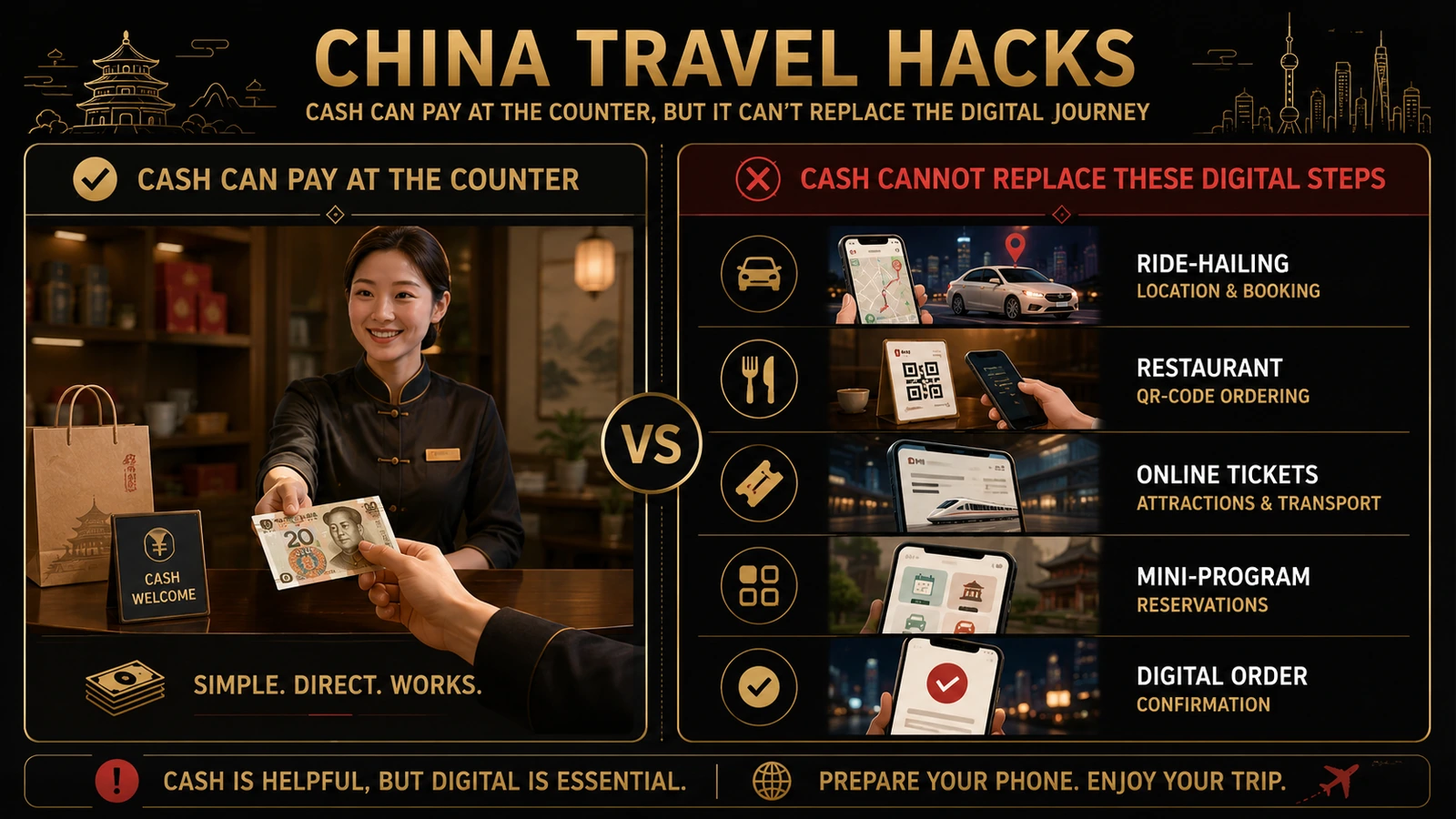
Cash is useful at the counter. It cannot replace every step that happens before you reach the counter.
So when someone says, “Cash still works in China,” that is true.
But it does not mean you can travel independently without preparing your phone and at least one mobile-payment app.
What Is the Most Practical Payment Setup?
You do not need ten different payment products.
For most short trips, this four-layer setup is enough.
1. Main mobile-payment option
Set up at least one before departure:
- Alipay; or
- WeChat Pay.
For many overseas travelers, Alipay is a practical main choice.
Make sure you can:
- log in;
- see the linked bank card;
- open the payment code;
- find the Scan button.
For the broader payment overview, see what payment methods tourists can use in China.
2. Second mobile-payment option
If possible, prepare the other app too.
You do not need to switch between them all day. Use your main app normally and keep the second one for situations where it is more convenient.
3. Cash backup
Carry some RMB in smaller notes.
Use it for:
- a dead phone;
- weak data;
- a small face-to-face payment;
- a normal taxi or staffed counter where cash is accepted;
- a transaction you want to finish before checking the app.
Do not carry more cash than you are comfortable protecting, and do not keep all of it in one place.
4. Physical-card backup
Bring at least one physical card enabled for overseas use.
A second card from another bank is useful when available.
Physical international cards are often more useful at hotels, airports, larger shopping centres, and some chain merchants. Do not assume every small local shop can accept them directly.
Your phone setup matters too
Also prepare:
- working mobile data;
- enough battery;
- a power bank;
- access to the phone number used for verification;
- your bank app;
- your bank’s contact details.
A mobile-payment setup depends on the phone and network around it.
What Should You Do If Mobile Payment Does Not Go Through?
Do not treat one failed payment as proof that the whole setup is unusable.
At the counter:
- Read the message once.
- Check which bank card is selected.
- Try another linked card.
- Switch between Alipay and WeChat Pay.
- Use RMB cash.
- Ask whether a physical card is accepted.
- Finish the current purchase, ride, or hotel payment.
- Check the app or bank message when you are no longer holding up the transaction.
For example, if Alipay does not complete a convenience-store payment, use WeChat Pay or cash.
Buy the water first. Look at the bank app after you step away from the counter.
Most of the time, this is simply one payment route that needs attention—not a sign that the rest of the trip will be difficult.
For deeper troubleshooting, see why a foreign card can be linked but still fail to pay.
Which Method Usually Makes Sense in Each Situation?
| Travel situation | Usually more convenient | Useful backup |
|---|---|---|
| Convenience store | Alipay or WeChat Pay | Small RMB notes |
| Restaurant | Mobile payment | Cash or a supported card |
| Small local shop | Mobile payment | Small-denomination cash |
| Hotel | Mobile payment or physical card | Cash, depending on hotel policy |
| Normal taxi | Mobile payment or cash | Another on-site payment method |
| Didi | In-app payment | Switch payment route or take a taxi |
| Metro | Local transport code or ticketing method | Single-journey ticket where available |
| Tourist attraction | Online order or ticket counter | Depends on the attraction |
| QR-code ordering | Mobile ordering and payment | Ask whether staff can take the order |
These are common patterns, not guarantees for every city, merchant, transport system, or platform.
Bottom Line
You can use RMB cash in China, and you do not specifically have to use WeChat Pay.
If Alipay is ready and working, it can be your main everyday payment method.
If possible, prepare WeChat Pay too, so you have a second mobile route.
Keep cash for the moments when it is genuinely helpful:
- your phone has no power;
- data is temporarily weak;
- the app needs attention;
- you need to finish a simple face-to-face payment;
- a normal taxi or staffed counter accepts cash.
The most practical setup is not “cash or WeChat Pay.”
It is:
Alipay for most everyday spending, WeChat Pay as a second option, and RMB cash plus a physical bank card as backups.
That matches how payment works in daily life here without making your trip dependent on one app, one card, or one phone-only plan.
Frequently Asked Questions
Is cash still accepted in China?
Yes. RMB cash can still be used for many face-to-face purchases. Small notes are more practical than carrying only large notes because a small merchant may not have much change ready.
Do tourists have to use WeChat Pay in China?
No. A working Alipay account can cover a large share of everyday merchant payments. WeChat Pay is useful as a second option, but it is not compulsory.
Is Alipay enough for a trip to China?
For many short-term tourists, Alipay can work as the main mobile-payment tool. Preparing WeChat Pay, cash, and a physical card gives you more flexibility.
When is cash most useful?
Cash is most useful when your phone has no power, the network is temporarily weak, the payment app needs attention, or you want to complete a simple face-to-face purchase quickly.
What should I do if both Alipay and WeChat Pay do not work?
Try another bank card, use RMB cash, or ask whether the merchant accepts a physical card. Finish the immediate purchase or ride first, then check the phone, account, or bank message afterward.
Last updated: July 26, 2026. Travel platforms, entry rules, app behavior, prices, and service availability can change. Re-check official sources before departure.
Discussion
Ask a question, share recent experience, or flag information that may be outdated.
0 visible comments
No discussions yet.