
eSIM
Can I Travel in China Without Alipay If I Have Data Roaming?
You can visit China without Alipay, but roaming data only keeps your phone online. Prepare both mobile-payment apps, cash, cards and a first-night backup.
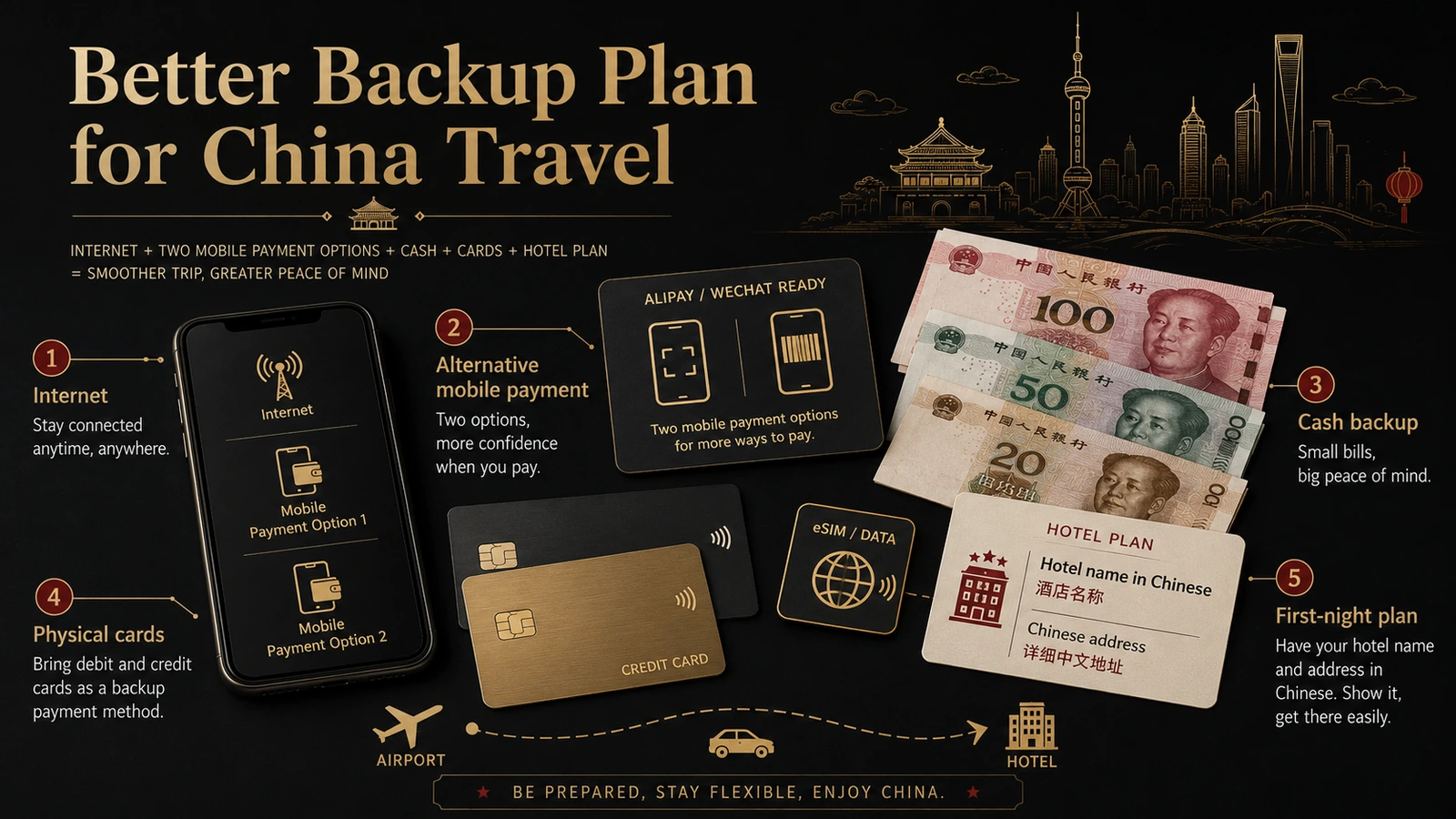
Quick Answer
Yes, you can travel in China without Alipay. But data roaming alone is not enough.
Roaming data keeps your phone online. It helps you open maps, translation tools, hotel messages, Didi, bank apps, and payment apps. It does not give you a working payment account.
China now runs heavily on mobile payment. In everyday life, Alipay and WeChat Pay are the two options people use most naturally at convenience stores, restaurants, cafés, shopping centers, taxis, and small local businesses.
The best preparation is not to depend on only one app. Set up both Alipay and WeChat Pay if possible, then carry some RMB cash and one or two physical bank cards as backups.
Data roaming gets your phone online. Alipay and WeChat Pay handle everyday payments. Cash and physical cards give you another route when you need one.
China Is Already a Mobile-Payment Country
If you live in a card-first country, it is easy to assume that a working Visa or Mastercard will cover most purchases once your phone has internet.
That is not how daily payment normally feels in China.
At a convenience store, customers usually open an Alipay or WeChat Pay code and let the cashier scan it. At a small restaurant, the table may have a QR code for ordering. At a local shop, the owner may have two payment codes on the counter but no card terminal that accepts an overseas card.
Cash still works. Physical cards are useful in hotels, airports, large shopping centers, and merchants with suitable card terminals. But for ordinary small purchases, mobile payment is the path staff and customers use all day.
This does not mean you are trapped if Alipay is unavailable. It means that traveling without both Alipay and WeChat Pay removes the payment method that fits local daily life most smoothly.
You can still find another way. You may pay cash, ask whether a card is accepted, use a staffed counter, take a normal taxi, or rely on a prepaid booking. The difference is that you will spend more time finding those alternative paths.
Data Roaming and Mobile Payment Are Not the Same Thing
The easiest way to understand this article is to separate connection from payment.
Data roaming gives your phone internet access
With a working roaming plan or travel eSIM, you may be able to:
- open online maps;
- use translation tools;
- contact your hotel;
- view hotel, train, flight, and attraction bookings;
- log in to your bank app;
- open Didi;
- see a driver’s location;
- open a restaurant’s QR-ordering page;
- use Alipay or WeChat Pay after those apps are already set up;
- receive app notifications.
That connection is essential for an independent trip.
Mobile-payment apps give you a way to pay
Alipay and WeChat Pay handle a different job. They let you open a payment code, scan a merchant code, and pay for supported merchant or in-app orders.
A phone showing 4G or 5G does not mean:
- your Alipay account is ready;
- your WeChat Pay setup is complete;
- your bank card has been added successfully;
- your bank will approve the transaction;
- the merchant accepts your physical foreign card;
- a Didi order has a usable payment route;
- a QR-ordering page can complete payment;
- your home phone number can receive every security code.
A working connection allows the payment app to communicate with its servers. It does not guarantee that the account, card, merchant, or transaction will work.
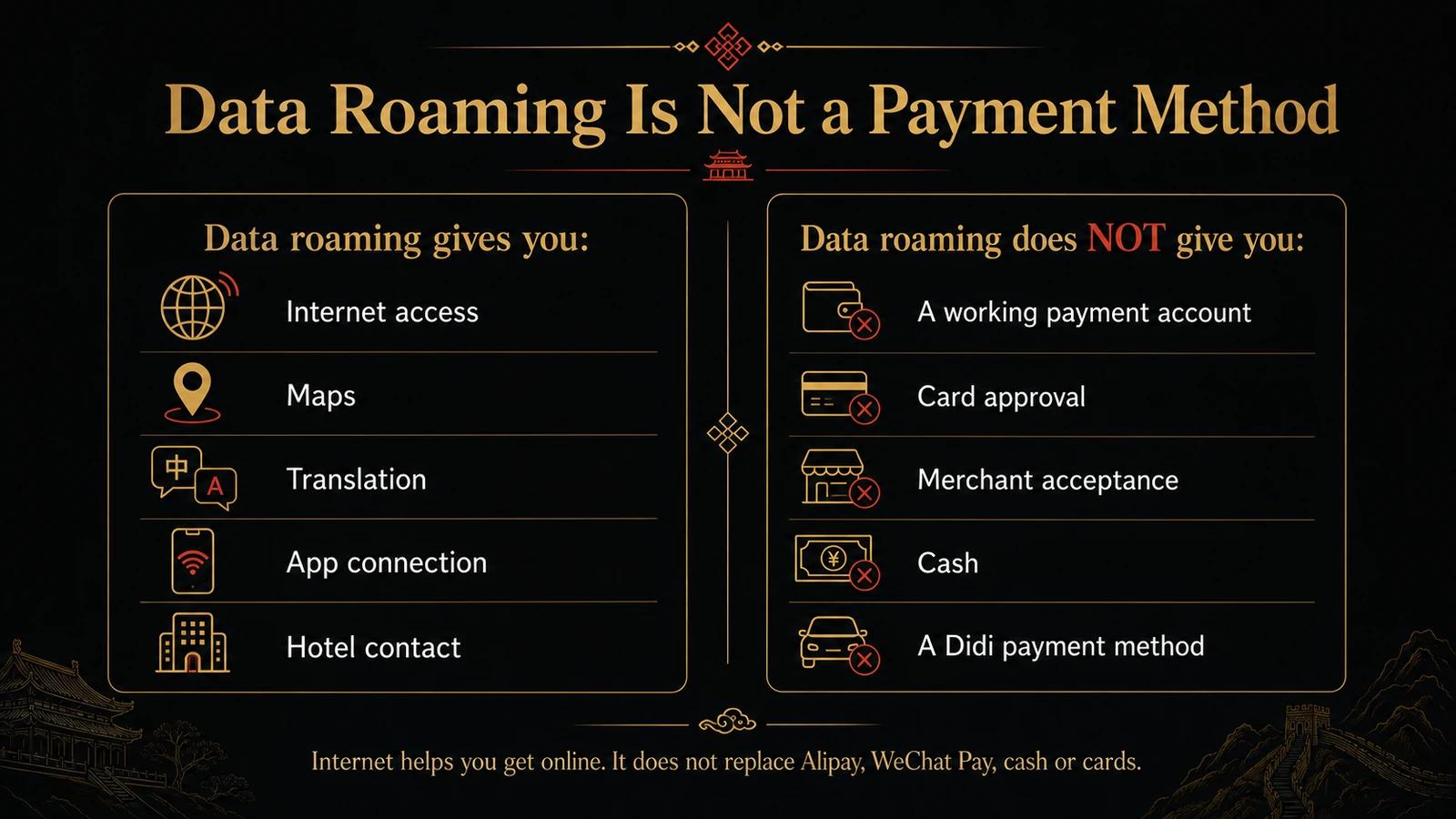
Internet access is one part of the setup. Payment access is another.
Why You Should Prepare Both Alipay and WeChat Pay
Do not turn this into a choice between Alipay and WeChat Pay.
Both apps are deeply used in China, and a first-time independent traveler benefits from having both ready.
You can use one as your normal option and keep the other as a second mobile-payment route. You do not need to switch between them for every purchase.
Preparing both helps because:
- different services may be easier to access through different apps;
- many restaurants and local services use WeChat Mini Programs;
- some transport or city-service entries may be easier to find in one app;
- staff may be more familiar with one payment route;
- one app may temporarily ask you to log in or confirm information;
- you avoid putting every mobile-payment attempt in a single account.
Eligible international visitors can add supported international bank cards to Alipay and Weixin Pay for normal merchant spending in China.
That does not mean you should rely on one bank card inside two apps.
If both apps use the same card and the card issuer blocks a transaction, switching apps may not solve the underlying card problem. When possible, bring two cards from different banks and make sure both bank apps remain accessible.
A practical arrangement is:
- Alipay ready for everyday payment;
- WeChat Pay also registered, verified, and linked;
- a second bank card available;
- RMB cash in smaller notes;
- physical cards kept with you;
- mobile data and battery kept working.
The point is not to build a complicated payment system. It is to avoid having the entire trip depend on one app, one card, or one phone-only route.
If Alipay Is Not Working Before Your Trip
You can still come to China.
But do not respond to an Alipay problem by preparing only data roaming and one foreign bank card.
Use the time before departure to build the rest of the setup:
- Continue checking whether Alipay can complete its basic setup.
- Set up WeChat Pay at the same time.
- Prepare RMB cash.
- Bring one or two physical bank cards.
- Prepay important bookings where practical.
- Confirm your airport-to-hotel route and first-night hotel payment.
For Alipay, the realistic goal is not to prove that every future transaction will succeed. Check that the account opens, the card appears, and you know where Pay and Scan are. This pre-trip Alipay readiness checklist explains the basic checks without treating one successful setup screen as a guarantee.
If Alipay still does not work when you leave, a prepared WeChat Pay account can handle many everyday merchant purchases. Cash and physical cards give you additional options.
That is a workable travel setup.
It is still less flexible than having both mobile-payment apps ready, so do not stop preparing one app simply because the other one appears to work.
Why Roaming Data Does Not Fix a Payment Problem
Imagine that you have just landed.
Your roaming data works. Maps load and your hotel booking opens.
But Alipay is not usable, and WeChat Pay was never set up.
You may immediately need to:
- buy water or food;
- reach the hotel;
- pay a taxi or ride-hailing order;
- pay a room charge or deposit;
- buy a metro ticket;
- submit a restaurant order.
The internet lets you see the relevant pages. It does not create a payment method inside them.
It also does not automatically fix:
- a failed card link;
- an account-verification request;
- an overseas transaction blocked by your bank;
- a merchant that has no foreign-card terminal;
- an SMS code sent to a home number that is no longer active;
- a digital order that only accepts its supported payment routes.
This is why arrival night is a poor time to start every account from zero.
You may be tired, carrying luggage, searching for the correct pickup area, and trying to reach a hotel before the front desk closes. Basic setup is much easier at home than beside an airport exit.
What Cash Can and Cannot Do
RMB cash remains available to overseas visitors, and it is an important backup.
Cash can help you:
- buy a drink or snack;
- pay at a staffed shop or restaurant that accepts cash;
- pay a normal taxi driver who accepts cash;
- use a staffed ticket counter where cash is accepted;
- finish a small purchase when your phone has no power;
- step away from the checkout before troubleshooting an app.
Carry some smaller notes. A small merchant may not have much change because most customers normally pay by phone.
Cash is useful, but it cannot replace a complete digital travel process.
It cannot:
- enter your destination in Didi;
- match you with a driver;
- show the vehicle and pickup point;
- open a QR-code restaurant menu and submit the order;
- create a real-name ticket booking;
- retrieve an electronic ticket;
- manage an in-app change or refund;
- confirm an online reservation.
Cash may solve the final amount due. It does not automatically solve everything that happens before payment.
What Physical International Cards Can and Cannot Do
Bring physical bank cards, but do not assume China works like a country where every small shop expects Visa or Mastercard.
International cards are more useful at:
- hotels;
- airports;
- larger shopping centers;
- international chains;
- merchants with compatible card terminals;
- ATMs that display the relevant card-network logo.
They are less dependable as a direct payment method at small local restaurants, kiosks, neighborhood shops, and street businesses.
A merchant may have a QR code but no terminal for your card. A terminal may exist but may not support your card network. Your bank may also pause an unfamiliar overseas transaction.
Before departure:
- enable overseas transactions;
- know your PIN;
- confirm that your bank app works;
- keep access to the number or method used for verification;
- save the bank’s support number;
- carry a second card when possible.
Your physical card has two jobs: direct payment where supported and access to RMB through a compatible ATM. It should support your mobile-payment setup, not be your only plan.
What Happens in Common Travel Situations?
Convenience stores and supermarkets
Alipay or WeChat Pay is normally the easiest method.
If one app does not work, try the other. Cash is useful for a small purchase. A large supermarket may accept your physical card, but a small convenience store should not be treated as guaranteed foreign-card territory.
Restaurants and cafés
At a staffed counter, you may be able to pay by mobile payment, cash, or a supported card.
The more confusing situation is QR-code ordering.
Roaming data may open the menu, but the order may still require a login, table number, order submission, and mobile payment.
Ask the staff whether they can take your order directly. Many restaurants can help. Do not assume every QR code means there is no human option, but do not assume cash alone will complete the phone-based order either.
Didi
Didi shows the difference between being online and being ready.
Data lets the app locate you, load the map, show the route, and contact the driver.
You still need:
- an account that can create the ride;
- a supported payment route;
- a destination entered correctly;
- access to the trip details.
Check your Didi setup before relying on it for an airport arrival. If it is not ready, use the normal taxi queue, a hotel transfer, or another transport route you confirmed in advance.
Normal taxis
A street or airport taxi does not require you to create an app order first.
The driver may accept Alipay, WeChat Pay, or cash, depending on the local setup and vehicle.
Save:
- the hotel name in Chinese;
- the full Chinese address;
- the hotel phone number;
- a screenshot of the map location;
- some RMB cash.
This gives you a practical first-night alternative to an untested ride-hailing account.
Hotels
Hotels usually have more payment options than small local shops.
Your room may be prepaid, paid at check-in, or handled through a booking platform. A deposit may be separate from the room charge.
Before departure, confirm:
- whether the room is fully prepaid;
- whether a deposit is required;
- how the deposit can be paid;
- whether the front desk accepts your international card;
- whether cash is accepted;
- whether a staffed front desk is open when you arrive.
A booking platform accepting your card does not prove that the hotel’s own terminal uses the same payment system.
For the first night, a hotel with a real front desk and a clear Chinese address is easier than a complicated self-check-in property.
Metro and buses
Transport payment differs by city.
You may find:
- single-journey tickets;
- ticket machines;
- staffed service counters;
- transport cards;
- Alipay transport codes;
- WeChat transport codes;
- local transit apps;
- card-based entry in selected systems.
No Alipay does not mean no metro. But without either mobile-payment app, you may need to work out a local ticket route in each city.
That is manageable. It is simply less convenient than having both apps ready.
Trains, flights, attractions, and online tickets
These services are not only about payment.
They may require:
- passport details;
- real-name booking;
- a selected date or train;
- order creation;
- electronic confirmation;
- a supported payment method.
Roaming data opens the booking page. It does not replace the identity and payment steps.
Prebook important intercity transport and first-night accommodation when practical. Do not leave every essential order for arrival day.
Who Will Feel the Difference Most?
Tour groups
Traveling without Alipay is easier when a tour company has already arranged transport, tickets, hotels, and meals.
The traveler uses fewer local apps and makes fewer spontaneous payments.
Travelers with a companion who can pay
A companion with working mobile payment can reduce friction.
The group should still carry cash and separate cards. One person’s phone should not become the only payment route for everyone.
Independent travelers
The lack of both Alipay and WeChat Pay is most noticeable when you:
- travel alone;
- change plans often;
- use Didi frequently;
- eat in local restaurants;
- visit small shops;
- use QR-code ordering;
- buy tickets yourself;
- move between several cities;
- visit smaller cities or residential areas;
- stay for a longer period.
You can still complete the trip. You will simply spend more time asking for manual alternatives, finding cash change, locating staffed counters, and checking whether a physical card is accepted.
The real question is not whether you can “survive.”
It is how independently you want to travel and how much daily friction you want to avoid.
The Minimum Setup Before You Fly
1. Prepare both Alipay and WeChat Pay
Check that:
- both accounts open normally;
- required identity steps are complete;
- eligible cards are added;
- you know where Pay and Scan are;
- you can still access the registered phone numbers.
Do not stop at “card linked.” You should at least understand the basic merchant-payment screens.
2. Bring two cards if possible
Cards from different banks give you a stronger backup than two cards from the same account.
Keep the physical cards available even after adding them to the payment apps.
3. Set up roaming data or an eSIM
Confirm:
- the plan covers mainland China;
- your phone supports it;
- you know how to enable it after landing;
- you have enough data;
- you are not relying only on airport Wi-Fi.
4. Keep access to your home number
Data roaming and SMS are not the same service.
If a bank or payment app sends codes to your home number, keep the original SIM active or confirm another verification route before departure.
5. Carry RMB cash
Bring a modest amount, including smaller notes.
Keep some cash separate from your main wallet.
6. Confirm your first-night plan
Save offline:
- hotel name in Chinese;
- Chinese address;
- hotel phone number;
- booking confirmation;
- map screenshot;
- airport-to-hotel route;
- taxi pickup area or confirmed transfer;
- room and deposit payment details.
The first night should be simple. It is not the time for a complicated self-check-in, an untested payment app, and a difficult transfer all at once.
What to Do If You Land With Data but No Working Mobile Payment
Do not stand at the airport exit trying to rebuild every account.
Use this order:
- Confirm that data and maps work.
- Try the Alipay or WeChat Pay account you prepared.
- Use RMB cash for a small purchase.
- Ask whether a physical card is accepted.
- Use the normal taxi queue or another confirmed airport transfer.
- Show the driver the hotel address in Chinese.
- Reach the hotel and put down your luggage.
- Charge the phone and connect to stable Wi-Fi.
- Then check the app, bank card, verification, or SMS problem.
Do not use a high hotel deposit, urgent Didi ride, last airport train, or departing train ticket as your first payment test.
After you are settled, use a normal convenience-store purchase to test Alipay or WeChat Pay. If one does not work, try the other app, another card, or cash.
Solve the purchase first. Troubleshoot after you step away from the counter.
Connection and Payment at a Glance
| Travel need | What roaming data helps with | What you still need |
|---|---|---|
| Maps and translation | Loads online information | A usable map or translation tool |
| Didi | Opens the app, map, and driver details | A ready account and supported payment route |
| QR ordering | Opens the menu page | Login, order submission, and payment |
| Hotel contact | Opens bookings and messages | A payment method the hotel accepts |
| Online tickets | Opens the booking page | Identity details and supported payment |
| Alipay and WeChat Pay | Keeps the apps connected | Working accounts, cards, and approved transactions |
| Bank verification | Opens the bank app | Access to SMS or the bank’s other verification method |
Actual results can vary by account, bank, merchant, city, operator, and platform.
Bottom Line
You can travel in China without Alipay.
But data roaming alone is not a complete China travel setup.
China is already a mobile-payment country. For an independent traveler, preparing both Alipay and WeChat Pay is far more practical than relying on only one app—or assuming roaming data, cash, and a foreign card will cover everything.
Use:
- roaming data or an eSIM for connectivity;
- Alipay and WeChat Pay for normal daily payment;
- RMB cash for simple face-to-face backup;
- physical cards for hotels, ATMs, and merchants that support them;
- a clear first-night plan for arrival transport and hotel payment.
Do not make your whole trip depend on one payment route. Prepare both major mobile-payment apps, then keep cash and physical cards behind them.
Frequently Asked Questions
Can I visit China if Alipay does not work?
Yes. Prepare WeChat Pay, RMB cash, physical bank cards, and prepaid essential bookings. Keep trying to complete Alipay too, because having both apps ready gives you more flexibility.
Is WeChat Pay alone enough?
WeChat Pay can handle a large share of normal merchant spending, but do not make it your only payment route. Prepare Alipay as well, then carry cash and physical cards.
Does data roaming solve payment problems?
No. Roaming data provides an internet connection. It does not create a payment account, approve a bank card, or guarantee that a merchant or app accepts your payment route.
Can I travel using only cash and foreign cards?
You can pay for many face-to-face purchases, but it will be less convenient. Cash and physical cards do not replace Didi booking, QR-code ordering, online reservations, electronic tickets, or other app-based steps.
What should I do if neither Alipay nor WeChat Pay works after arrival?
Use cash or ask whether a physical card is accepted for the immediate purchase. Use a normal taxi or confirmed transfer to reach the hotel. Once you are settled, check the account, card, SMS, and bank messages in a calmer place.
Last updated: July 26, 2026. Travel platforms, entry rules, app behavior, prices, and service availability can change. Re-check official sources before departure.
Discussion
Ask a question, share recent experience, or flag information that may be outdated.
0 visible comments
No discussions yet.