Airport Transfer
How Can Foreign Travelers Find the Correct Didi Pickup Point at a Chinese Airport?
Find the correct Didi pickup point at a Chinese airport by matching the terminal, legal ride-hailing zone, final bay, driver message, and vehicle details.
Quick Answer
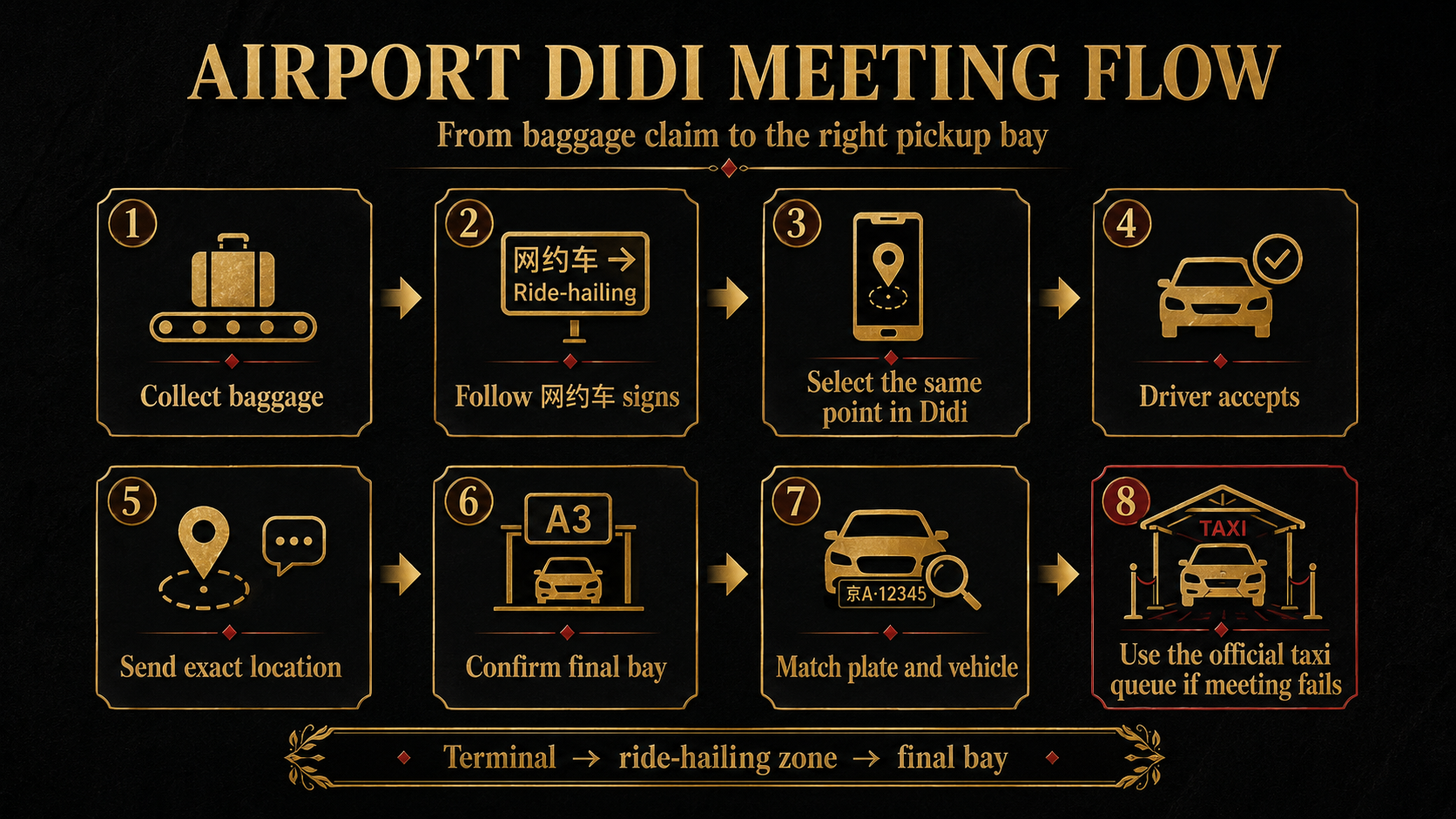
Do not wait at the first arrivals door and assume your Didi driver can pull up in front of you. First confirm your terminal, follow the airport signs to the legal ride-hailing area, and choose the same pickup zone in Didi.
Once a driver accepts, match the final floor, lane, platform, or bay, send your exact location through the in-app chat, and check the full plate, vehicle type, and color before you get in.
A Didi Airport Pickup Is a Three-Part Location Match
A Didi pickup at a Chinese airport is usually not one simple map pin. Three different locations have to match.
1. Terminal and arrivals area
Start with the basics:
- the airport name and airport code;
- the terminal number;
- domestic or international arrivals;
- the floor you are currently on.
The airport name is not the terminal. A large airport may have several terminals that are far apart. If you are at Terminal 2 and the driver is heading to Terminal 3, both phones may show “airport,” but you are not in the same place.
After baggage claim, check your flight record, the baggage-hall exit signs, or the airport information screens. Do not rely on GPS alone. It may place you in the right part of the airport without knowing whether you are on arrivals, departures, or a basement parking level.
2. Legal airport ride-hailing zone
The first arrivals door is not always a legal Didi pickup point.
Depending on the airport and terminal, you may need to walk to a:
- designated ride-hailing area;
- parking building;
- ground transportation center;
- basement level;
- dedicated pickup lane.
This is the part that catches many first-time visitors. You can be outside the terminal, and the driver can already be inside the airport, but the airport road layout may prevent the driver from reaching the curb where you are standing.
A common real-world situation is a traveler waiting outside international arrivals while the driver can only enter the ride-hailing section of a parking building. The map makes them look close. The roads and floors make them effectively separate.
3. Final sub-zone, lane, or bay
Reaching the ride-hailing area is not always the end.
You may still need to match:
- Zone A or Zone B;
- the correct floor;
- a lane or platform;
- a numbered pickup point;
- the driver's final bay.
“P2 parking building” is often not specific enough. The passenger may be on Level B2 while the driver is waiting on Level 1. Both people believe they are at P2, but they still cannot see each other.
Keep this sequence in mind:
Airport name ≠ terminal Terminal ≠ legal pickup zone Pickup zone ≠ final driver bay
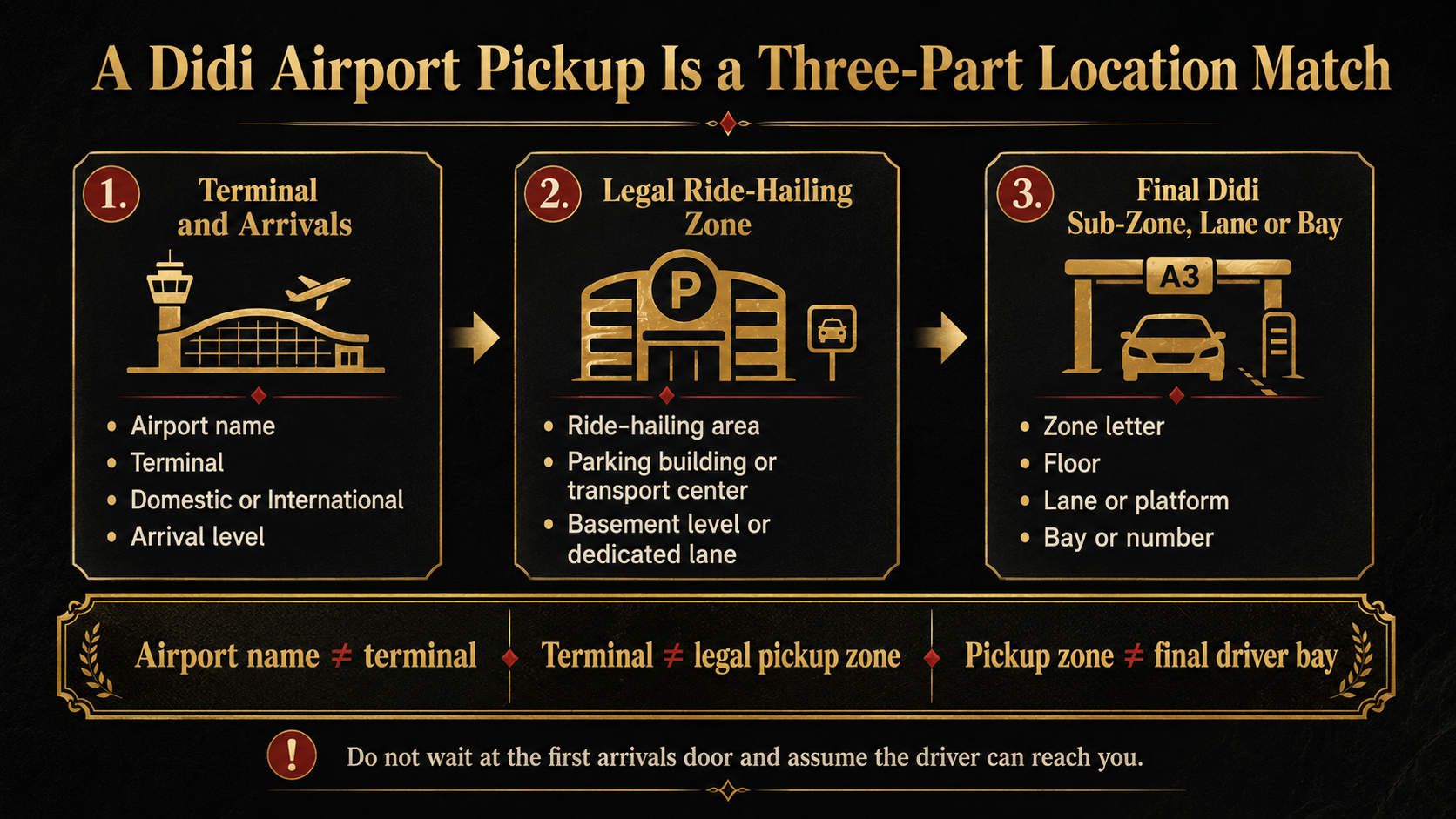
The driver is not searching the whole airport. The driver is usually heading to the specific pickup area that the order and airport traffic rules allow.
Before You Request the Ride, Confirm Where You Actually Are
For an on-demand ride, finish the airport process first.
Make sure:
- immigration is complete, if applicable;
- you have collected every bag;
- you have left the restricted baggage area;
- you know which direction the ride-hailing zone is;
- Didi opens and you can sign in;
- mobile data is working;
- location and notifications are enabled;
- your phone has enough battery;
- your hotel's Chinese name and address are saved;
- your vehicle choice can handle your luggage.
Do not request an immediate ride while the aircraft is still taxiing or while you are waiting at immigration. Getting off the plane, clearing border control, waiting for bags, and walking through a large terminal can take time. If the driver arrives while you are still in a restricted area, neither side has a useful way to fix the meeting point.
DiDi's current China app listing says the app supports an English interface, login with international mobile numbers, bilingual in-app messaging, and in-app English customer service.
Before your trip, prepare the core China travel apps before arrival rather than trying to solve login, maps, translation, and payment after baggage claim.
Didi's map, live driver location, and messages also need a stable data connection. When using a travel eSIM, set things up so you can keep reliable travel data while your home line remains available.
Follow the Airport's Ride-Hailing Signs
At the airport, the signs usually matter more than the shortest line on your phone map.
Look for wording such as:
- 网约车
- 网约车上客区
- 网约车乘车点
- 网络预约出租车
- Ride-Hailing
- Online Car-Hailing
English wording is not identical at every airport. Some airports mainly use Chinese, and some place the ride-hailing direction under signs for a parking building or ground transportation center.
Airport arrangements can be very different even within the same city. For example:
- Beijing Capital Airport's current guidance directs Terminal 2 passengers to the southeast side of Level 1 in Parking Building 2, while Terminal 3 passengers are directed to Area H on B2 in Parking Building 3.
- Shenzhen Bao'an Airport's Didi walking guide shows a route to Ride-Hailing Zone B in the ground transportation center, followed by a vehicle-plate entry screen and platform confirmation.
- Guangzhou Baiyun's pickup arrangements vary by terminal and continue to change. A May 2026 Guangzhou government notice added a T3 pickup point outside Gate 72, which is why an old screenshot should not be treated as a permanent airport map.
These are examples of how the system works, not a nationwide location list. Your actual route should come from the current airport signs, the current Didi order page, and airport staff.
If you are unsure, show the pickup-page text to an airport information desk or a uniformed staff member. They can usually point out the correct parking building, floor, or ride-hailing direction.
Do not follow someone in the arrivals hall simply because they call out “Taxi,” “Didi,” or “Car.”
Select the Same Pickup Zone in Didi
When choosing the pickup point, do not stop at the airport name.
Check, in order:
- the correct terminal;
- the parking building or transportation center;
- the floor;
- the zone letter or number;
- any walking guide, entrance photo, or pickup instructions in the app.
If Didi suggests P2 but the current signs for your terminal point somewhere else, do not drag the pin to a random curb and hope the driver can stop there.
Show the pickup screen to airport staff and ask:
网约车上车点在哪里? Where is the ride-hailing pickup point?
When should you request the ride?
First confirm the legal pickup area and the walking route.
Request the ride when you are already there or when you can reliably reach it within the driver's expected arrival time. This does not mean every airport requires you to stand at the final bay before ordering. It means you should not order while you still have no idea whether the pickup point is upstairs, underground, or in another building.
The same practical rule applies to a reserved ride: read the current order instructions. A Didi reservation is still different from a licensed private airport transfer, and you may still need to meet the vehicle in the airport's ride-hailing zone.
After the Driver Accepts, Lock the Meeting Point
As soon as the driver accepts, save or screenshot:
- the full pickup-point name;
- terminal;
- parking building;
- floor;
- zone;
- lane, platform, or bay;
- full license plate;
- vehicle type;
- vehicle color;
- estimated arrival time.
Do not rely only on the driver's name.
The driver's message may be more specific than the original pickup point. You may select “Ride-Hailing Zone B,” then receive a message telling you to use Bay 6. At that point, Bay 6 is the meeting point. Waiting at the entrance to Zone B may still leave you out of sight.
Before moving to a new number, confirm that it is still in the same terminal, parking building, floor, and legal ride-hailing zone. Do not see “A3” and start changing floors without checking the rest of the location.
Some airports use an interactive screen, vehicle-plate call-up system, or assigned platform. Use that process only when the current airport signs or order instructions clearly tell you to. It is not a universal rule.
Before boarding, match:
- the full plate;
- vehicle type;
- vehicle color;
- the active order in your app.
If the current app asks for a ride code, verification number, or part of your phone number, follow the instruction shown inside the active order. Do not give a driver your bank OTP, account-login code, or unrelated security code.
How to Communicate Without Speaking Chinese
You do not need fluent Chinese, but you do need a precise location.
Use Didi's in-app messages when possible. Written details are easier to check than a phone call, especially when floors and bay numbers are involved.
Do not send only:
I am outside.
A major airport may have many exits, two road levels, several parking structures, and different pickup zones. “Outside” tells the driver almost nothing.
Use this format:
Terminal + parking building + floor + zone + number
For example:
I am at Terminal 2, Parking Building P2, Level 1, Ride-Hailing Zone B, Point 6.
You can copy this Chinese sentence and fill in the brackets:
我在【航站楼/停车楼/楼层/区域/编号】,请到这个上车点接我。
Example:
我在T2航站楼,P2停车楼1层,网约车B区6号点。
If you cannot understand a phone call, send:
我不会说中文,请在滴滴消息里告诉我具体上车点。 I do not speak Chinese. Please send the exact pickup point in the Didi chat.
A photo of the zone sign can help. Keep the photo focused on the parking-building name, floor, zone letter, bay number, or ride-hailing sign. Do not include your passport, payment code, full phone number, or clear faces of unrelated travelers.
Do not repeatedly say “OK” on a call when you have not understood the location. Return to the in-app chat and ask for the building, floor, and number in writing.
What to Do If You and the Driver Cannot Find Each Other
The worst response is to keep moving without a confirmed destination.
If you go upstairs while the driver enters the basement, the map may still show you close together even though the meeting is getting harder.
Stop and recheck the three levels
Stay at a legal, safe, clearly marked point that is easy to describe.
Then recheck:
- the terminal;
- the legal ride-hailing area;
- the floor, lane, platform, or bay.
Ask specifically whether you are in the same terminal, parking building, floor, zone, and numbered point. GPS distance alone cannot answer that.
Do not bounce between Arrivals, Departures, a parking basement, and an outside road.
Send the complete location, then wait for a clear answer
Send the driver:
- terminal;
- parking building;
- floor;
- zone;
- number;
- a photo of the sign.
Check whether the driver has sent a new bay or platform. Move only after the new location is clear.
Do not walk to an unmarked road because a message says only “come outside.” Do not step into a vehicle lane unless the airport route clearly directs passengers there.
Check the order before rebooking
Confirm:
- whether the same driver is still assigned;
- whether the order was canceled;
- whether the pickup point changed;
- whether the driver's vehicle is still moving;
- whether the app shows a waiting or fee message.
Waiting, cancellation, and charges depend on the current order and platform rules. Do not assume every cancellation is free.
If the old order is finished or canceled and you have now found the correct pickup zone, you can decide whether to request another ride. Confirm the old order first so you do not create two active pickups.
When the phone connection is unstable, the driver has canceled, you are carrying heavy bags, or you are too tired to keep troubleshooting, stop changing floors. Go to the official airport taxi queue instead.
Never accept a stranger's request to cancel the platform order and pay privately.
When the Official Taxi Queue Is the Better Backup
Using the official taxi queue is often the simplest backup.
Switching makes sense when:
- your phone has no data;
- the battery is almost gone;
- Didi will not open or log in;
- you and the driver have already missed each other several times;
- you have a lot of luggage;
- you are traveling with children, older adults, or someone with limited mobility;
- it is late and you no longer want to troubleshoot;
- airport staff recommend the taxi line;
- leaving the airport now matters more than saving a small amount.
Use the queue with clear airport signs and a normal managed line. Do not follow arrivals-hall solicitors to an unofficial vehicle.
Didi, taxis, metro, and airport buses each make sense in different situations. When you need the wider picture, compare Didi with taxis, metro and other China transport options.
Final Airport Pickup Checklist
Before ordering and after the driver accepts, confirm:
- baggage collected;
- correct airport and terminal;
- correct domestic or international arrivals area;
- official ride-hailing signs found;
- parking building and floor confirmed;
- the same specific pickup point selected in Didi;
- enough time to reach it before the driver;
- plate, vehicle type, and color saved;
- zone, floor, and number sent to the driver;
- final lane or bay confirmed;
- vehicle checked before boarding;
- official taxi backup located.
The goal is not to make the driver search the whole airport for you. The goal is to give both sides the same terminal, the same legal pickup zone, and the same final bay.
If you have completed the steps above but want your own airport, arrival time, first-night hotel, luggage, Didi, payment, data, and backup plan checked together, see a personalized China Arrival Readiness Review. It is a pre-arrival readiness review, not live pickup support, emergency assistance, or a guarantee that a driver will find you.
Last updated: July 26, 2026. Travel platforms, entry rules, app behavior, prices, and service availability can change. Re-check official sources before departure.
Discussion
Ask a question, share recent experience, or flag information that may be outdated.
0 visible comments
No discussions yet.