
Late Arrival
Will a Hotel in China Hold Your Confirmed Room If You Arrive After Midnight?
Learn when prepaid, guaranteed and pay-at-property hotel bookings in China may be held after midnight, and what to confirm before a late arrival.
Quick Answer
A hotel in China will not normally cancel a fully prepaid or properly guaranteed booking simply because you arrive shortly after midnight. But “confirmed” does not mean the room is held indefinitely. The result depends on the rate plan, the property’s no-show cutoff, and whether someone—or a workable self-check-in system—is available when you arrive.
A fully prepaid booking is usually the strongest late-arrival arrangement. A credit-card guarantee is not the same as full payment, and a pay-at-property reservation without a valid guarantee is more vulnerable. A no-show charge also does not prove that the room must remain empty for you.
Before departure, confirm four separate things: how the booking is secured, when it may be marked as a no-show, whether check-in is possible at your expected time, and whether the hotel has acknowledged your late arrival in writing.
A “Confirmed” Booking Is Not a Confirmed Late Arrival
A confirmed booking usually means:
- the reservation has been created;
- it is not currently shown as canceled;
- the property or platform has accepted it.
It does not automatically mean:
- the hotel knows you will arrive after midnight;
- the room will be held until any hour;
- the front desk is staffed all night;
- a host will wait for you;
- a door code or key instruction has been sent;
- later nights will remain active after a first-night no-show.
A traveler may add “Arriving late” under Special Requests and still have no real late-arrival agreement. Unless the property replies, the note only proves the request was sent.
Booking.com’s current guest guidance tells travelers requesting a different check-in time to contact the property directly before arrival, and it does not promise that the request will be accepted.
The useful question is:
Has the hotel acknowledged my expected arrival time and confirmed that the reservation will remain active?
Prepaid, Guaranteed and Pay-at-Property Bookings Are Different
| Booking type | What has been paid or secured | Late-arrival strength | Main risk | What to confirm |
|---|---|---|---|---|
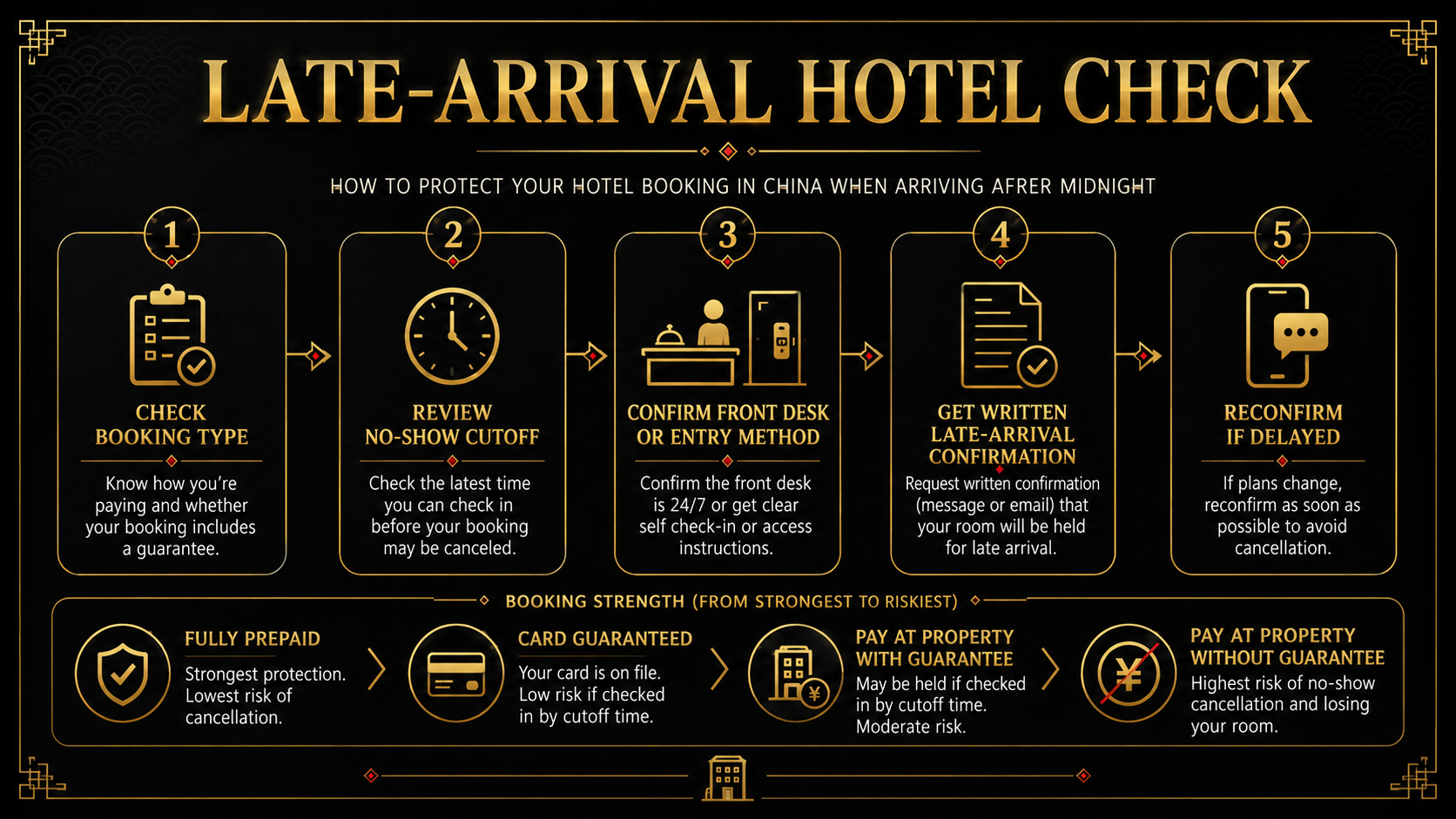
| Fully prepaid | Room charge paid in full | Usually strongest | No-show and room-hold rules still apply | Cutoff and front-desk hours |
| Credit-card guaranteed | A valid card secures the booking | Relatively strong | Invalid card or failed guarantee | Guarantee and no-show terms |
| Pay at property with a valid guarantee | Pay at the hotel, but a card secures the booking | Moderate to strong | The hotel may charge or release the room after its cutoff | How long it will be held |
| Pay at property without a guarantee | No payment and no reliable guarantee | Higher risk | The property may mark no-show and release inventory | Latest arrival and written acceptance |
| Special request only | A late-arrival note was sent | Not a guarantee | The request may not be read or accepted | Direct written confirmation |
Fully prepaid
A fully prepaid reservation is usually the safest option because the room charge has already been collected.
It still does not require the hotel to keep the room empty until the following day’s checkout. The property’s no-show rules apply, and prepaid bookings are not immune to overbooking or operational disruption.
Credit-card guaranteed
A card guarantee does not necessarily mean the room charge has been paid.
It usually means the hotel or platform has a valid card that may be charged if the guest does not arrive or cancels too late. If the card expires, fails verification, or is not accepted as a valid guarantee, the booking may become less secure.
Pay at property
Pay-at-property bookings are not automatically canceled after midnight. The risk rises when there is no prepayment, no valid guarantee, and no written late-arrival agreement.
A traveler who chooses pay at property, provides no working guarantee, and never contacts the hotel may be marked as a no-show after the property’s cutoff.
A prepaid room charge is also separate from any security deposit or card pre-authorization required at check-in. Use the separate guide to separate the prepaid room charge from the hotel deposit.
No-Show Charges Do Not Automatically Mean the Room Stays Empty
A no-show generally means the guest did not arrive as arranged and did not complete an acceptable late-arrival arrangement.
The consequences depend on the hotel, room, rate plan, guarantee, and cancellation terms. A property may charge the first night, apply another penalty, release the room after its cutoff, or change the remaining nights.
Booking.com’s property-policy documentation allows cancellation, prepayment, and no-show penalties to vary by property and room rate. Ctrip’s current hotel FAQ likewise says prepaid or credit-card-guaranteed bookings can incur a no-show charge, generally described there as one night, while the actual booking terms remain controlling.
A penalty and room inventory are separate issues. The no-show charge compensates the hotel under the reservation terms; it does not prove that the room must remain unavailable to other guests.
How late will a hotel hold the room?
There is no China-wide cutoff.
Marriott’s current late-arrival guidance tells guests arriving after midnight to contact the hotel directly so the property can note the reservation and ensure the room is held. The public page does not provide one universal release time for every Marriott hotel.
Park Hyatt Guangzhou publishes a property-specific rule: its no-show terms vary by rate and date, and no-show rooms are held until noon the next day before being released.
These examples show why your own confirmation, rate terms, property policy, and written hotel response matter more than a general brand assumption.
What happens to the remaining nights?
Do not assume that only the first night will be canceled. Do not assume the whole stay will disappear either.
Ask:
If I arrive after midnight, will the remaining nights stay active?
If the first night is marked as a no-show, the hotel may need to retain, restore, or recreate the later nights.
A Held Room Is Useless If Nobody Can Check You In
Late arrival requires two separate conditions:
- the reservation must still be active;
- someone or something must let you enter and complete check-in.
A regular hotel with a 24-hour front desk
A genuine 24-hour front desk usually means staff should be available overnight. It does not prove that your reservation remains active.
A hostel with limited desk hours
A hostel may still have your bed or room, but the desk may close before you arrive. Without advance arrangements, you may have no way to collect a key or card.
A guesthouse or homestay
The host may not live on site. The room can remain reserved while the host has already left, leaving you without a door code, gate access, or key instructions.
A serviced apartment or self-check-in stay
These properties may require advance identity submission, a door or elevator code, key collection at another address, online verification, or a specific entrance.
Foreign travelers should carry the original passport used for check-in and confirm that the property can handle the required guest-registration process. For the wider accommodation setup, use the guide to prepare the full China hotel booking and check-in process.
Book the Correct Hotel Night
An arrival after midnight normally still uses the previous hotel night.
The flight lands at 11:30 p.m. on July 10, and the traveler expects to reach the hotel at 1:30 a.m. on July 11. The hotel booking must begin on July 10, because the traveler is using the room for the night of July 10.
If the traveler books only July 11, normal check-in will usually begin on the afternoon of July 11—not at 1:30 a.m.
The exception would be a property that explicitly offers an unusual early-morning arrival product, hourly stay, or written early check-in arrangement.
Use the realistic hotel-arrival time, not the flight’s landing time. Immigration, baggage, finding transport, and the drive to the hotel all add time.
How to Get a Real Late-Arrival Confirmation
Before contacting the hotel, check:
- whether the booking is fully prepaid;
- whether it has a valid card guarantee;
- the latest check-in time;
- the no-show cutoff;
- whether the front desk is staffed 24 hours;
- what happens to later nights;
- the entry method for an apartment, guesthouse, or self-check-in stay.
Ask specific questions:
Is the front desk staffed 24 hours?
My expected arrival time is approximately 1:30 a.m. on [date]. Will the room be held for me?
At what time would the reservation be marked as a no-show?
If I arrive after midnight, will the remaining nights stay active?
Do I need a door code, key-pickup instruction or advance passport registration?
Include the booking number, guest name, expected local arrival time, flight or train number, and whether the stay includes multiple nights.
What counts as useful written confirmation?
The strongest evidence is:
- a direct reply from the hotel through official email or platform messaging;
- a written platform response stating that the hotel confirmed;
- the exact expected arrival time;
- a clear statement that the room will be held;
- front-desk, door-code, or key instructions.
A Special Request with no reply is not enough. “Request sent” is not enough. An automated “subject to availability” message is not a promise.
A phone call can help, but ask for the important result to be repeated in writing.
What to Do If Your Flight or Train Is Delayed Again
A confirmation for 1:30 a.m. may not cover a new 4 a.m. arrival.
Act in this order:
- send the new expected arrival time;
- provide the flight or train number;
- ask the hotel to continue holding the room;
- save the new written reply;
- contact the booking platform if the hotel does not respond;
- monitor whether the booking still appears active;
- prepare a nearby hotel with a 24-hour front desk.
A platform can help contact the property, but it cannot always force the hotel to retain the booking or guarantee a refund.
The risk is highest when the reservation is pay at property, has no valid guarantee, and the hotel has not acknowledged the delay.
What to Do If the Hotel Marks You as a No-Show
If you reach the hotel and the reservation is no longer active, solve the immediate night before starting a long dispute.
- Confirm the correct hotel, branch, building, and entrance.
- Show the booking confirmation.
- Show the payment record or guarantee.
- Show the written late-arrival confirmation.
- Ask the front desk to check the original reservation and remaining nights.
- Contact the booking platform.
- Save the current order status, staff response, and screenshots.
- Move to a nearby staffed hotel if the problem cannot be solved quickly.
- Handle refunds, fees, and responsibility after you are safely inside.
For a multi-night reservation, ask whether only the first night was marked as a no-show, whether the entire stay was canceled, and whether the remaining nights can be restored.
Stop waiting and use the backup when there is no active room, nobody can let you in, the platform cannot resolve the situation promptly, or children, older travelers, safety, or exhaustion make further waiting unreasonable.
Solve the night first, then solve the dispute.
Final Late-Arrival Hotel Checklist
Before departure:
- book the correct hotel night;
- identify whether the reservation is prepaid, guaranteed, or pay at property;
- confirm that the guarantee card is valid;
- read the latest check-in time;
- read the no-show terms;
- confirm whether the front desk is staffed 24 hours;
- send your realistic local arrival time;
- obtain written confirmation that the room will be held;
- confirm what happens to the remaining nights;
- obtain door-code, key, or entry instructions;
- save the booking confirmation and payment record;
- save the hotel’s English and Chinese names, address, and phone number;
- save the booking platform’s support route;
- update the hotel if the delay changes;
- identify a nearby hotel with a 24-hour front desk.
The safest late-arrival booking is not merely paid and confirmed. It is prepaid or guaranteed, supported by a clear no-show policy, reachable at the expected hour, and acknowledged by the hotel in writing.
For travelers who want their actual arrival point, expected time, first-night hotel, transfer, payment, internet, apps, and backup plan checked together, a personalized China Arrival Readiness Review provides a one-time pre-arrival review for US$69.90. It does not guarantee that a hotel will hold a room and does not provide ongoing real-time assistance with the property.
Last updated: July 27, 2026. Travel platforms, entry rules, app behavior, prices, and service availability can change. Re-check official sources before departure.
Discussion
Ask a question, share recent experience, or flag information that may be outdated.
0 visible comments
No discussions yet.