
Visa & Entry
What Is the Difference Between China’s 30-Day Visa-Free Entry and 240-Hour Visa-Free Transit?
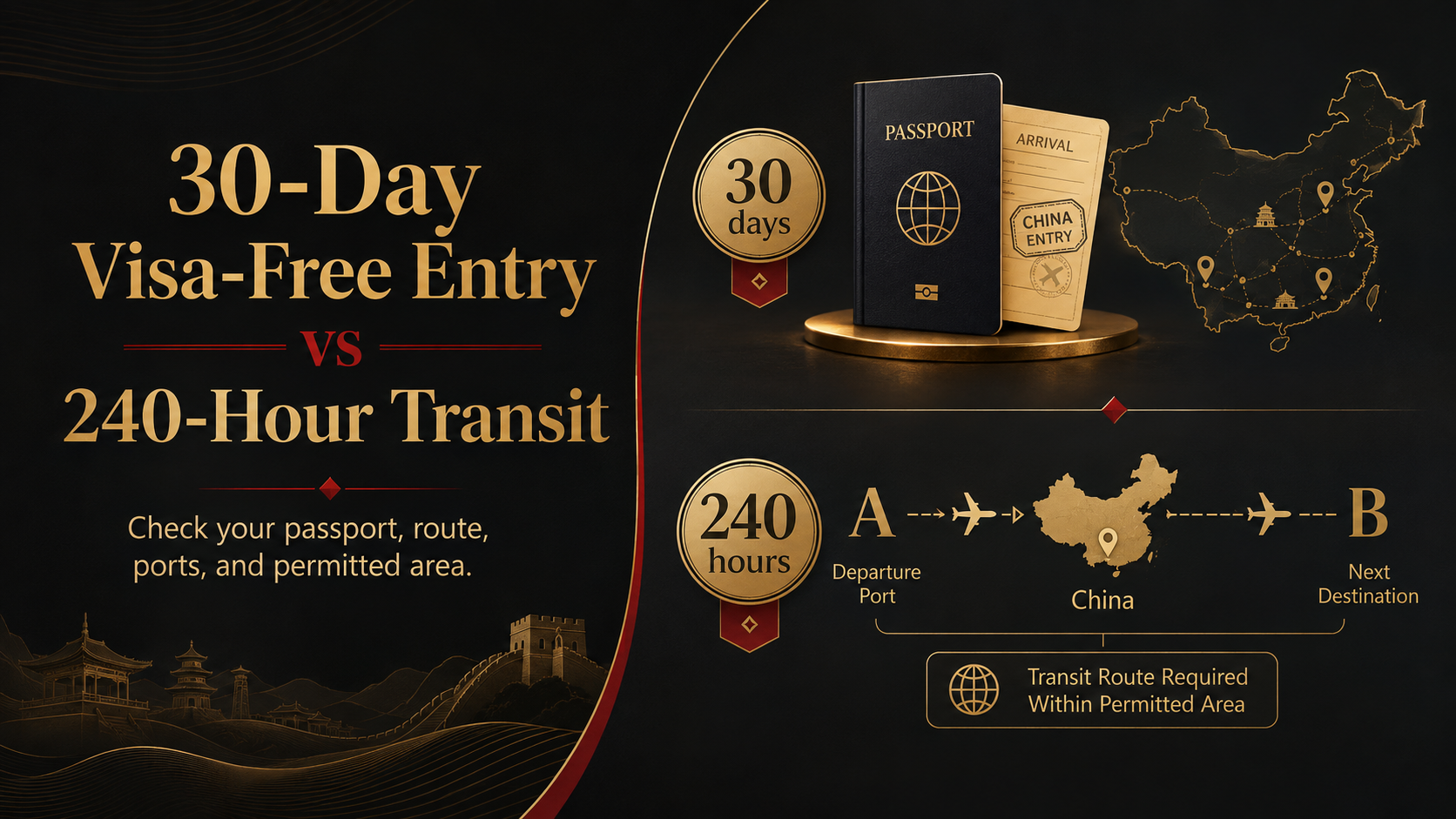
China’s 30-day visa-free entry is mainly based on ordinary-passport eligibility, while 240-hour transit also requires a qualifying third-country route, designated port, onward ticket, and permitted travel area.
Quick answer
China’s 30-day visa-free entry and 240-hour visa-free transit are two different policies. The difference is not simply “30 days versus 10 days.”
- 30-day visa-free entry is mainly based on your ordinary passport and the visa-free rules that apply to it.
- 240-hour visa-free transit is based on both your passport and a qualifying international transit route through mainland China.
Use this order:
- Check whether your ordinary passport qualifies for unilateral visa-free entry.
- Check whether a bilateral mutual visa-exemption agreement applies.
- If regular visa-free entry does not apply, check the 240-hour transit policy.
- If neither policy applies, obtain the correct Chinese visa before travel.
Do not begin with “How many days will I stay?” Begin with “Which policy applies to my passport and route?”
What is 30-day visa-free entry?
China currently allows holders of ordinary passports from certain countries to enter mainland China without a visa for stays of up to 30 days.
The unilateral policy covers short visits for purposes such as:
- tourism;
- business;
- visiting family or friends;
- exchanges;
- transit.
As of August 5, 2026, the National Immigration Administration’s unilateral visa-free list contains 50 countries.
This form of visa-free entry does not require a third-country route. An eligible traveler may arrive in China from any country or region and may leave for the same country.
For example, this route can be acceptable under regular visa-free entry:
United Kingdom → mainland China → United Kingdom
Eligible travelers may enter through sea, land, or air ports open to foreign nationals. They do not need to register with a Chinese embassy or consulate before departure.
Visa-free status does not guarantee admission. Border officers may still check your passport, stated purpose, accommodation, tickets, invitation documents, and other entry conditions. Work, long-term study, journalism, and similar activities are outside this short-stay policy.
The 30-day period is calculated from 00:00 on the day after entry.
Unilateral entry and bilateral agreements must be checked separately
The current 50-country list covers China’s unilateral visa-free policy. It is not a complete list of every nationality that may have some form of ordinary-passport visa-free access.
China also has bilateral mutual visa-exemption agreements with certain countries. Singapore, Thailand, Malaysia, and other countries may rely on separate agreements rather than the unilateral list.
The terms are not always identical. Depending on the agreement, they may include:
- a maximum stay for each entry;
- a limit such as 90 days within a 180-day period;
- specific eligible passport types;
- other conditions.
Do not assume that every policy described as “30-day visa-free” has exactly the same legal basis or cumulative-stay rule. Check the current official terms for your passport.
What is 240-hour visa-free transit?
The 240-hour policy is not a general 10-day tourist waiver. It is a transit policy for eligible travelers passing through mainland China on the way to a third country or region.
As of August 5, 2026, it applies to citizens of 55 countries and operates through 65 designated ports in 24 provincial-level areas.
A traveler normally needs all of the following:
- nationality from the current eligible list;
- a valid international travel document;
- a passport normally valid for at least three months;
- eligibility to enter the next country or region;
- a confirmed onward international ticket departing within 240 hours;
- entry through a designated port;
- travel only within the permitted area;
- departure within the allowed period.
The traveler applies for temporary entry procedures at the arrival port. Approval remains subject to immigration inspection.
The 240-hour period is calculated from 00:00 on the day after entry.
What counts as a third-country or third-region route?
Use this simple formula:
A country or region → mainland China → B country or region
B must be different from A.
Route that may qualify
United States → mainland China → Japan
The traveler arrives from the United States and leaves for Japan.
Route that does not fit the transit rule
United States → mainland China → United States
That is a return trip, not transit to a third country or region.
The important points are:
- the last place outside mainland China before entry;
- the first place outside mainland China after departure.
Do not look only at the first origin and final destination shown on a long itinerary.
For example:
United States → South Korea → mainland China → Japan → United States
For the China transit assessment, the relevant section is normally:
South Korea → mainland China → Japan
Connecting flights, technical stops, separate tickets, and complex multi-city bookings can change the answer. Routes involving Hong Kong, Macao, or Taiwan should be checked against current official rules and the exact ticketed itinerary rather than forum comments.
The main differences
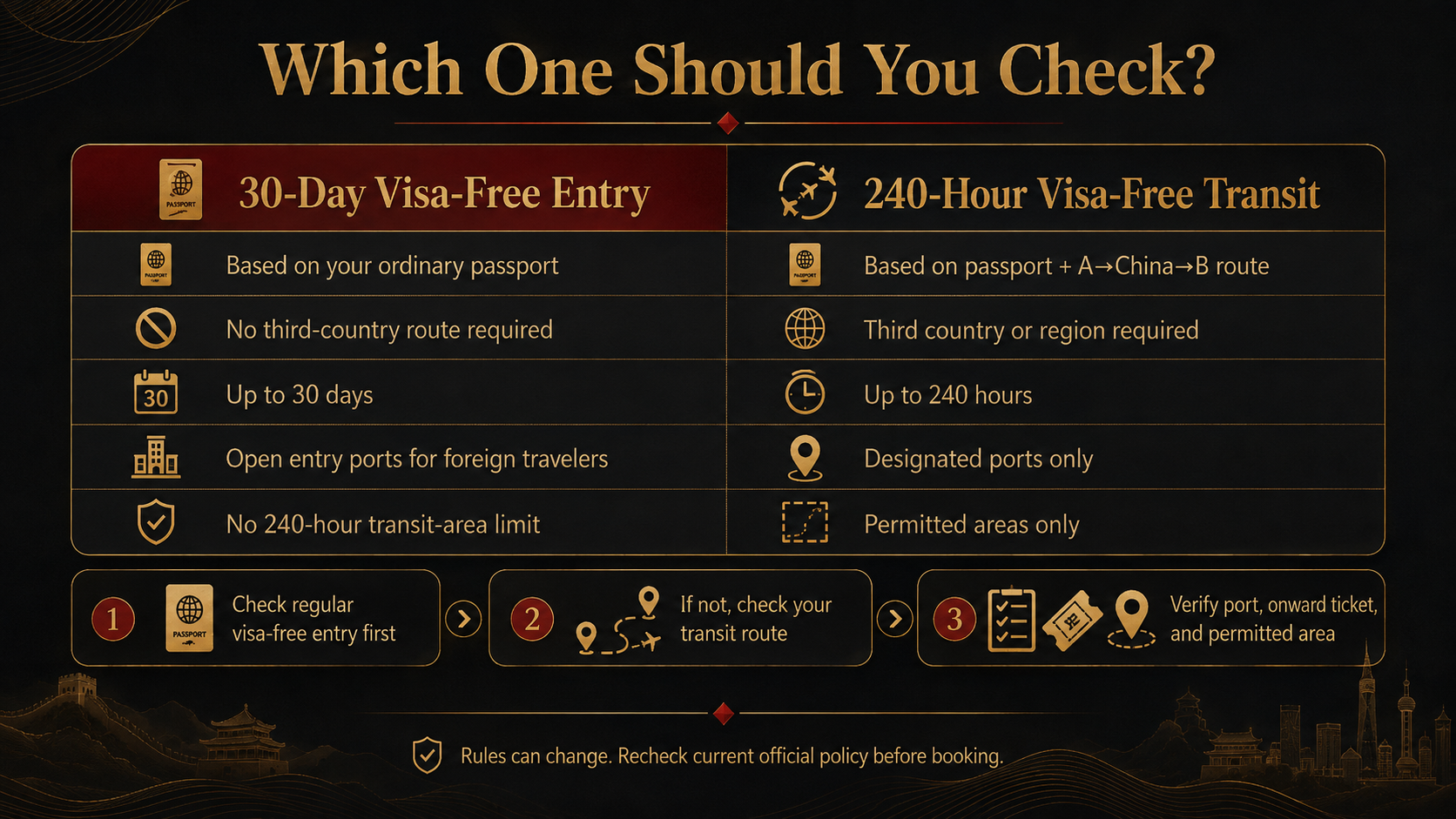
| Question | 30-day visa-free entry | 240-hour visa-free transit |
|---|---|---|
| What determines eligibility? | Ordinary passport and the applicable unilateral or bilateral policy | Eligible passport plus a qualifying A → China → B route |
| Is a third country or region required? | No | Yes |
| Maximum stay | Usually up to 30 days | Up to 240 hours |
| Entry ports | Sea, land, and air ports open to foreign nationals, subject to applicable rules | Designated ports only |
| Travel inside mainland China | Not restricted by the 240-hour permitted-area list | Only within officially permitted areas |
| Onward ticket | A third-country ticket is not required for eligibility | Confirmed onward travel to a third country or region is required |
| How is it handled? | Entry is examined under the applicable ordinary visa-free policy | Temporary entry procedures are handled at the designated arrival port |
| Is entry guaranteed? | No | No |
What if both policies appear to apply?
Check the regular visa-free policy first.
China’s current 240-hour policy states that where a traveler is covered by a bilateral mutual visa-exemption agreement or China’s unilateral visa-free policy, those regular visa-free provisions prevail.
In practical terms, an eligible ordinary-passport holder usually does not need to design an artificial third-country route just to enter under the 240-hour policy.
As of the information-checked date:
- Canada and the United Kingdom are on both the unilateral 30-day list and the 240-hour transit list;
- the United States is on the 240-hour transit list but not the current unilateral 30-day list.
A Canadian or British ordinary-passport holder should therefore check regular visa-free entry first. A US passport holder who does not have a Chinese visa would need to examine the 240-hour route, port, onward-ticket, and permitted-area requirements carefully.
Ports and travel areas are not the same
Regular 30-day visa-free entry is not limited to the 65 ports used for the 240-hour policy. Eligible travelers may use ports open to foreign nationals, subject to any specific legal or bilateral conditions.
The 240-hour policy is more restrictive:
- you must enter through a designated port;
- you must remain within the officially permitted area;
- some participating provincial-level areas allow travel throughout the area;
- others allow travel only in specified cities or zones.
“24 provincial-level areas” does not mean all of mainland China is open under the transit policy. Check every mainland destination on your itinerary before buying tickets.
Check these points before buying non-refundable tickets
Follow this order:
- Confirm your nationality.
- Confirm that you hold an ordinary passport.
- Check the current unilateral visa-free list.
- Check whether a bilateral mutual visa-exemption agreement applies.
- Confirm that your travel purpose is allowed.
- Confirm that the policy will still be valid on your actual entry date.
- If regular visa-free entry does not apply, check the 240-hour nationality list.
- Review the complete A → mainland China → B route.
- Identify the final overseas stop before China.
- Identify the first overseas stop after China.
- Confirm the date and arrangement of the onward international ticket.
- Confirm that the arrival port is currently designated.
- Confirm that every mainland destination is inside the permitted area.
- Check passport validity.
- Prepare accommodation, itinerary, and onward-travel documents.
- Save the current official rules for offline access.
For a practical document checklist, save your China entry and onward-travel documents offline.
Do not rely only on a blog, search-result summary, airline forum, or an old screenshot. Rules, eligible nationalities, ports, permitted areas, and expiry dates can change.
Current expiry dates also matter
For the current unilateral policy, the Chinese Embassy in the United States lists:
- Russia: effective through September 14, 2026;
- 48 other countries: effective through December 31, 2026;
- Brunei: no expiry date shown on that page.
These dates may be extended or changed. Recheck them against your actual arrival date.
Airline staff may also ask for evidence that you qualify. Carry a clear itinerary, accommodation details, onward tickets where relevant, and an offline copy of the current official policy.
Bottom line
Remember these two rules:
- 30-day visa-free entry mainly depends on your ordinary passport. It does not require a third-country route.
- 240-hour visa-free transit depends on your passport, an A → China → B route, a designated port, confirmed onward travel, and permitted areas.
Check regular visa-free entry first. Use the 240-hour transit policy only when its full route and location conditions are met.
If neither policy applies, obtain the correct Chinese visa before departure rather than trying to resolve the issue at airline check-in.
Information checked: August 5, 2026
Last updated: August 5, 2026. Travel platforms, entry rules, app behavior, prices, and service availability can change. Re-check official sources before departure.
Discussion
Ask a question, share recent experience, or flag information that may be outdated.
0 visible comments
No discussions yet.